
Omdia: AI drives market polarization and predicts a further 7% drop in PC shipments in 2027
The Zhitong Finance App learned that on November 4, Omdia published an article stating that in 2026, due to supply chain disruptions and rising component costs, the consumer electronics market will experience a decline in shipments. Looking ahead to 2027, this situation will be difficult to reverse in the short term. Omdia predicts PC shipments will drop a further 7% in 2027. In such a market environment, PC manufacturers' operational capability and product line depth will be a key factor in whether they can succeed during the industry downturn.
AI drives market polarization, challenges and opportunities coexist
AI-driven demand growth has exacerbated the tight supply of key components, leading to supply chain disruptions and sharp price increases. Among them, DRAM and SSD have been significantly affected. At the same time, rising costs and limited supply have curtailed shipments of various categories of consumer electronics; on the other hand, components that fail to benefit from increased AI demand are facing weak consumer demand, making the market relatively vulnerable on the other side.
From the perspective of PC manufacturers, the scale of procurement and bargaining power are also increasing market differentiation. Large manufacturers have stronger market awareness and can make stocking decisions earlier; in the long run, they also maintain stable cooperative relationships with suppliers to obtain more favorable purchase prices. In contrast, when suppliers need to trade off resources between customers, small and medium-sized manufacturers are often the first to lower their supply priorities and have to obtain supplies through more complex market channels, further driving up operating costs. According to Omdia data, as of the second quarter of 2026, the share of PC vendors outside the top six shipments had fallen below 10%, and this ratio was generally between 10% and 15%.
Looking at the PC product portfolio, products such as NVIDIA RTX Spark, AMD Ryzen AI Halo, and Mac Studio are receiving market attention. These products have similar capabilities to AI infrastructure hardware products, and are mainly aimed at running and developing local models rather than traditional PC workloads. Although higher prices will limit the scale of their shipments, enterprise performance is gradually showing a broader trend of optimization and adoption; in some cases, such products can also replace server deployments to a limited extent. At the same time, low-cost products have been impacted by multiple rounds of parts supply. According to Omdia data, the share of PC products sold under $500 in shipments is falling rapidly, and is currently below 30%.
Optimizing product portfolios, maintaining reasonable pricing strategies, and ensuring stable supply are top priorities for PC manufacturers
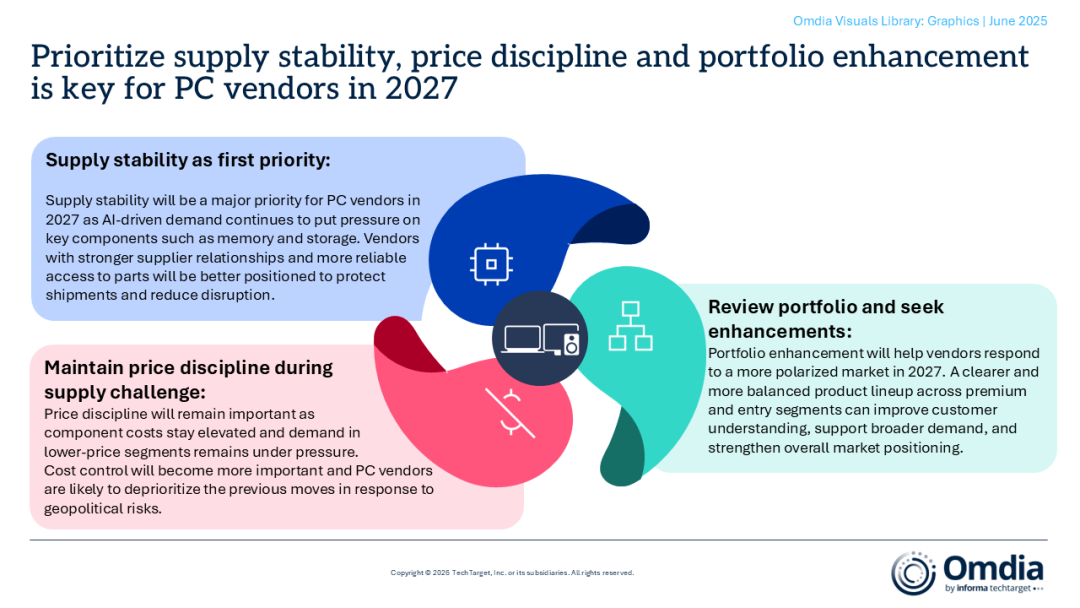
For PC manufacturers, the most important thing now is to re-examine the product portfolio and replan the future direction. Overall, the strategic plans of manufacturers are showing a clear trend of polarization.
For manufacturers that rely more on low-priced products and the consumer market, maintaining a relatively stable pricing strategy is the key to maintaining shipment volume; cost control will be its core task in the next few quarters. On the other hand, supply chain adjustments previously carried out by manufacturers to deal with geopolitical risks may require lowering the priority of related measures or even shrinking appropriately if they continue to push up costs.
For manufacturers that are more dependent on high-price markets, expanding the user base is also a long-term priority. In particular, as smart AI drives the growth in demand for cross-device collaboration and drives the development of the AI hardware market, whether manufacturers should launch lower priced products to expand the user base is becoming an important strategic issue. Although this move may have an impact on brand positioning, it will help control the extent of the decline in shipments.
Additionally, manufacturers may also need to adjust their supply chain management thinking. Over the past year and a half, we have seen that it is difficult for some manufacturers to adapt to changes in component suppliers reducing their supply priorities for consumer electronics products. They still adopt tough supply chain management methods, requiring suppliers to provide greater flexibility or accept lower profit margins. As a result, they have been boycotted by suppliers. Cost pressure is expected to continue in the coming year, so ensuring that suppliers and original design manufacturers (ODMs) obtain reasonable profits to maintain stable supply will remain a key task for manufacturers.
In a market environment with limited opportunities for growth, PC vendors need to focus on three core tasks: seeking market share through a more comprehensive and clearly positioned product portfolio, maintaining prudent pricing strategies, and ensuring stable supply.
Keep an eye on the changing needs of cloud service providers (CSPs)
This supply-side driven industry downturn initially stemmed from a surge in demand for CSP and AI infrastructure hardware, which led to a sharp increase in demand for memory and storage devices, and then the impact gradually spread to a wider range of supply categories. As the PC industry's priority in supply allocation is relegated to a lower or lower position, even if PC vendors are not directly involved in the server-related supply chain, they still need to closely track changes in CSP demand in real time.
Looking ahead, the next round of market cycle changes may be driven by sudden changes in demand rather than excessive expansion of production capacity by suppliers.