
Goldman Sachs traders warn of an “invisible bear market”: the S&P 500 is only 3% away from the new high, and 60% of the constituent stocks have already entered the bear market
The Zhitong Finance App learned that the S&P 500 index is only about 3% behind the latest record high, yet 60% of the constituent stocks in this benchmark index are mired in a bear market. Bobby Molavi, head of executive services at Goldman Sachs EMEA and trader, said the scene was shocking. He said that strangely enough, the capital expenditure of technology giants is the core of the AI-driven rise in the stock market, yet the stock prices of these giants and capital expenditure beneficiaries are falling at the same time.
“I don't understand why both are under pressure at the same time, especially if the benchmark situation is AI will change everything,” Molavi said in the report. He described the situation as an “invisible bear market.”
The index reached a new high, yet 60% of constituent stocks fell into an “invisible bear market”
Tech stocks have been hit hard in recent weeks as investors withdrew from AI-related stocks due to concerns about the sustainability of large-scale spending. On the other hand, most S&P 500 constituent stocks have risen over the past month as capital shifts from crowded trading to defensive and low-allocation sectors.
The biggest winner in the AI era has fallen into a bear market
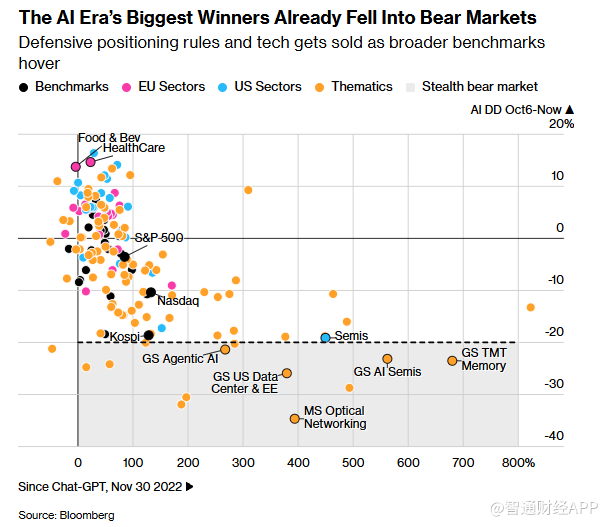
Molavi said that since October 15, the market capitalization of the Big Seven has evaporated by a total of 4 trillion US dollars; in his memory, this is the first time that profits are “not good enough”.
On Thursday, Alphabet Inc. (GOOGL.US)'s market capitalization evaporated by 500 billion US dollars, the biggest drop in 20 years, but the S&P 500 fell only 0.3%, as healthcare, real estate, and essential consumer sectors made up positions.
Chipmakers, on the other hand, have no such buffer space. The Philadelphia Semiconductor Index closed down 7% last Friday, falling below the 200-day EMA for the first time in a year. The forward price-earnings ratio fell back to about 16 times, a low point in the AI cycle.
According to Molavi, demand is not the problem. According to the latest financial report, Google Cloud, a subsidiary of Alphabet, doubled its revenue, Microsoft (MSFT.US) Azure grew 48%, and Amazon (AMZN.US) AWS grew 39%, the fastest growth rate in five years.
AI capital expenditure bills expire, credit markets issue sharper warning
What the market is really concerned about is the billing and payback cycle of AI spending. Hyperscale cloud service providers changed from “cash printers” to “cash consumers,” and this state of affairs continued for more than a year or two.
Together, the big four tech giants generated $26 billion in free cash flow, a fraction of what it used to be. They are increasingly financing AI construction through debt, equity, and cash. Molavi wrote that Amazon's long-term debt climbed from $66 billion to $173 billion in nine months.
The debate over AI cash became particularly intense this year
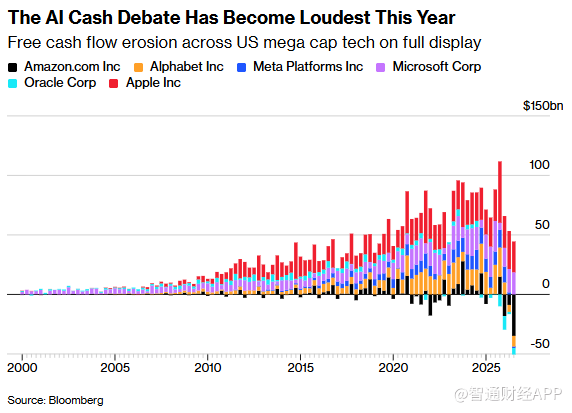
In the words of this Goldman Sachs trader, last week was when AI capital expenditure bills were due, and investors began to focus on returns rather than ambition, and on cash flow rather than capital expenses.
He said that credit ratings are a sharper warning sign for the market. According to Molavi statistics, since 1996, interest spreads between Class B and CCC bonds have reached 8% less than five times. In every case like this, the S&P 500 is at least 11.5% below its 52-week high, two of which are close to 30%.
However, as of last week, the index fell less than 2% from its higher point. He wrote, “Friday, wait and see.”