
Saul Centers (BFS) Could Be 28% Undervalued As Valuation Signals Split
Saul Centers: Recent Returns In Focus
Saul Centers (BFS) has drawn fresh attention after a tough patch in the real estate sector, with the stock down about 3% over the past month and roughly 14% over the past 3 months. Investors are weighing these declines against the company’s long operating history as a retail focused REIT.
Over the past year, Saul Centers has delivered a 1 year total shareholder return of 5.92%, even as its 90 day share price return declined 14.47%. Recent weakness around the current US$29.20 level suggests momentum has been fading as investors reassess risk and income prospects for the REIT.
Scan beyond Saul Centers and compare other income focused real estate plays with resilient balance sheets using our hand picked list of solid balance sheet and fundamentals (24 results).
At roughly US$29, Saul Centers trades well below both analyst targets near US$43 and one intrinsic estimate implying a 28% discount. Does that gap reflect mispricing, or is it a fair mark on risk?
DCF Valuation Check: Is Saul Centers Mispriced?
On Simply Wall St's numbers, Saul Centers screens as undervalued based on cash flows, with the SWS DCF model pointing to a fair value of about $40.78 per share against a last close near $29.20.
The DCF framework projects future cash flows for the REIT and discounts them back to today using a required return. This aims to translate long term rental income and residual property value into a single present figure. That process is sensitive to assumptions about occupancy, rent trends, refinancing costs, and terminal values, which can all move around for a retail focused landlord.
For a business like Saul Centers, where earnings have declined 5.2% per year over the past 5 years and profit margins have slipped from 11.5% to 7.8%, cash generation and interest coverage matter more than simple headline revenue growth. The model still arrives at a value comfortably above the market price, even though current forecasts only point to revenue growth of 3.5% per year, slower than the wider US market at 13.1%.
That gap between the SWS DCF estimate near $40.78 and the market price around $29 suggests investors are applying a heavy discount to factors such as leverage and the fact that interest payments are not well covered by earnings, despite high quality earnings and a long established portfolio concentrated in the Washington DC and Baltimore areas.
Look into how the SWS DCF model arrives at its fair value.
Result: DCF Fair value of $40.78 (UNDERVALUED)
Still, Saul Centers faces pressure from interest costs that are not well covered by earnings, as well as a concentrated footprint in the Washington DC and Baltimore markets.
Find out about the key risks to this Saul Centers narrative.
Another Angle On Saul Centers: Earnings Multiple Sends A Different Message
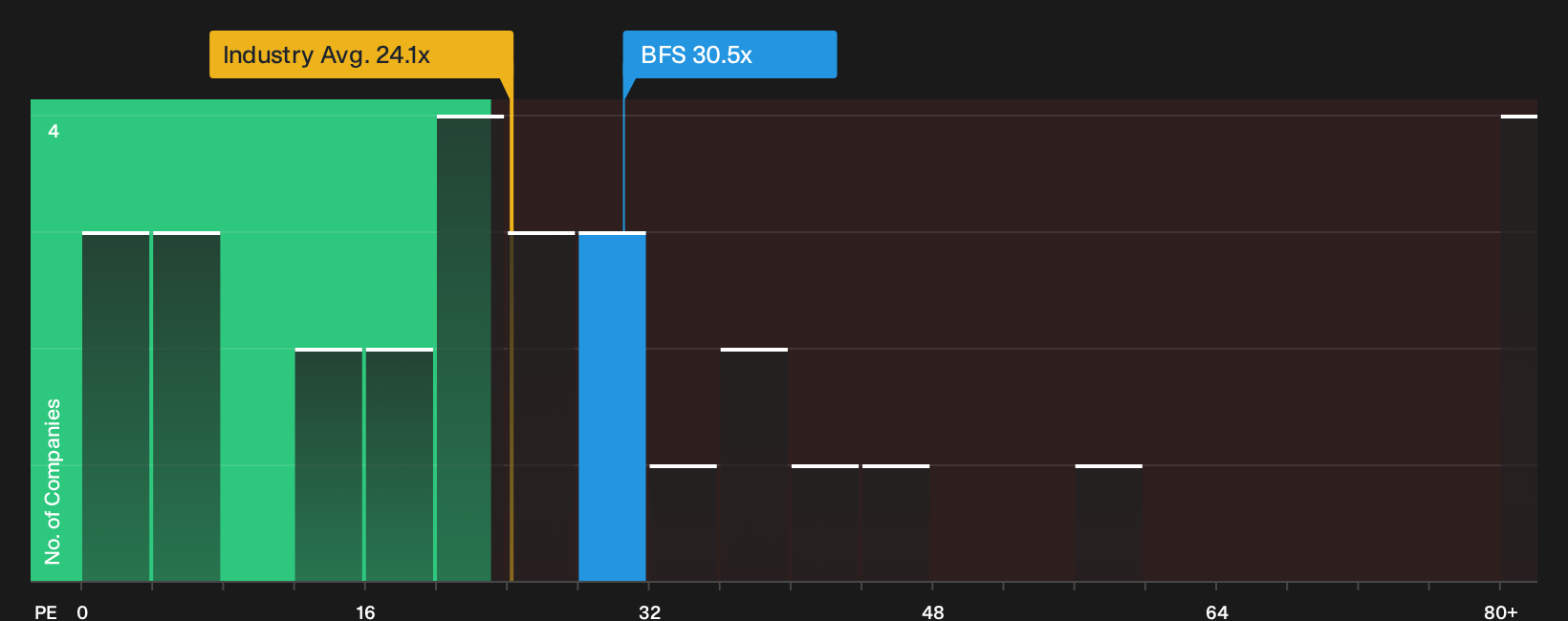
Saul Centers might screen as cheap on a DCF view, but its earnings multiple points in the opposite direction. The stock trades on a P/E of 30.5x, compared with 24.1x for the US Retail REITs group and 20.1x for close peers.
That richer valuation, despite earnings that have declined 5.2% per year over 5 years and profit margins that slipped from 11.5% to 7.8%, suggests the market is already paying up for stability and the 8.08% dividend yield. The question for you is simple. Does that premium multiple leave enough room if fundamentals stay under pressure?
See what the numbers say about this price — find out in our valuation breakdown.
Simply Wall St performs a discounted cash flow (DCF) on every stock in the world every day (check out Saul Centers for example). We show the entire calculation in full. You can track the result in your watchlist or portfolio and be alerted when this changes, or use our stock screener to discover 34 high quality undervalued stocks. If you save a screener we even alert you when new companies match - so you never miss a potential opportunity.
Next Steps
Mixed signals on Saul Centers so far. If you want to move quickly and develop your own view from the data, consider both sides by reviewing the 2 key rewards and 3 important warning signs
Hunting For More Ideas Beyond Saul Centers?
If Saul Centers has you thinking more broadly about opportunities and risks, do not stop at a single ticker. Cast a wider net and pressure test your thesis across different types of businesses using the Simply Wall St screener.
- Target potential mispricings by scanning for companies that combine quality fundamentals with attractive valuations through the 34 high quality undervalued stocks.
- Prioritise income by focusing on resilient payouts and robust metrics using the 4 dividend fortresses.
- Guard against surprises by concentrating on companies with stronger finances and dependable metrics via the 29 resilient stocks with low risk scores.
Have feedback on this article? Concerned about the content? Get in touch with us directly. Alternatively, email editorial-team@simplywallst.com