
Gold prices have fallen by about a quarter since the end of February. Global central banks bucked the trend and increased their holdings by 321 tons, with China and Poland leading the way
The Zhitong Finance App learned that a report released by the World Gold Council (WGC) on Tuesday showed that despite the pressure of rising oil prices and higher interest rates, central banks bought gold at the fastest rate since the end of 2024 in the third quarter. Central banks made net purchases of 321 tons of gold in the three months to the end of September. After a slow start to 2026, this figure brings the estimated year-to-date purchase volume to 675 tons, which is slightly higher than the same period last year.
This set of data highlights that central banks, as an important force driving the gold bull market for many years and reached a record high in January of this year, are still the key support for gold prices in an overall dull market. Since the outbreak of the war in Iran at the end of February, the price of gold has shrunk by about a quarter because rising energy costs have intensified market expectations for tighter monetary policy, which poses resistance to gold, which does not generate interest returns.
John Reade (John Reade), a senior market strategist at the World Gold Council, said that the weakening of gold prices during the quarter is likely to cause some central banks to increase their purchasing efforts. He said that for central banks that look down on the future of the US dollar, the strengthening of the US dollar may also make it more attractive to shift some of their reserves to gold.
“If you think the dollar will weaken in the long run, and you hold short-term US Treasury bonds that are about to expire, then you may use some of these 'expensive dollars' to buy gold,” Reed said.
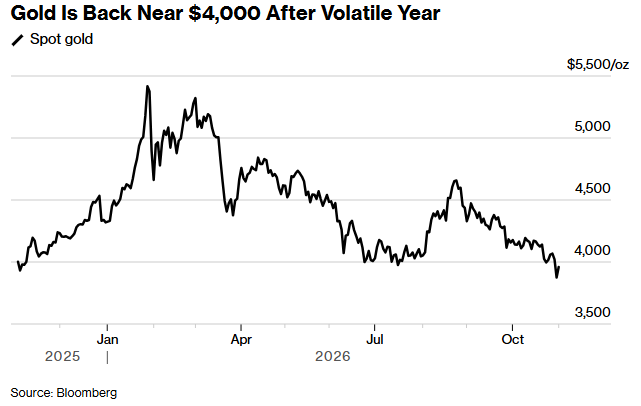
The price of gold is back to around $4,000
Nearly two-thirds of the estimated central bank purchases were not disclosed by the monetary authorities of each country themselves. The consulting firm Metals Focus Ltd. represents the World Gold Council and combines public data, trade statistics, and field research to calculate purchasing volumes.
In the most recent quarter, the largest buyers under the disclosed caliber were China and Poland, which increased their holdings by 63 tons and 41 tons, respectively. Russia was the only major seller, reducing holdings by 19 tons during the quarter.
The trend in gold prices has been weak in recent months, and the war in the Middle East continues to push up expectations for crude oil prices and interest rates. However, the World Gold Council said that capital inflows to gold ETFs were clearly strong, with holdings increasing by 211 tons in the third quarter to a record high.
Affected by tax policy adjustments in India and China and high gold prices, consumers switched to lighter, less-weighted products, and demand for jewellery fell 17% to 313 tons, making the Association's weakest third quarter since data were available in 2000.