
What KB Financial Group Doubters Missed
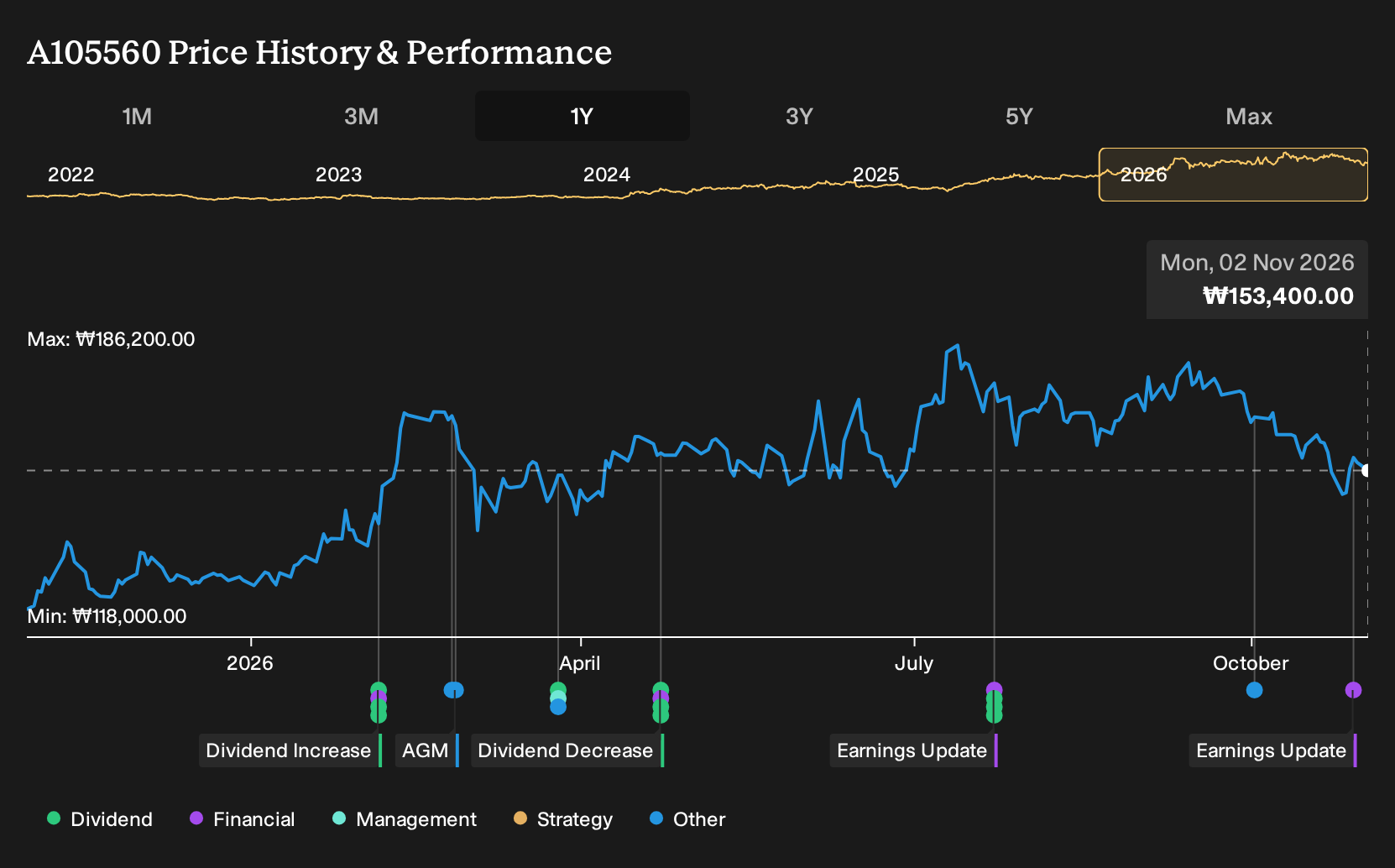
If you had put fresh money into KB Financial Group back in November 2025, the decision hinged on whether digital expansion and overseas growth could offset margin pressure and rising costs. For KB Financial Group shareholders, the return over the past year was 34.0%, including dividends. With revenue and profit both higher in Q3 2026 but net margin sharply lower, early buyers now face a sharper question: Which mattered more at the start, growth potential or shrinking profitability?
On Simply Wall St, a Narrative is an investor's thesis written down: the reasoning, plus the numbers it rests on. Run those numbers and you get an estimated Fair Value.
KB Financial Group has already moved. See which of 192 high quality undervalued stocks still trade below our estimates.
The Two Stories Investors Had To Choose Between On KB Financial Group
The shares cost ₩116,800 at the start of the period, so anyone looking at KB Financial Group then had to decide which future seemed more realistic.
On the optimistic side, the bull Narrative put Fair Value at ₩140,977. That view leaned on assumptions like 9.0% annual revenue growth supported by faster digital adoption, overseas expansion and a future P/E of 9.3x.
The bear Narrative instead suggested Fair Value of ₩92,200. This version focused on South Korea's aging demographics, rising fintech competition and an assumed margin decline to 29.0% over time.
What The Results Changed For The KB Financial Group Thesis
The clearest fact was the Q3 2026 results. KB Financial Group reported revenue of ₩2,449,824.9m and net income of ₩1,907,460m, which supported the growth assumptions in both Narratives, while the drop in net margin from 41.0% to 7.8% challenged the profitability focus of the optimistic case. Overall, the evidence cut both ways.
The lesson is simple. When a thesis leans on future efficiency, track net margin alongside revenue and profit. That margin line tests the promise, especially in cases where digital spending and overseas build-out are central to the story.
What KB Financial Group's Price Now Asks You To Believe
KB Financial Group trades at ₩153,400 today after a 34.0% gain over the past year from ₩116,800. The selected Narrative sees Fair Value above that level based on what the business could earn and return if current plans hold together.
The argument leans on capital-markets and fee income, disciplined credit costs and a cost-income ratio that stays below 40%. It also suggests today's price may not fully credit the assumption that KB Financial Group can keep ROE around recent levels while still returning CET1 above 13.5% through dividends and buybacks.
"The main thing that has to go right is that KB Financial Group continues to grow capital-markets-linked and fee-based income through its securities and nonbank subsidiaries while keeping credit costs within the guided early to mid 40 bps range and sustaining a sub 40% cost-income ratio."
That disagreement has a full argument behind it. → Uncover the higher Fair Value this Narrative argues for
Looking Beyond KB Financial Group
KB Financial Group shows what a large bank can do with scale, technology and capital strength. You can also look sideways, not just locally.
Big corporate and wealth clients still want one institution that can move money, advise on deals and manage assets under one roof.
Another global player leans into that same need, tying together payments, investment banking and asset management for many of those customers.
Its role in financing data infrastructure, cross border money flows and fee based investing puts it close to where capital is already moving.
The open question is how that broader reach might behave in a different rate or trading backdrop than KB Financial Group faces today.
The case is on the record, with the assumptions it rests on. → See the Narrative that values this company 23% above its price
Have feedback on this article? Concerned about the content? Get in touch with us directly. Alternatively, email editorial-team@simplywallst.com