
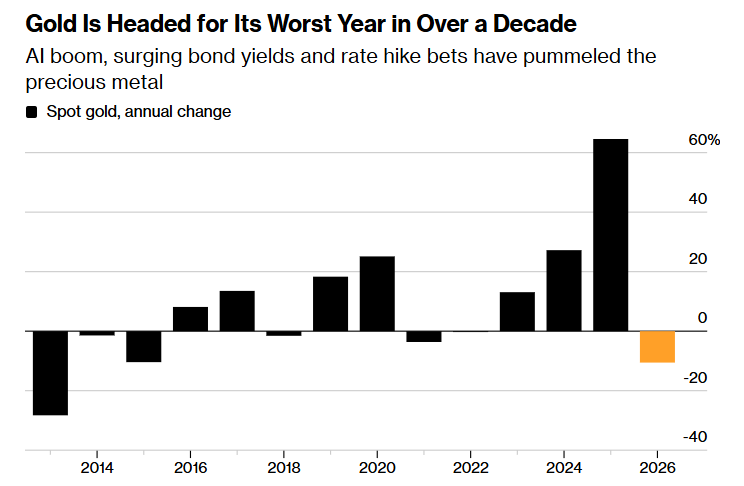
The price of gold fell more than 8% during the year and fell below the 4,000 US dollar mark. The US midterm elections may be an opportunity for gold to “turn over”
As the price of gold moves towards its worst annual performance in more than ten years, investors are now judging whether changes in the US political landscape can allow this precious metal to rediscover the appeal of risk avoidance.
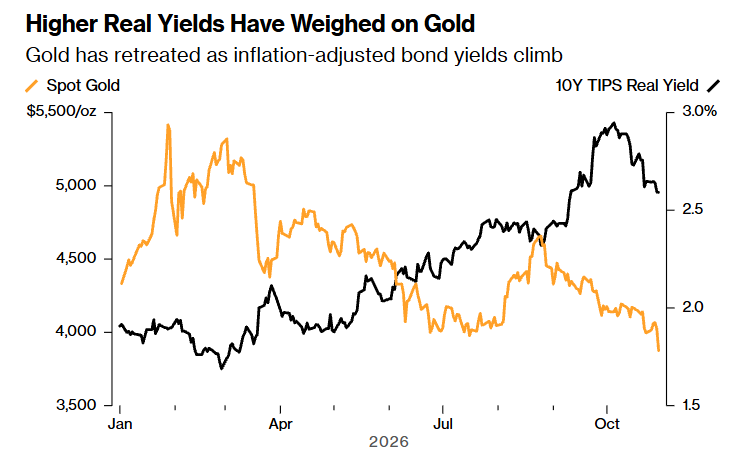
The Zhitong Finance App observes that, generally speaking, during periods of ongoing global friction, gold is a safe haven for capital. However, at the beginning of 2026, the price of gold reached a record high of more than 5,500 US dollars per ounce, driven by a trend, but now it has fallen below 4,000 US dollars, a drop of more than 8% during the year. The boom in artificial intelligence (AI) investment, soaring treasury yields, and expectations of interest rate hikes have all seriously dampened this interest-free asset.
Midterm Elections: Key Variables for Gold
The US midterm elections this Tuesday may shift the market narrative back to the issue of inflation and fiscal deficits — a pattern that is expected to revive gold's status as “the most reliable asset when everything is at risk.” Using Trump's first term as a reference, Congress was divided after the midterm elections, the legislative process almost stalled, and almost no one dealt with the US fiscal deficit of about 2 trillion US dollars, which in turn raised concerns about monetary policy.
Polls show that the Democratic Party is expected to win a majority of seats in the House of Representatives, but there is still uncertainty about where the Senate belongs. Even if the Democratic Party controls Congress, the president still has veto power — which means spending will be curtailed, putting downward pressure on US bond yields and removing one of the biggest resistances facing gold. Trump has threatened to use this power. In an interview with the New York Post, he said that if the Democratic Party wins a majority of seats in Tuesday's midterm elections, he may have to become “Mr. Veto” (Mr. Veto).
“History doesn't repeat itself, but it always rhymes.” Matt Miskin, co-chief investment strategist at Manulife John Hancock Investments (Manulife John Hancock Investments), said and quoted the rise in gold in 2019 as a reference, “If the situation in 2027 is somewhat similar to 2019, the current weakness in gold may actually be reversed.” He pointed out that the gridlock (gridlock) is likely to reduce the risk that fiscal policy will further push up real returns, which is “a very positive development” for gold. Currently, its strategy has made a small increase in positions around $4,000, and the overall position is between neutral and slightly oversized.
“Unconventional tension” in the face of debt distress
Another logic to bullish on gold is that as the US debt burden continues to increase, investors will turn to precious metals to hedge against the risk of a weakening dollar.
Anthony Saglimbene, chief market strategist at Amerrprise, believes that regardless of the composition of the next Congress, it will inherit a difficult fiscal situation. And a government impasse will not only hinder spending, but also prevent spending cuts or revenue increases that are extremely difficult politically, but are critical to improving the government's finances.
For gold investors, this is an unusual contradiction: when financial concerns drive up yields, interest-bearing assets are more attractive, and gold is pressured as a result; however, rising yields also confirm that fiscal pressure is intensifying, making gold attractive again as an alternative store of value. Saglimbene anticipates that investors concerned about the US fiscal situation will seek safe havens other than government bonds and instead embrace gold — a sharp rise in yield due to deficits and debt concerns, which may in turn be a potential tailwind for gold prices.
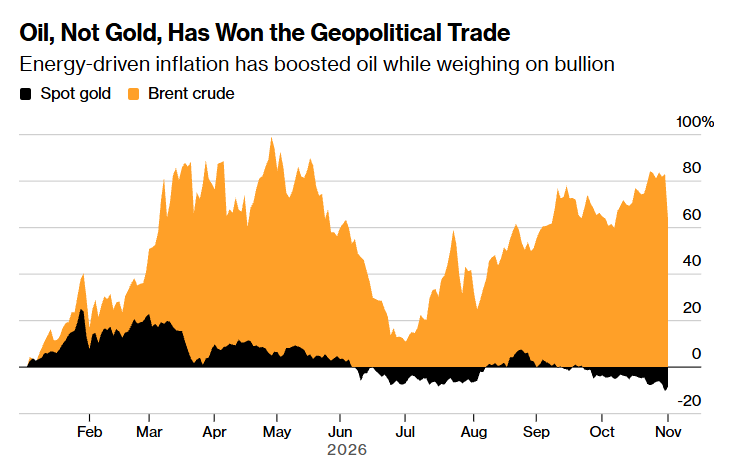
One of the key characteristics of this year's market is that even as geopolitical turmoil intensifies and concerns about US finances continue to accumulate, gold has not continued to show the safe-haven properties investors expect. Currently, high oil prices have heightened concerns about inflation and expectations of tighter currency, prompting investors to switch to treasury bonds with higher yields. Instead, safe-haven needs due to geopolitical risks have been covered up.
The AI boom debate: another main line in the fate of gold
Gold's mid-term trend is closely linked to the sustainability of the AI boom. The huge demand for capital to finance AI infrastructure construction is prompting companies to issue large debts — just as the US government also needs to finance huge deficits, the two forces are working together to boost yields and suppress the price of gold.
Roger Aliaga-Díaz, head of global portfolio building at Vanguard Group (Vanguard), said the AI capital spending boom is one of the strongest investment cycles in decades and is unlikely to come to an abrupt end. Pioneer expects economic growth to be higher than market consensus next year.
According to Pioneer, large deficits are not necessarily good for gold: if policymakers maintain credibility and are willing to curb inflation by raising interest rates, fiscal expansion will eventually translate into higher yields — which is bad news for gold — rather than the market losing confidence in the dollar. “If the Federal Reserve does its job,” fiscal concerns are not enough to be a major driver of gold. However, he also pointed out that once investors begin to question the independence of the Federal Reserve or its will to curb inflation, the appeal of gold will increase dramatically.
Short-term volatility and risk of stagflation
As the election approaches, the market is also facing the risk of short-term fluctuations. Man Group's Kristina Hooper said that if there is an election dispute, it may stimulate safe-haven purchases of gold before and after voting; a divided government will eventually clash over spending, government shutdown, or debt ceilings.
For investors trying to determine whether the disappointing performance of gold in 2026 is the beginning of a longer decline or a good buying opportunity, the bigger question is where the market will go after the election. Hooper is closely watching for signs of stagflation — continued inflation compounded by slowing growth. This environment has always been favorable to gold. “The bigger story is whether we will actually enter that stagflation environment.” She pointed out that a combination of weak employment growth and continued pressure on prices is emerging.
Overall: If growth weakens, real yields fall, or market unease over Washington's inability to rectify its finances intensifies, gold may quickly return to its former appeal; however, if AI investment continues to support growth, the Federal Reserve remains hawkish, and US bond yields remain attractive, gold will continue to be snubbed.
As Miskin said, “The assets that really aren't being looked forward to this year are high-quality bonds, defensive stocks, and even gold — and we're digging for gold in these abandoned assets.”