
What Might Markets Have Been Telling Us Monday Regarding Tuesday's Mid-Term Election?
It's possible - possible - the commodities complex was indicating what it thought was going to happen with US mid-term elections Tuesday. But as we saw last week, markets can be caught leaning the wrong way (supposedly).
The Energies sector melted down Monday with WTI crude oil down 7.5% and diesel fuel falling 5.5%.
The Grains sector was quietly mixed following weeks of heavy noncommercial selling.
Afternoon Summary: Over the decades, I’ve said countless times that if we want to understand what the market is saying all we have to do is focus on what it is trying to tell us. This goes along with Market Rule #5, “It’s the what, not the why”, though 99.9% of the industry feels the need to make up reasons why markets moved every day. But I digress. If we apply what I’ve tried to teach, and look at today’s session, what are markets trying to tell us about Tuesday’s US mid-term elections, if anything? The sector that stands out to me is Energies. Yes, I’ve read all the same old made-up excuses for Monday’s meltdown about “peace talks” and so on, but what if there is something more? What if Energies markets are pricing in a seismic shift in US politics, one that could bring the ruling regime down like a house of cards. If control of Congress is lost, and the new Congress uses the US Constitution to flex its muscle, then the US president’s War on Iran could be over sooner rather than later. I was asked this morning what we should expect in markets tomorrow, with my reply being along the line of “what we saw last week following the Brazilian presidential election, but on steroids”.
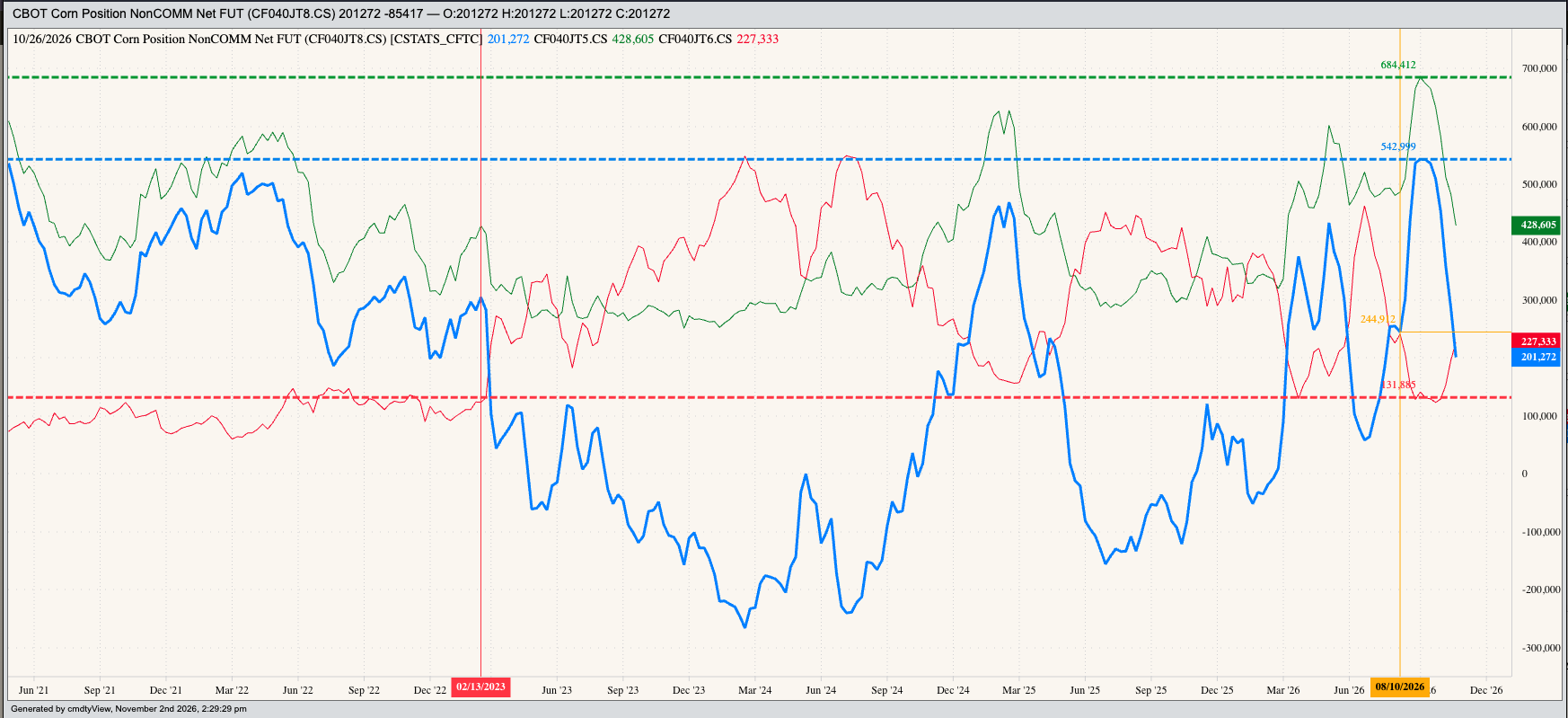
Corn: Applying Rule #6 to the corn market again, we can easily see what happened to open the week. Let’s try the exercise I used to do at presentations. Here are the numbers: December (ZCZ26) closed 0.5 cent higher on relatively light trade volume of 180,000 contracts. March finished 1.0 cent higher while registering about 100,000 contracts changing hands, with May up 1.75 cents at the close on trade volume of fewer than 45,000 contracts. What happened? We know funds have been liquidating longs at an electrifying rate with the long futures position cut by 255,805 contracts and net-long futures positioned decreased by 341,730 contracts over the previous 7 positioning weeks. Heading into Tuesday’s session, Dec is down 0.5 cent for this positioning week. Adding all this together, funds were either covering some recently added short futures positions (an increase of 103,980 contracts the past four weeks) or adding back some longs while commercial interests either stayed on the sidelines or took shelter in a bunker, waiting for Tuesday to pass. Monday morning saw a large sale of roughly 1.73 million metric tons to Mexico, activity that likely supported the Dec-March and March-May futures spreads late last week. Let’s see what tomorrow brings.
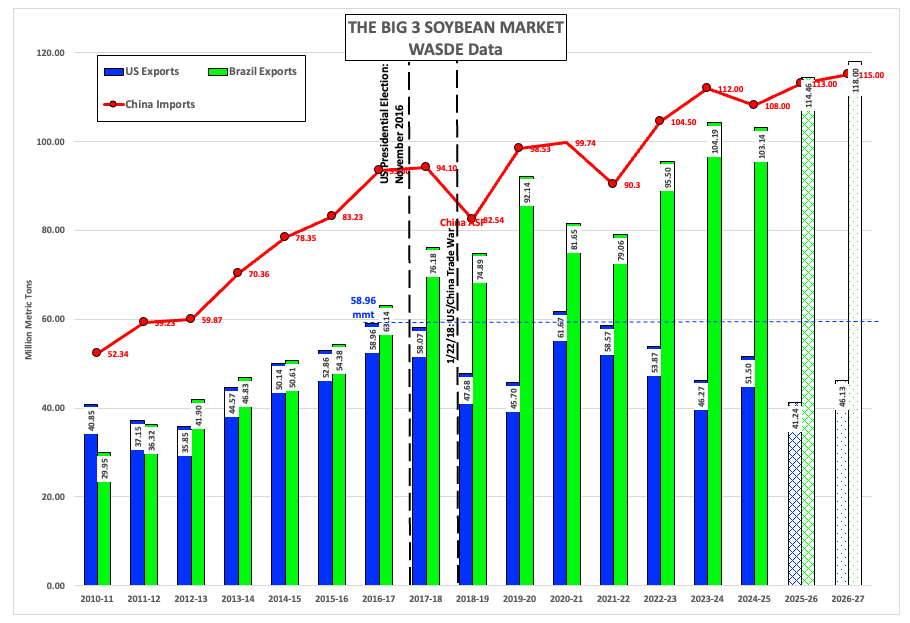
Soybeans: The soybean market is an interesting study. The January issue (ZSF27) lost as much as 18.75 cents ahead of mid-term elections. What does this tell us? A couple of interpretations. First, if the current regime is forced to make Trade War peace with China due to the economic hardship it has created globally, then the US might – might – see an uptick in export demand over the coming years. (Much will still depend on Brazil’s weather.) This could be considered slightly bullish for the US soybean market. Yet here we are, staring at strong double-digit losses across the board. Recall the Energies sector was pummeled with diesel fuel (HOZ26) down 24.5 cents at this writing, possibly on the idea Congress could force an end to the unnecessary (illegal?) War on Iran in early 2027 (emphasis on the word “could”). Spillover selling had the oilseed sector lower, but at least in soybean oil I’m not seeing signs of commercial pressure. As for soybeans, the January issue finished 17.5 cents in the red and lost 0.25 cent to March which lost 0.75 cent to May which lost 1.75 cents to July. For now, the commercial side seems to be paying more attention to Brazil’s weather and 2027 crop.
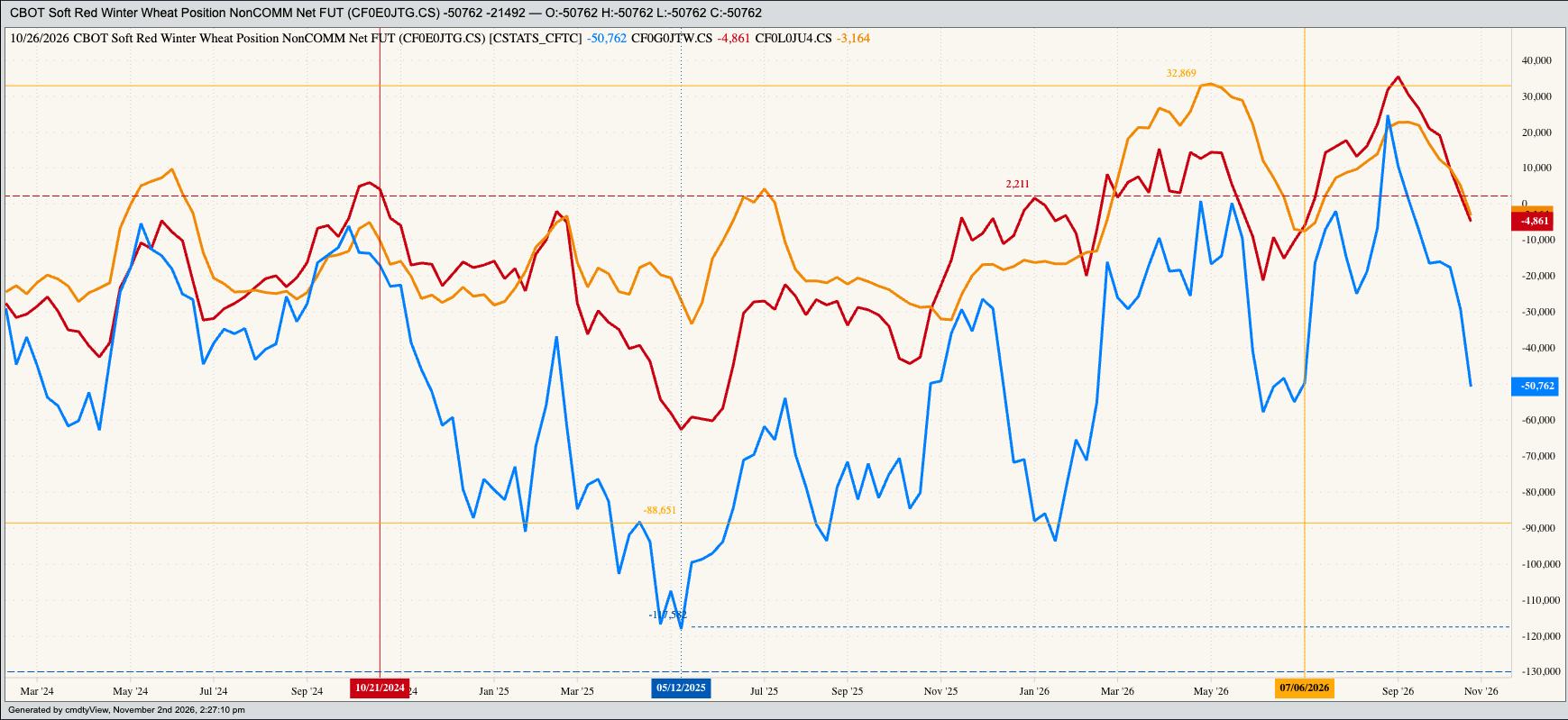
Wheat: What would a weakening of the regime mean for the wheat sub-sector? My argument would be “nothing” based on what I like to call the Wheat Reality, “One bushels (metric ton) of wheat left over is too many”. If that’s the case, then why did all three markets rally Monday? To answer that, all we have to do is look back at last Friday’s Commitments of Traders report. Watson increased its net-short futures position in SRW by 21,490 contracts pushing it out to 50,760 contracts, the largest the position has been since Tuesday, June 30. We also see Watson switched directions in both hard red markets, moving to net-short in both winter and spring and putting all three markets net-short for the first time since July 7. Given all this, a light round of short-covering ahead of Tuesday’s uncertainty is not surprising. For the record, December SRW (ZWZ26) finished with a gain of 3.0 cents and gained 0.5 cent on March. Similarly, Dec HRW (KEZ26) closed 1.75 cents higher and also gained 0.5 cent on March. Closing out the trifecta, Dec HRS (MWZ26) settled 2.0 cents higher and gained 1.0 cent on March. The One Day Wisdom tells us one day does not a trend make.
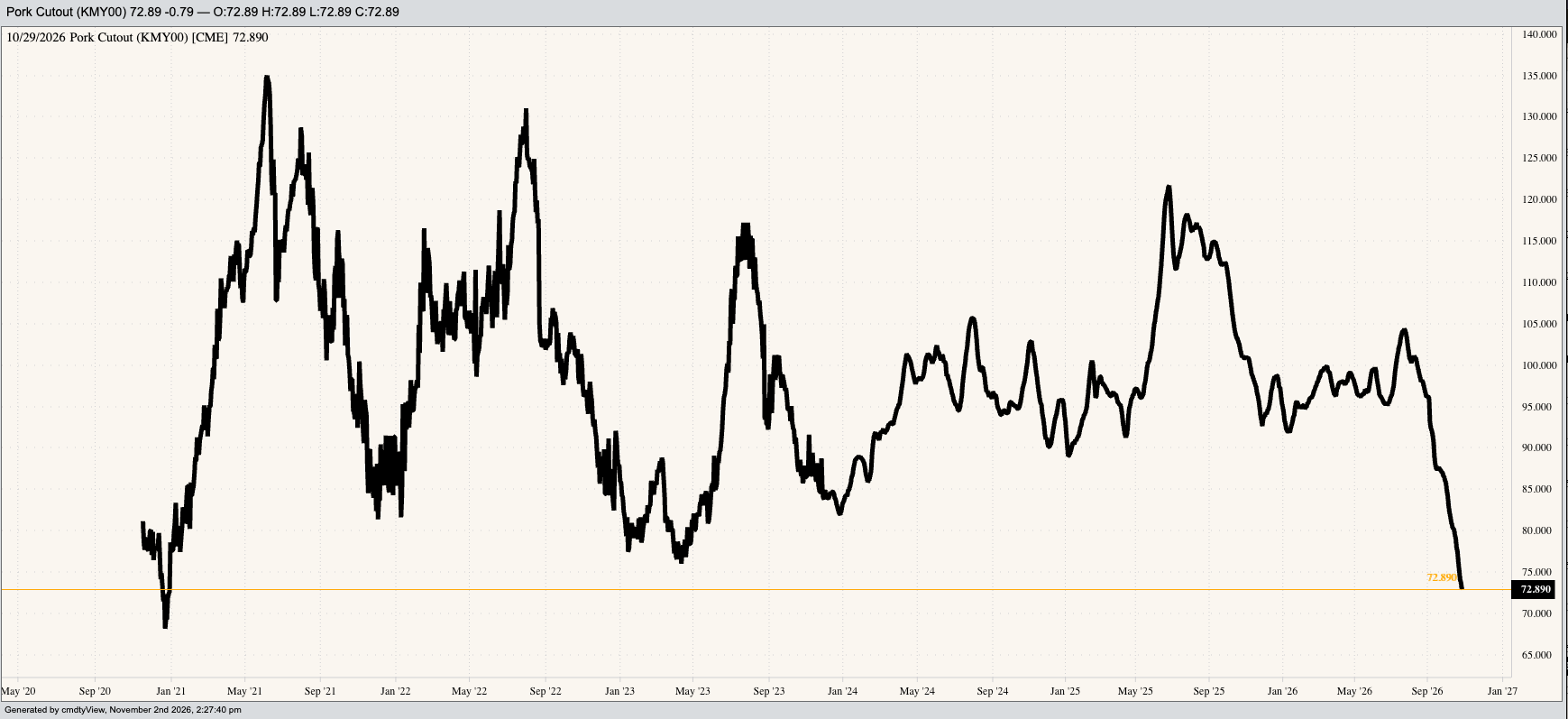
Livestock: I want to mention the Livestock sector again this afternoon because the effects of the looming economic problems created by the current US regime might finally be rising to the surface. Commercial activity stood out to me again Monday, most notably the selling in live cattle as December (LEZ26) finished $1.25 lower and lost $0.575 to February which lost $0.20 to April which lost $0.125 to June and so on. Over in hogs we see the December issue (HEZ26) down $0.70 and losing $0.825, again likely tied to the Pork Cutout Index that sank to its lowest price since December 30 last Friday. Why would red meat prices be falling? It is possible we are finally starting to see US consumer demand moving to the lower priced poultry section of the meat shop. Granted, some of this is seasonal as the US entered its “holiday season” with the coming and going of Halloween this past weekend. As for feeder cattle, the January issue (GFF27) finished $0.90 higher but lost $0.125 to March. Here last Friday’s Commitments of Traders report showed Watson switched to a small net-long futures position 1,670 contracts. If it were me, which it isn’t, I wouldn’t be overly excited about adding contracts at this time.
On the date of publication, Darin Newsom did not directly have a position in any of the securities mentioned in this article. All information and data in this article is solely for informational purposes. For more information please view the Barchart Disclosure Policy here.