
Not Newmont. Not Barrick. This Gold Stock Collects Cash Without Running a Mine.
Key Points
The company receives royalty and streaming revenue from mining companies.
Franco-Nevada has raised its dividend for 19 consecutive years.
Franco-Nevada's low overhead helps it see higher margins.
The biggest problem with gold mining stocks is that mining is inherently expensive and complicated. Rising prices for diesel fuel, heavy machinery, labor, explosives, and energy directly eat into mining companies' operating margins.
Many of the top gold mines in the world are in areas with unstable governments, which adds complications as well, and a single strike or political conflict at one key site can severely dampen a company's earnings.
Missed Nvidia in 2009? This Rare Signal Is Flashing Again. In 2009, a "Double Down" signal flashed for a little-known chipmaker called Nvidia. For the first time in years, that same "Total Conviction" signal is flashing for a company 1/100th the size of Nvidia. Continue »
Gold streaming companies such as Franco-Nevada (NYSE: FNV) benefit from rising gold prices without the headaches of actually producing gold. Franco-Nevada provides upfront funding to mining companies to build or expand a mine, and in return, it receives a percentage of the mine's revenue, known as a royalty, or the right to purchase a portion of the mine's gold production at a pre-agreed-upon discounted price, known as a stream.
Here are three reasons why I prefer Franco-Nevada's stock to traditional gold mining stocks right now.
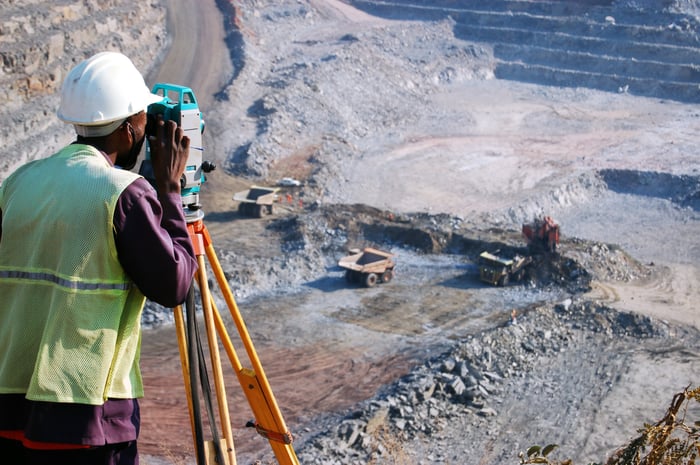
Image source: Getty Images.
Higher-margin cash flows than miners
Since the mining operator bears 100% of the operational expenditures, diesel costs, labor expenses, and equipment maintenance, Franco-Nevada receives top-line cash flow with exceptionally high profit margins and very low overhead.
For example, Barrick Mining (NYSE: B) in the second quarter reported an adjusted earnings before interest, taxes, depreciation, and amortization (EBITDA) margin of 60%, while Newmont (NYSE: NEM) had an adjusted EBITDA margin of around 61.2%. Franco-Nevada, on the other hand, reported an adjusted EBITDA margin of 91.2%.
While gold mining companies have to hire hundreds or thousands of workers, Franco-Nevada had, as of last year, only 41 full-time employees and five part-time contractors.
Greater mine diversification than gold miners
Instead of taking on single-mine risk, Franco-Nevada has interests in 447 assets, including 129 operating mines. It also has diversity in its mining, with 85% of its assets in precious metals, but it also has interests in natural gas liquids, oil, and gas. With the price of gold, natural gas, and oil all increasing this year, the company is benefiting from all three.
The majority of its revenue comes from 427 royalty payments, with the rest coming from 14 streaming payments. While more than 80% of its six-month revenue came from precious metals, such as gold, silver, and platinum group metals, it also brought in $45 million from oil, gas, iron ore, natural gas liquids, and other mining assets.
The company is having a record year
Midway through its fiscal year, nearly every financial category is a record. Franco-Nevada reported six-month revenue of $1.23 billion, up 67% year over year, including $1 billion in operating cash flow, up 39% over the same period last year, and earnings per share (EPS) of $4.27, up 80% year over year.
That kind of growth allows it to continue to raise its dividend. It has increased its dividend for 19 consecutive years, including a 16% increase this year to $0.44 per share.
Plenty of reward with less risk
The price of gold is up more than 105% over the past five years. This year, however, it went from a high of $5,344.30 per spot ounce in February to its current price of around $3,913. That kind of volatility has made buying gold stocks tricky.
Barrick's shares are down more than 15% this year, while Newmont's are up a little more than 5%. Franco-Nevada's shares are up more than 8%. Franco-Nevada's upside is limited compared to gold mining companies, but its downside is even more limited. That's why the longer you hold the stock, the greater the advantage is. Since the company went public in 2007, its total return is nearly 2,000%.
James Halley has positions in Newmont. The Motley Fool recommends Franco-Nevada. The Motley Fool has a disclosure policy.