
Should Lenswear Anniversary Require Action From Nikon (TSE:7731) Investors?
- Nikon Lenswear marked its 80th anniversary in October 2026, spotlighting a broad eyeglass portfolio from single vision to progressive lenses, built on decades of optical know how.
- The new Z Series lens range, derived from Nikon camera lens contrast evaluation techniques, shows how the group reuses core imaging expertise inside its vision care business.
- We will now look at how Nikon's investment narrative could be shaped by the Z Series contrast focused lens technology milestone.
Scan for other precision optics businesses that are applying specialist know how to everyday products by checking out our curated list of 73 high quality undiscovered gems alongside Nikon's latest lens milestone.
Nikon Investment Narrative Recap
Nikon asks shareholders to believe that decades of optics expertise can support a shift toward higher value segments like metrology and digital manufacturing while the legacy imaging and vision care lines keep doing their job. The 80 year Nikon Lenswear milestone and Z Series launch help that story around optical know how, but they do not change the core near term catalyst, which is execution on industrial inspection and digital manufacturing revenue growth. The biggest operational risk still sits in Nikon reaching its FY2030 revenue and profit ambitions from a currently loss making base.
Lenswear and the Z Series matter more as a proof point that Nikon can repurpose optics research across businesses than as a financial swing factor in the short term. Investors are still watching the industrial side, such as the APDIS MV5X Laser Radar rollout and broader metrology positioning, because that is where the narrative around higher margin, more recurring industrial customers and progress toward the ¥1 trillion revenue and ¥80 billion operating profit targets really sits.
The most relevant operational milestone tied to this lens news is Nikon’s broader use of precision optics in industrial inspection, especially through the APDIS MV5X Laser Radar system that leans on high precision sensor technology. The same kind of contrast and imaging know how that underpins Z Series eyeglass lenses also supports Nikon’s pitch in automated inspection, where the business is treated as a key participant in the metrology market opportunity through 2035.
For you as an investor, the interesting thread is consistency. The 80th anniversary Lenswear story shows Nikon still investing in optical performance and contrast measurement for human vision. On the industrial side, APDIS and related metrology offerings are the main operational catalyst tied to earnings forecasts that assume revenue growth of 3.6% a year and a move from losses to forecast profitability, while the risk is that adoption of these high value systems or execution on digital manufacturing lags those expectations.
Nikon Consensus Expectations In Context
Nikon's current analyst storyline focuses on a shift from loss making operations toward positive profitability over the next few years. The Z Series lens milestone feeds into that by highlighting how optical expertise may support this broader shift. Analyst models assume the wider group can move from a reported loss today to positive earnings while growing the top line at a measured pace, with the industrial metrology and digital manufacturing efforts doing much of the heavy lifting in those forecasts.
Consensus assumptions call for Nikon's revenue to expand by 4.0% each year for roughly the next three years. Profit margins are modeled to move from a loss position of 13.8% today to a positive margin of 3.6% in three years. This would represent a change in how effectively the business converts sales into profit compared with the current base.
On earnings, analysts expect Nikon to move from a loss of ¥94.3 billion today to earnings of ¥27.7 billion by around 2029, with that profit level tied to an earnings per share figure of ¥83.91 in the same year. The swing from today’s result to the forecast outcome comes to about ¥122.0 billion in earnings improvement, which highlights how much needs to change at group level even if the Z Series lens line itself is a relatively small financial lever.
Valuation work in those models links Nikon’s 2029 forecast to revenue of ¥769.6 billion and earnings of ¥27.7 billion in that year. It also assumes the stock could be trading on a P/E ratio of about 23.6x those earnings. That multiple sits above the 9.6x P/E quoted for the wider JP Consumer Durables sector in the same report, so any investor using these numbers is implicitly assuming higher earnings power or a richer rating than the sector average if the forecasts play out.
Analysts also build in a slow increase in the share count, with the number of Nikon shares expected to grow by 0.08% per year over the next three years. This expected dilution is small in the context of the overall earnings swing modeled, yet it still matters when you translate group earnings into earnings per share and compare those outcomes with today’s levels and with any future executive incentive plans tied to stock based compensation.
Nikon's narrative projects revenues of ¥769.6 billion and earnings of ¥27.7 billion by 2029. This assumes 4.0% yearly revenue growth and an earnings improvement of about ¥122.0 billion from a current loss of ¥94.3 billion.
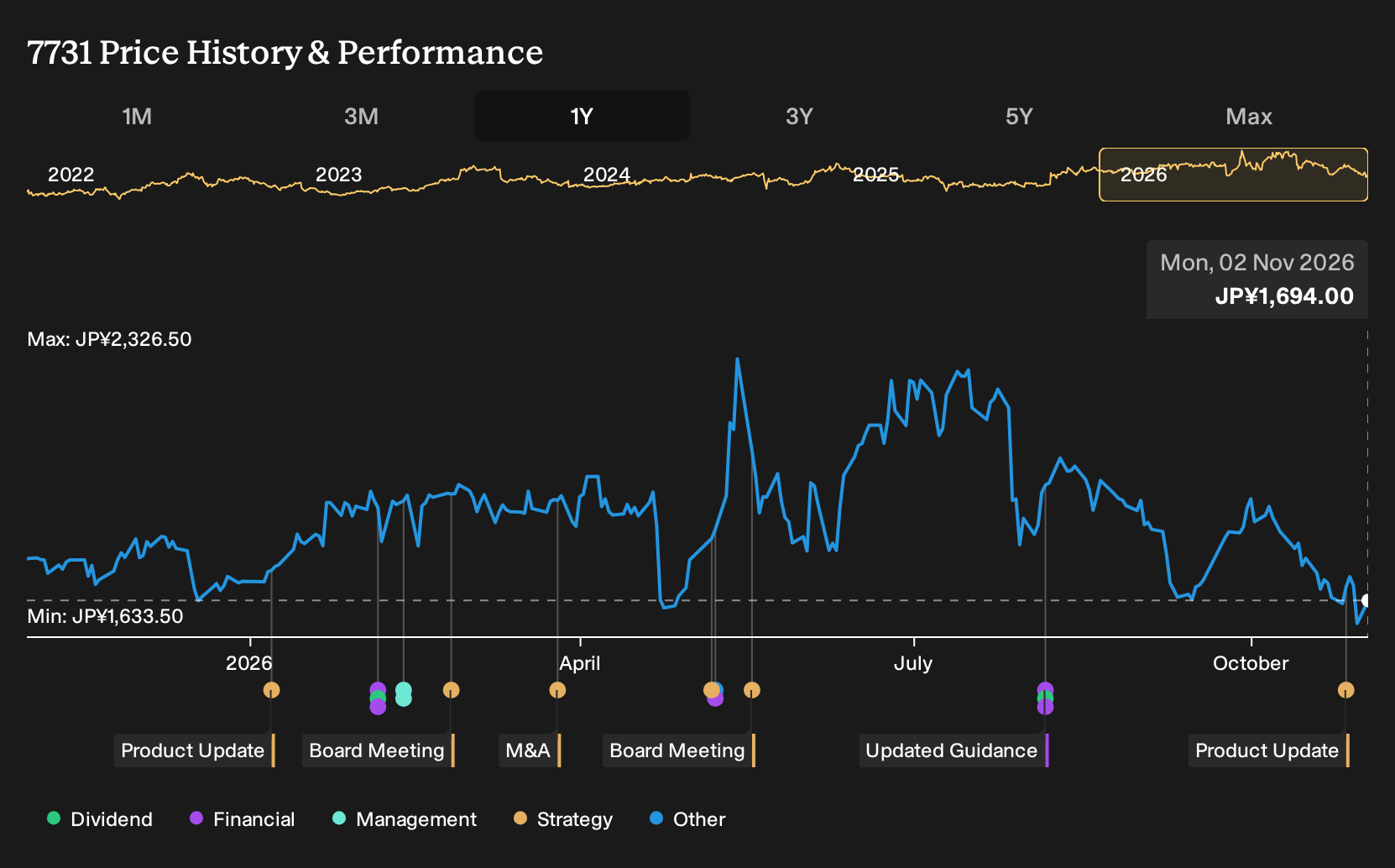
Uncover why Nikon's fair value indicates a 4% potential downside to its current price, which leaves little room for error.
Exploring Other Perspectives
Two fair value estimates from the Simply Wall St Community span roughly ¥1,623 to about ¥2,541 per share, which already shows how far private views on Nikon can stretch. When you also consider the metrology ambitions, the APDIS MV5X rollout and the FY2030 profit targets, you get even wider possible paths. Treat these opinions as a menu and explore several angles before deciding how Nikon fits your portfolio.
Explore another Nikon fair value estimate, including one that suggests as much as 51% upside from the current price!
Form Your Own Verdict
Don't just follow the ticker; dig into the data and build a conviction that's truly your own.
- A great starting point for your Nikon research is our analysis highlighting 2 key rewards that could impact your investment decision.
- See our latest analysis for Nikon. The report includes a comprehensive fundamental analysis summarized in a single visual, the Snowflake, making it easy to evaluate Nikon's overall financial health at a glance.
Looking For More Investment Ideas Beyond Nikon?
If you want to put Nikon in context and stress test your own thesis, comparing it with a wider watchlist can be useful. The Simply Wall St Screener lets you scan other listed companies through the same lens of cash flows, balance sheets, and dividend policies so you can see where Nikon fits in your broader plan.
- For investors hunting for underappreciated quality, start with a focused set of potential value opportunities using the 15 high quality undervalued stocks.
- If resilience matters more than rapid growth, filter for companies with sturdier finances by checking the list of solid balance sheet and fundamentals (22 results).
- Income focused readers can concentrate on payout strength and stability by reviewing the 30 dividend fortresses.
Have feedback on this article? Concerned about the content? Get in touch with us directly. Alternatively, email editorial-team@simplywallst.com