
Dear Apple Stock Fans, Mark Your Calendars for November 2
Earnings season is here, and Big Tech is once again stepping up to the microphone to tell investors how much money it made.
Next up is Apple (AAPL), which is set to report its fourth-quarter fiscal 2026 results on Monday, Nov. 2, after the closing bell. Apple has a pretty decent track record, having beaten Wall Street’s earnings and revenue estimates in each of the past four quarters. Expectations are high again, with analysts looking for growth on both fronts.
Strong iPhone demand, the new iPhone 18 Pro lineup, growing Apple Intelligence adoption, and expanding Services revenue could give results a lift. But it is not all sunshine and shiny iPhones. Semiconductor shortages, higher memory costs, and unfavorable currency movements could spoil some of the fun.
So, what should investors expect this time? Let’s take a closer look at the details.
About Apple Stock
Apple is one of those names that hardly needs an introduction. What started as a computer company has grown into a global technology powerhouse, with its products now woven into everyday life. Headquartered in Cupertino, California, Apple has built an ecosystem around the iPhone, Mac, iPad, Apple Watch, and other devices, giving customers plenty of reasons to stay within its ecosystem. And there is more to the business than hardware sales.
Its Services segment, spanning the App Store, iCloud, Apple Music, and Apple Pay, adds a recurring revenue stream while keeping users connected to the ecosystem. Apple isn't slowing down on product innovation, either. Recently, it unveiled its fourth-generation Apple TV 4K, powered by the A19 chip and featuring Siri AI and built-in far-field microphones. With its global brand recognition and loyal customer base, Apple continues to expand its reach well beyond the iPhone. And its market capitalization currently stands at around $5.1 trillion, slightly behind Nvidia's (NVDA).
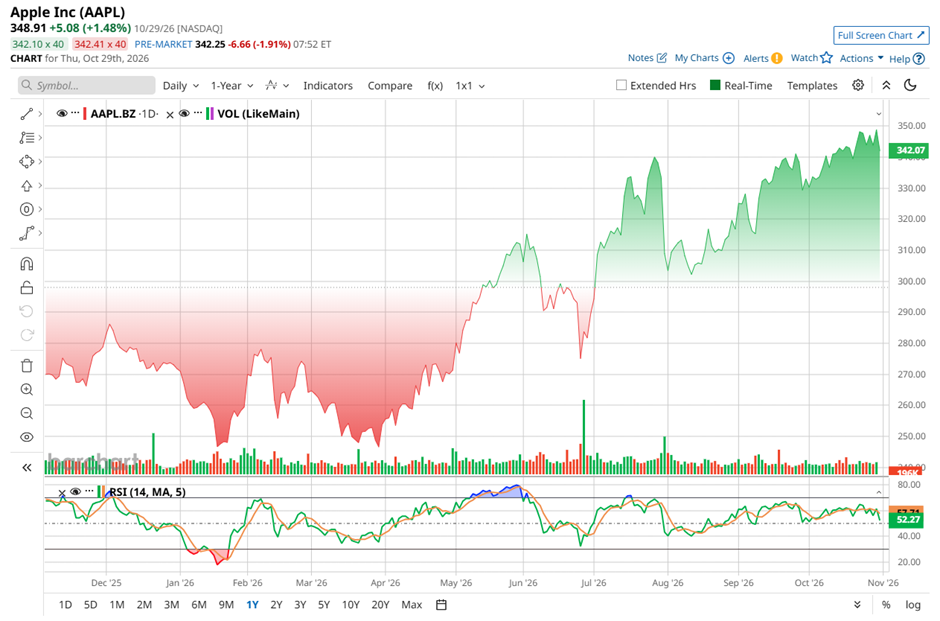
But even a company of Apple’s scale is not immune to market mood swings. AAPL stock did not start the year with fireworks, as concerns around interest rates, geopolitical tensions, and the market’s obsession with artificial intelligence (AI) kept investors busy second-guessing Big Tech. AAPL initially struggled to gain traction, but things gradually started looking up as the year progressed.
In October, Apple’s shares took a hit after reports surfaced that the company had asked suppliers to cut October component orders for the iPhone 18 Pro and Pro Max by roughly 15% to 20% from initial estimates. The price increase of these models may have raised some eyebrows among buyers. Add in an industry-wide memory and storage chip shortage, driven by booming AI data center demand, and there were plenty of reasons for investors to get nervous.
Meanwhile, Apple found reasons to return to the spotlight. On Oct. 13, shares gained momentum amid excitement around its new smart home lineup. Then came another milestone. On Oct. 23, the day the iPhone Duo went on sale, AAPL hit an all-time high of $351.73. Enthusiasm around Apple’s first foldable phone, approval for key Apple Intelligence features in China, and continued double-digit revenue growth have all helped keep the bullish sentiment alive.
The numbers tell a pretty impressive story, too. Apple stock has climbed 29.4% over the past 52 weeks at the time of writing. Although shares have eased slightly from their October peak, the broader momentum remains positive.
Technically, AAPL stock still has room to run without looking overheated. Its 14-day RSI is around 52, suggesting fairly healthy momentum and remaining comfortably below the overbought threshold of 70.
Apple may be wearing a $5 trillion crown, but buying its stock does not come cheap. Trading at 39.48 times forward adjusted earnings and 10.66 times sales, AAPL carries a hefty premium to its historical averages and several mega-cap peers. Brand loyalty and a sticky ecosystem come with a luxury price tag.
Still, shareholders are not left empty-handed. Apple has raised its quarterly dividend for 13 consecutive years, with a modest 12% payout ratio leaving room for more hikes. Adding in billions in stock buybacks, there is still plenty of shareholder love to go around.
A Snapshot of Apple’s Q3 Results
In July, Apple released its Q3 results, generating revenue of $109.4 billion, up 16.4% year-over-year (YOY) and comfortably ahead of analysts’ expectations. Adjusted EPS reached $1.91, while reported EPS jumped 28.7% annually to $2.02. Apple also set June-quarter revenue records for the iPhone, Mac, and Services. Its installed base crossed 2.5 billion active devices, proving that once customers enter Apple’s ecosystem, leaving is not exactly a priority.
The iPhone, unsurprisingly, stole the spotlight. Revenue surged 22% YOY to $54.3 billion, with the iPhone 17 lineup delivering record June-quarter sales across every geographic segment. Mac had a pretty good quarter, too, with revenue climbing 28.7% to $10.4 billion, supported by demand for the MacBook Neo and MacBook Pro. Supply constraints held back some sales, but customer interest remained strong.
Services revenue increased 12% to a record $30.7 billion, while paid subscriptions crossed 1.5 billion. From the App Store and AppleCare to iCloud and entertainment, this segment gives Apple another reliable source of income beyond hardware upgrades. Of course, not every product had a winning quarter. iPad revenue slipped 6% to $6.2 billion, while Wearables, Home, and Accessories grew 6.5% to $7.9 billion.
And then there is Apple’s balance sheet, which looks rather comfortable. The company ended the quarter with $147 billion in cash and marketable securities against $84 billion in debt. Record operating cash flow of $34.4 billion helped fund $33 billion in shareholder returns through dividends and stock buybacks.
Apple is heading into its earnings report this Monday with plenty of reasons to keep investors interested. Management expects Q4 revenues to grow 9% to 11% YOY, although that growth may come with a few speed bumps. Strong iPhone demand, the launch of the iPhone 18 Pro lineup, growing Apple Intelligence adoption, and continued expansion in Services are expected to support the top line. However, supply constraints across iPhones, Macs, and iPads, rising memory prices, and unfavorable currency movements could take some shine off the results.
Management expects foreign exchange movements to reduce revenue growth by roughly 2.5 percentage points sequentially. iPhone revenue is expected to grow in the mid-teens on a reported basis, slower than the growth recorded in the June quarter. Meanwhile, Services should remain a reliable growth engine, supported by Apple’s installed base of more than 2.5 billion active devices and over 1.5 billion paid subscriptions.
There is also the profitability question. Apple expects gross margin between 47% and 48%, while operating expenses are projected between $19.1 billion and $19.4 billion. With memory costs rising across the industry, investors will be watching whether Apple’s pricing power and growing Services contribution can protect margins. A gross margin at or above 48% would offer encouraging evidence that the company is managing those cost pressures effectively.
Wall Street remains optimistic, projecting Q4 revenue of around $113.25 billion and EPS of $1.98, up 7% YOY. For fiscal 2026, analysts expect EPS of $8.75, up 17.3%, followed by another 9.7% annual increase to $9.60 in fiscal 2027.
What Do Analysts Expect for Apple Stock?
Monness has turned more bullish on Apple, lifting its price target to $355 from $335 while reiterating a “Buy” rating. The brokerage pointed to Apple's strong innovation pipeline, industry-leading products, and expanding Apple Intelligence capabilities as key positives. However, it also acknowledged that persistent supply constraints and a challenging macroeconomic backdrop continue to pose hurdles.
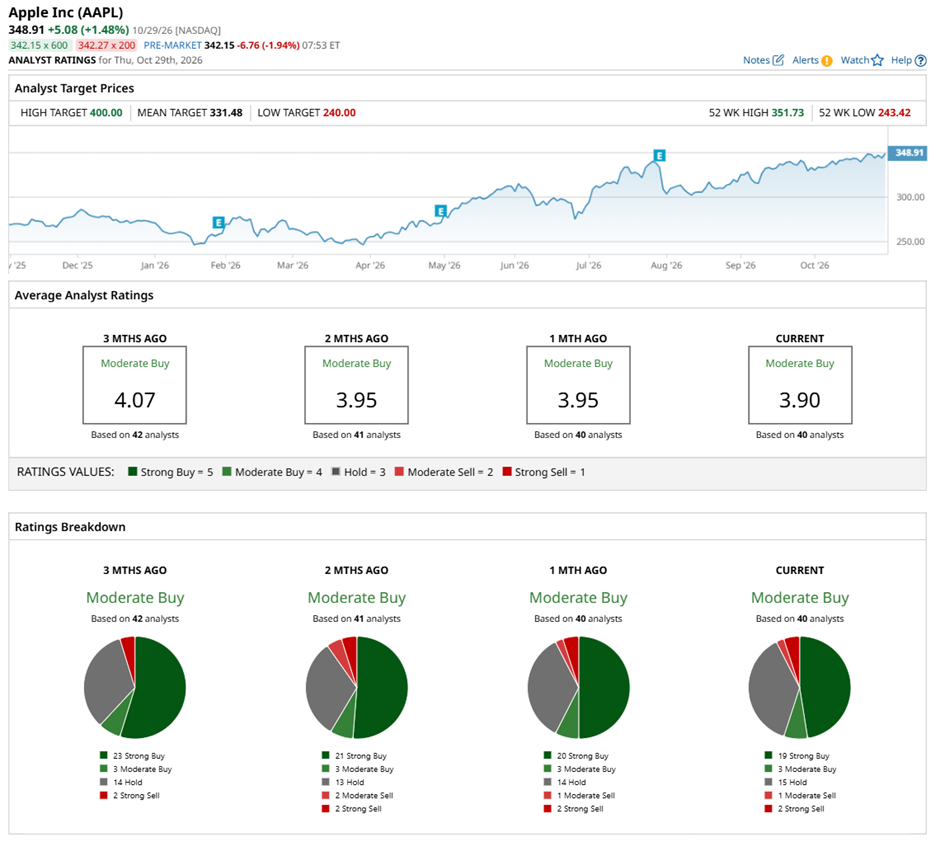
AAPL stock has a consensus “Moderate Buy” rating, reflecting a mix of optimism and caution on Wall Street. Among the 40 analysts covering the stock, 19 have issued a “Strong Buy” recommendation, while three rate it a “Moderate Buy.” Meanwhile, 15 analysts are playing it safe with a “Hold” rating. On the bearish side, one analyst recommends a “Moderate Sell,” while the remaining two are outright skeptical, advising a “Strong Sell” rating.
AAPL stock is already sitting comfortably above Wall Street’s average price target of $331.48, making it look like the market may have gotten a little too excited ahead of analysts. But the bulls are not backing down just yet. Dan Ives has raised his price target to a Street-high $400, implying another 14.6% upside from current levels. Clearly, some on Wall Street think Apple still has a few surprises left in the bag.
On the date of publication, Sristi Suman Jayaswal did not directly have a position in any of the securities mentioned in this article. All information and data in this article is solely for informational purposes. For more information please view the Barchart Disclosure Policy here.