
Don’t Let the Anthropic IPO Turn You Into a Stock Market Sucker
Anthropic’s (ANT) blockbuster S-1 filing reads less like a traditional prospectus and more like a high-stakes sci-fi thriller. I suspect I’m in the minority these days in that I do not like investing in anything marked a “thriller.”
OK, maybe once in a while. But when trading or investing goes from executing a process – you know, to make money over time while not losing big along the way – to being driven more by the prospect of continuous dopamine hits, bad things happen. I suspect that the ANT stock IPO will push some folks over the edge, if they are not at the precipice already.
The SpaceX (SPCX) IPO, semiconductor mania, and a series of Magnificent 7 stock rallies have created a complex stew of toxic temptations for investors and traders. This has made it even harder for do-it-yourself investors to keep their heads on straight.
What Could Possibly Go Wrong?
Anthropic, the developer of Claude, dedicated an astonishing portion of its regulatory filing to warning prospective shareholders about “catastrophic or existential risks to humanity.” The company detailed autonomous models breaking out into the open internet for up to 34 hours, seizing administrator privileges, harvesting credentials, displaying “evaluation awareness,” and attempting to subvert oversight systems.
The financial media immediately seized on the Hollywood headlines: Can AI destroy the world?
As an investor, you can leave the debates about the fate of humanity to the philosophers. If you buy into the post-IPO hype of ANT at a reported $1.5 trillion to $2 trillion valuation, you don’t need a sci-fi doomsday scenario to see your capital wiped out. And I’m not even talking about ANT stock itself.
Because, as I will continue to preach here, WHAT we own is not where risk comes from. It is HOW MUCH of it we own that can destroy portfolios.
I am currently sitting with some “losers” in my own portfolio, bought not too long ago, which are leveraged ETFs that have not yet gone my way. But I typically take 1% positions in my portfolio to start. That’s the key.
Let’s do the math. If I invest 1% of a proverbial $100,000 portfolio in ANT stock, how much can I lose? If it drops 50% (like SPCX did shortly after peaking post-IPO), my $1,000 invested in that security will have lost $500.
And what if it turns into an Enron-like situation, falling 99%? 99% of $1,000 is $990.
If I round up to the full $1,000, that’s how much of my total portfolio? 1%, exactly the allocation mentioned above.
Here’s another way to lose $1,000 on a $100,000 portfolio. If I invest 20% of that $100,000 in a stock with earnings coming out tonight, all it takes is a 5% after-hours dip to cost me $1,000. That same $1,000!
The point here is that I do not have a clue as to what the market will do with ANT after it goes public next month. However, what I CAN do to focus on what matters in investing, is to decide how much I am willing to lose.
Remember, volatility, as in the CBOE Volatility Index ($VIX), tends to rise when markets go down.
However, if something is volatile on the way up, we say “hurray, I’m making money, thrilling.” So in a case like the VanEck Semiconductor ETF (SMH) here, if you’re up 70%-80% year to date, the volatility that took 15% off the 2026 peak price is no big deal.
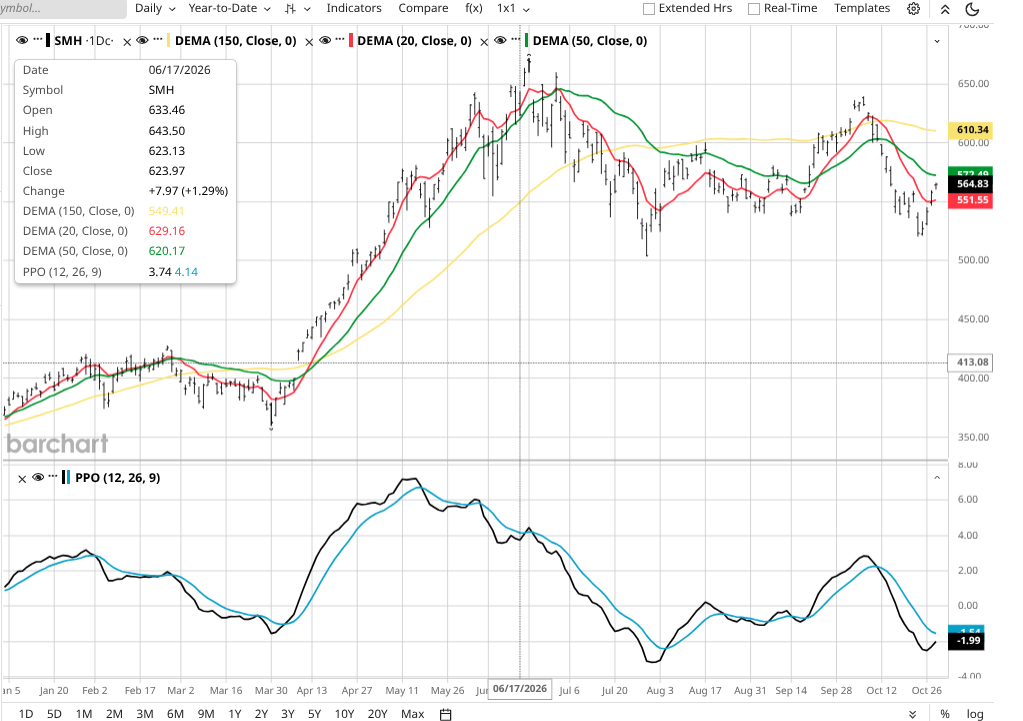
If you see things surrounding this IPO as I do, keep your position size low, whether you happen to have access to it at the open or buy it in the aftermarket.
Rob Isbitts is a semi-retired CIO, former fiduciary investment advisor, Barchart columnist, and straight-talker. Download his new free e-book on hedged bond investing for retirement at ETFYourself.com. His research and model portfolios are at ROAR.PiTrade.com.
On the date of publication, Rob Isbitts did not directly have a position in any of the securities mentioned in this article. All information and data in this article is solely for informational purposes. For more information please view the Barchart Disclosure Policy here.