
Changes in the Senate and House of Representatives have affected all sectors of the US stock market! Healthcare is difficult, clean energy is rising, and clean energy is fighting for policy dividends, AI infrastructure is tested by delivery and costs
The Zhitong Finance App learned that developments in the US midterm elections are becoming an important catalyst for the performance of various industries/sectors in the stock market compared to the general market benchmark. If the Democratic Party achieves strong election results, the clean energy and housing sector may be supported by policy expectations, while AI, data centers, and defense companies may face stricter supervision.
In anticipation of the Democratic Party sweeping the Senate and House of Representatives (the “Blue Congress”), the division within the healthcare sector of the US stock market is particularly prominent. Increased medical spending may support some healthcare-related businesses, but insurance plan reviews and drug price and fee regulations may also reduce the profit margins of related companies. The financial industry, on the other hand, is mainly facing a possible slowdown in the deregulation process or even an overall tightening of financial regulations under the leadership of the Democratic Party, while the crypto asset sector is more directly affected by the progress of legislation and corporate investigations.
This policy game is taking place in a context where the market is already clearly divided: the S&P 500 healthcare sector has accumulated a cumulative increase of more than 19% this year, reaching a record high, while the Philadelphia housing index fell close to 5% during the year. The former benefits from defensive funding, while the latter is still under pressure from interest rates and mortgage costs. Therefore, favorable policies brought about by elections require continued subsidies, improved financing, increased demand, or changes in profit margins before entering corporate valuation. Investors of the prediction platform Polymarket, as listed in a series of media reports on Monday, are betting real money on the probability that the Democratic Party will sweep both houses by about 72%, the Republican Party will hold the Senate, and the Democratic Party will win the House of Representatives about 23%, which means that the market is more concerned about the gap between actual results and current expectations, and the extent to which policies can advance after winning the election.
The US midterm elections are approaching, and various industries are preparing to deal with a major shift in policy
As the US midterm elections approach, the US business community is preparing to deal with possible changes in Washington's power pattern.
Analysts and strategists said that if the Democratic Party performs strongly, clean energy, housing and healthcare stocks may benefit, while companies corresponding to artificial intelligence, data centers, and defense stocks may be subject to stricter scrutiny by lawmakers.
According to Polymarket, the world's largest prediction market, the probability that the Democratic Party will sweep both houses of Congress is 72%, and the probability that the Republican Party will hold the Senate and the Democratic Party will win the House of Representatives is 23%.
The probability that the Republican Party will hold both the Senate and the House of Representatives is only 6%. Meanwhile, according to a Reuters and Ipsos poll, President Donald Trump's approval rating fell to the lowest level in his political career as voters worried about the cost of living and the war with Iran.
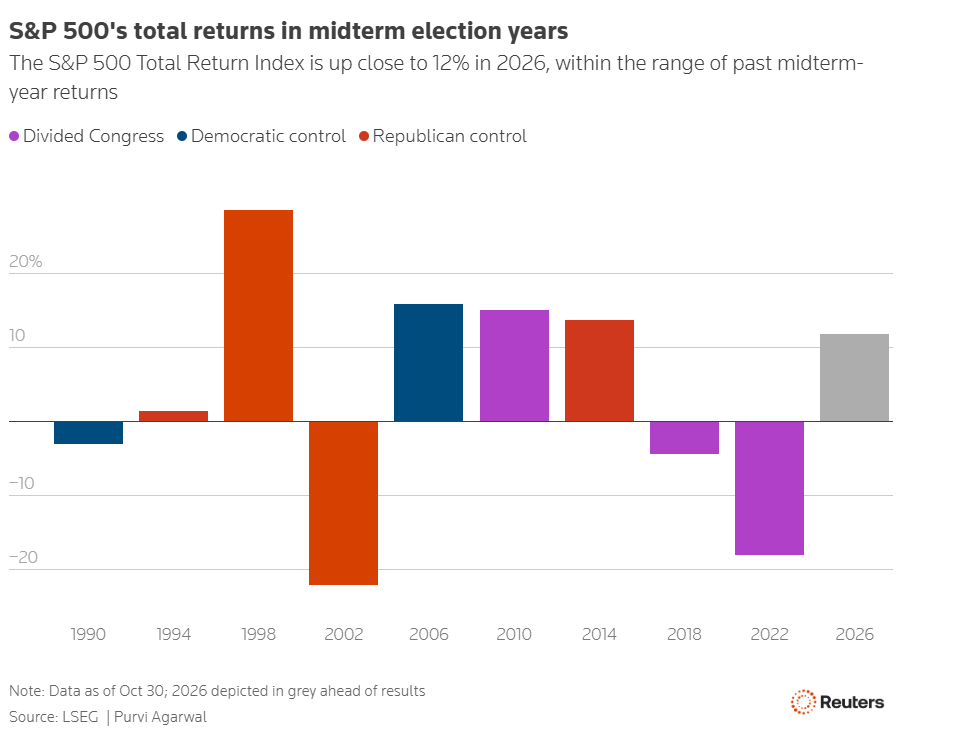
Even if both houses of Congress are bipartisan, it would give the Democratic Party more control over investigation and funding matters, but it would still have to overcome Trump's possible veto power.
As of November 2, Beijing time, the real money betting data of investors in the forecast market Polymarket showed that the implied probability of the Democratic Party winning control of the House of Representatives and the Senate was about 95% and 73% respectively; in the two-house combined market, the Democratic Party controlled both houses at the same time, while the Republican Party held the Senate and the Democratic Party won about 23% of the House of Representatives. These offers show that the Democratic Party's recapture of the House of Representatives is already a highly concentrated market expectation, and there is still more room for surprise in the Senate results.
The market impact of the current US midterm elections focused on three issues: how far the election results deviate from current expectations, whether AI data centers can be delivered on schedule, and whether fiscal policy is further driving up financing costs. The same election results may simultaneously improve the policy environment for AI companies, but increase supply pressure on long-term US bonds, so stocks, bonds, and the US dollar may not necessarily react in the same direction.
The US midterm elections usually do not cause sharp fluctuations in financial markets. However, the results of the November 3 election may have deepened investors' concerns about AI spending and debt ceiling negotiations; if the Democratic Party steps up scrutiny of companies, the election results may also have an impact on the US business community.
“Blue Congress” means that the Democratic Party controls both houses of the Senate and the House of Representatives at the same time. What Citigroup strategists emphasized in the “midterm election” strategic framework released on October 30 is exactly this kind of poor expectations — if the Republican Party unexpectedly stays in the Senate, the market may lower concerns about strengthened regulations and future corporate tax increases, providing a rebound catalyst for financial stocks and some AI computing power themes and semiconductor core assets; if the Democratic Party gains 53 seats or more, it may strengthen investors' judgment that it will continue to control the Senate in 2028 and further seek the leadership of the White House, prompting the market to adjust future profit growth expectations for technology stocks ahead of schedule.
Investors are closely watching the following industries:
The first is the potential beneficiary industry of the “blue wave”:
clean energy
Analysts said that the strong performance of the Democratic Party may reinforce market expectations that the federal government will continue to support clean energy development, benefiting companies such as solar manufacturer First Solar (FSLR.US), residential solar installer Sunrun (RUN.US), core inverter manufacturer Enphase Energy (ENPH.US), and clean power developer NextEra Energy (NEE.US).
The Democrat-controlled Congress passed the Inflation Reduction Act in 2022, investing hundreds of billions of dollars in climate and energy security measures, including expanding tax credits for renewable energy, nuclear energy, and electric vehicles.
UBS believes that under a divided government pattern, the two parties still have room to pass legislation to speed up approval of energy and infrastructure projects, and it is expected that nuclear energy will receive support from both sides.
The Democratic Party plans to review the Trump administration's move to relax emissions regulations, and may use the Congressional Review Act to overturn regulations that make gasoline-powered trucks and sports utility vehicles easier to sell.
Automakers Ford (F.US), General Motors (GM.US), and Stellantis (STLA.US), which have scaled back their electric vehicle plans and lobbied to relax regulations, may be under pressure.
home builder
UBS said the Trump administration will continue to implement the 21st Century ROAD Housing Act passed by Congress in late June to increase the supply of affordable single-family homes.
UBS said that if the Democratic Party gains control of both houses, it may increase measures to improve housing affordability, including restrictions on landlords in large institutions, but these measures will still face Trump's veto.
The Philadelphia Housing Index (.HGX) has fallen close to 5% this year as the outlook for rising interest rates and mortgage interest rates is putting pressure on the industry.
Sectors at risk under the “blue wave”:
Artificial intelligence and data centers
Analysts expect that the Democratic Party's majority will bring more scrutiny of artificial intelligence, which may put pressure on major AI data center key storage and memory-related technology companies, such as Micron Technology (MU.US), SNDK.US (SNDK.US), and Seagate (STX.US), whose stock prices have risen this year.
The slowdown in artificial intelligence and data center spending may also drag down semiconductor equipment manufacturers (leaders in semiconductor equipment such as Asmack, Fanlin, Ke Lei, and Applied Materials), power supply leaders, and key AI infrastructure hardware companies leading the AI data center construction process.
Once the Democratic Party has taken the majority of seats, it is more likely to use the power of subpoena to require technology company executives to swear evidence or submit records relating to harmful acts of artificial intelligence agents.
Additionally, voters in at least 10 states may vote on referendum bills that may impose new restrictions, licensing requirements, or suspension of data center development.
However, Société Générale said that the AI deal is likely to continue because the Democratic Party is unlikely to get a majority sufficient to overthrow Trump's veto, and key federal institutions are still controlled by the Republican government.
Certain segments of healthcare
If the Democratic Party sweeps both houses, the healthcare industry will face the prospect of both pros and cons. Increased scrutiny of Medicaid and Medicare Advantage plans may put pressure on insurance companies, but TD Cowan believes that the risk of major changes and extensive structural reforms in the industry is limited.
As investors turn to defensive sectors amid market fluctuations, the S&P 500 healthcare sector (.SPXHC) has risen more than 19% this year to a record high, second only to energy stocks in terms of performance.
The Democratic Party's control of the House of Representatives will increase the possibility of funding fiscal plans that include more health-care spending through tax increases.
Magdalena Ocampo, a market strategist at Xin'an Asset Management, said, “The Democratic Party's sweeping across both houses may provide a stronger impetus for measures targeting medical costs, consumer expenses, prescription drug pricing, and areas that are thought to exacerbate affordability issues.”
Defense and military industry
Defense stocks rose after Trump called in January to raise the military budget to $1.5 trillion, higher than the approved $901 billion, but have since recovered most of the gains.
The relevant budget vote is unlikely to take place before 2027. The Democratic Party's control of the House of Representatives may bring military spending back under scrutiny. Analysts pointed out that Congress has yet to disburse funds for multi-billion dollar contracts signed by large defense contractors to replenish inventories.
However, since the Iran conflict shows no sign of ending, US military leading industrial companies such as RTX (RTX.US) and Northrop Grumman (NOC.US) continue to see strong demand for weapons, driving their backlog of orders to historical records.
finance
A team of analysts at Morgan Stanley recently said in a research report that increased supervision after the victory of the Democratic Party may slow down the pace of regulatory relaxation, but it is unlikely to derail this process.
The last time the Democrat-controlled Congress made large-scale reforms to banking regulation was through the 2010 Dodd-Frank Act; the law tightened capital requirements, established consumer protection regulators, and imposed new transaction restrictions.
The Republican Party's greater control will help improve regulatory clarity and policy continuity. Barclays analysts said that maintaining a favorable environment for mergers and acquisitions and maintaining capital market activity is an important driving force for large banks' profits.
The quarterly results announced earlier this month by Wall Street's biggest financial giants, such as JPMorgan Chase (JPM.US), Citigroup (C.US), Goldman Sachs (GS.US), and Wells Fargo Bank (WFC.US), indicate that the boom in mergers and acquisitions and transactions driving record profits in the first half of the year may be slowing down.
cryptocurrencies
Analysts agree that the election is unlikely to have a significant impact on cryptocurrency prices, but it is likely to affect the speed at which cryptocurrency legislation progresses in Congress.
The Senate failed to advance the Clarity Act in September due to Democratic opposition. Analysts say that if the Democratic Party controls the Senate, it will be more difficult for the cryptocurrency bill to get back ahead next year.
Reuters previously quoted information revealed by people familiar with the matter as reporting that congressional Democrats are preparing to investigate cryptocurrency companies linked to Trump and his family, believing there is a potential conflict of interest in related transactions.
A lawyer told Reuters that this may bring negative news and legal risks to some listed companies in the cryptocurrency and blockchain industry.
From AI infrastructure to energy and defense: How can elections reshape costs, orders, and profit expectations?
As far as the AI industry chain is concerned, increased supervision may affect profit expectations along two paths: one is to raise compliance requirements around investigation of agent behavior, model security, and corporate responsibility; the other is to change data center operation time and costs through local approval, power grid construction, and community coordination. The latter affects computer room acceptance, chip deployment, and customer billing, which in turn is transmitted to order fulfillment from storage, semiconductor equipment, power, and thermal management suppliers.
Morgan Stanley's October public study summarized this trend as “conditional construction expansion”: AI investment continues to advance, but developers may need to bear more grid and energy costs and accept new tax and utility arrangements. The bank still predicts that the capital expenditure of hyperscale cloud vendors will reach 1.5 trillion US dollars in 2027, indicating that the expansion of investment scale and tightening construction conditions can occur at the same time.
As a result, clean energy, nuclear power, and power grid construction may be supported by energy policies and AI electricity demand at the same time, but different companies have different benefit mechanisms: solar equipment companies pay more attention to tax credits and project economics, nuclear power operators pay more attention to long-term power sales contracts, and power grid engineering companies pay more attention to approved projects and financial implementation. UBS believes that nuclear energy is still expected to receive support from both parties; the two parties may also discuss speeding up approval and requiring data center developers to bear more grid upgrade costs. The key investment idea that can be derived from this is that some of the additional costs may be transferred from residential electricity prices to AI developers, and at the same time create order opportunities for power infrastructure companies.
Defense, finance, and health care need to test the “demand-policy-cash flow” link separately. Defense companies have a large backlog of orders, and they still need to observe the pace of congressional funding and delivery; banks' mergers, acquisitions, underwriting, and transaction revenue depend on capital market activity, and increased supervision may not necessarily end business expansion; increased medical expenses can coexist with price constraints, and the overall rise in the industry cannot replace segmented profit analysis. Congressional investigations can be strengthened after changes in control, and major legislation is still subject to systems such as the presidential veto power. This also determines that the market may first trade sentiment and valuation, and then wait for actual policies and profits to be verified.