
After a sharp decline in technology stocks, UBS saw an opportunity to buy on dips: the market underestimated the AI supercycle, and 2027 may reach an inflection point in returns
Zhitong Finance App learned that after the US stock market NASDAQ 100 Index, which has the title of “global AI trading and technology stock weather vane”, evaporated more than $2 trillion in a single month in October, Gerry Fowler, chief European stock market strategist and derivatives director from UBS Group, said in an interview on Monday that after the recent decline in AI trading, the valuations of hyperscale cloud computing service providers seem attractive, because the AI supercycle reflected in the market's latest pessimistic pricing shows that it will last less time than is likely to actually last.
“When the overall valuation multiples of hyperscale cloud computing service providers such as Alphabet, Microsoft, and Amazon are already less than 20 times, and their revenue is still growing at a rate of 10% to 20% per year, this means that the market is taking a rather pessimistic view. As a result, I think the desire to buy these stocks again on dips is quite strong.” He said in an interview with the media on Monday.
Fowler said hyperscale cloud service providers may be nearing the point where their huge AI spending will begin to pay off. He believes there may be an inflection point in 2027, when data center deliveries will drive the fulfillment of backlog orders and revenue will begin to catch up with capital expenses. He added that the capital has not disappeared from the market, but has gone to the most core hardware vendors for AI computing power infrastructure, such as memory chip makers. These companies are now beginning to return funds to investors.
Big tech giants or cloud computing supergiants agree that huge capital expenditure (CapEx) data is mainly used to purchase AI chips, servers, and other capital expenses required to build large-scale AI data centers and traditional cloud computing as a whole; AI financing costs mainly include interest on loans, financing fees, etc., which are usually calculated separately from capital expenses, but a small portion of eligible construction period interest may have been capitalized and cannot be re-included in the total cost...
Google's parent company Alphabet announced last week that free cash flow was negative for the second consecutive quarter, exacerbating pessimism and anxiety about global AI trading topics. The Nasdaq 100 Index, which has a high weight in tech stocks linked to the AI theme, fell 3.5% on Friday, the biggest one-day decline since June.
However, according to Fowler, AI deals are beginning to expand beyond the first batch of data center beneficiaries. Many cable, power equipment, and other infrastructure suppliers focusing on the construction process in large-scale AI data have sold out their production capacity one after another until 2027 or even 2028, leaving room for profit forecasts to increase as a result. As the market is driven by unexpected changes in growth, he believes the next phase of this unprecedented AI bull trading trajectory must find growth drivers in other key areas.
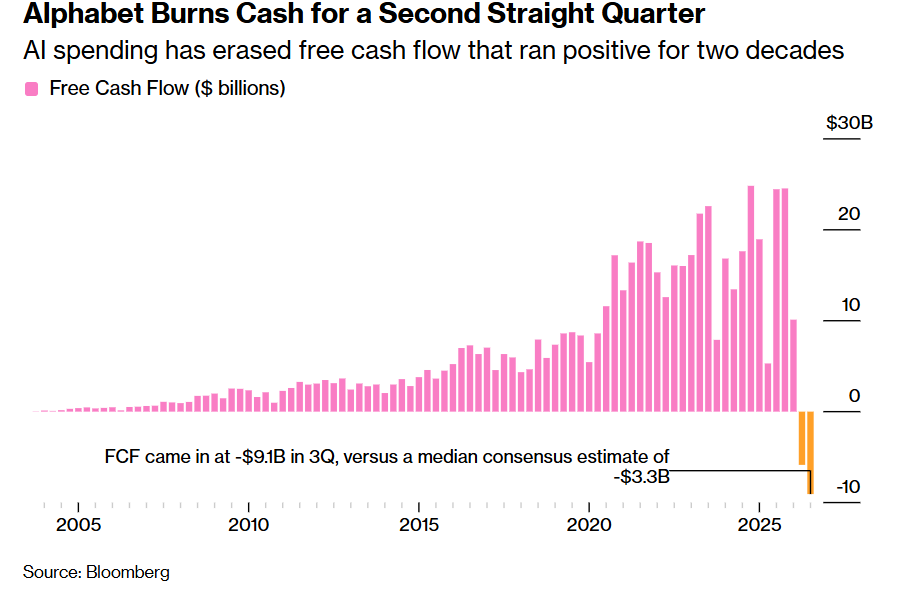
As shown in the chart above, Google's parent company Alphabet spent cash for the second consecutive quarter — spending associated with AI computing power infrastructure turned negative free cash flow, which had remained positive for 20 consecutive years.
Instead, he pointed out that key global and European industrial-type companies helping to build new plants are worth paying attention to. In the interview, he emphasized that lithography giant ASML.US (ASML.US) is an example: this company supplies the most critical semiconductor equipment — cutting-edge EUV or even high-NA EUV lithographs — to memory chip manufacturers such as Samsung Electronics and SK Hynix, which are expanding production capacity, rather than directly selling AI infrastructure-related hardware products to AI data centers.
“As a result, Asmack suddenly began receiving an increase in profit forecasts, and now this is also the case for quite a few key companies in the industrial sector in Europe and other regions.” he said.
Global technology stocks have suffered a severe setback: the market is repricing the waiting period for cash returns
Fowler from UBS's core bullish judgment on global AI computing power topics and a wide range of technology stocks is that recent market sell-offs may have underestimated the duration of the AI investment cycle. According to this European market chief strategist, the 2027 AI data center delivery wave is expected to drive backlog orders into strong revenue, and large-scale production expansion by memory chip manufacturers and chip manufacturing leaders such as TSMC may also transfer profit growth on a large scale to semiconductor equipment type industrial system suppliers such as Asmack, opening up a new investment direction for AI trading topics.
On October 29, the Nasdaq 100 Index and the Philadelphia Semiconductor Index fell by about 1.38% and 1.42%, respectively; thereafter, they fell sharply by 3.46% and 7.20% on the October 30 trading day. The NASDAQ 100 unexpectedly recorded its biggest one-day decline since June, while Intel plummeted by 28.58%, the worst single-day performance since 1974.
The credit market explains the source of pressure in this round of sell-offs. On October 15, CoreWeave's five-year credit default swap (CDS) spread broke through 1,100 basis points, and the yield on bonds due in 2031 once reached about 16%; Alphabet, Amazon, and Meta's default protection costs also reached record highs, but the increase was significantly less than CoreWeave. Funding is increasing the demand for AI payback speed and solvency.
Alphabet's free cash flow for the third quarter was negative at US$9.065 billion, for two consecutive quarters; Amazon's net free cash flow outflow for the past 12 months to the end of September was approximately US$42.4 billion. Google Cloud's revenue increased by 103% and AWS grew by 39.3% during the same period, which is enough to show that the market's controversy over AI transactions focused on whether strong demand can be converted into a timely cash return covering the investment. However, it should be noted that negative free cash flow increases external financing requirements, but it cannot be directly equated with operating losses or credit deterioration to the same extent as new cloud enterprises.
From data center delivery to storage expansion: AI market looks for the next round of profit growth
The 2027 inflection point proposed by Fowler has a clear industrial logic: only after the data center has completed power supply, server deployment and inspection, can the signed orders be converted to billable services; only when utilization is increased can there be an opportunity to improve return on capital.
Another key growth path is storage demand driving record production expansion in fabs, which in turn increases procurement of lithography, deposition, and etching equipment. Its investment focus is to look for predicted trends that have not been fully factored into optimistic profits and the pace of continuous expansion and growth, rather than simply deducing that there is still room for the same increase in stock prices based on full order schedules.
From the perspective of heavyweight AI inference workloads, the continuous back-office execution of the AI agent Muse, which has recently become popular around the world, and the improvement in the capabilities of the cutting-edge AI model Astra in complex computer tasks have expanded the scope of work that AI can handle; multi-step tasks, tool calls, and parallel agents may also increase model calls and context processing corresponding to each user. Anthropic has observed in its research system that multi-agent tasks use about 15 times more tokens than normal chats. What can be deduced from this is that with the full penetration of cutting-edge AI agents such as Muse, AI computing power requirements will spread along GPU computing, HBM and DRAM capacity bandwidth, KV cache and SSD storage, high-performance CPU tool execution, and high-speed data transmission systems based on optical interconnect chips; total resource requirements ultimately depend on the combined effects of increased task volume and improved unit task efficiency.
Looking at engineering logic, intelligent systems expand a question-and-answer session to planning, search, tool execution, and result verification. Multiple rounds of reasoning increase computational requirements. The management of the US semiconductor equipment giant Application Materials clearly stated earlier that smart applications urgently require AI accelerators such as AI GPUs and more CPU-intensive computing architectures, and significantly increase DRAM and NAND requirements over the long term to provide additional growth impetus for wafer manufacturing equipment. This is also why TSMC's third quarter revenue for the “King of Global Chip Foundry” is 46.72 billion US dollars, a significant increase over the previous year. 41.2%, gross profit margin 66.4%, and the total investment related to chip manufacturing equipment from 2026 to 2028 is expected to significantly exceed the previous three years.
Therefore, the semiconductor equipment side can be described as benefiting from the joint promotion of “demand for expansion of production” and “process upgrading”. The full-surround gate structure of advanced logic chips, high-rise 3D NAND, and HBM stacking and advanced packaging have raised the technical requirements for EUV or even high-NA EUV lithography technology, precision deposition, selective etching, chemical mechanical polishing, and defect control. Demand continues to grow, which may not only drive new production lines, but also increase the need to upgrade existing production lines.
Damo Wilson added this judgment from the market pace: the midterm elections, AI financing pressure, and liquidity constraints may first push the S&P 500 to 7,100 points, but they still look at 8,000 points after the risk is absorbed. He believes that the adjustment of enterprises between equity and debt financing will help them adapt to changes in capital costs; high-quality companies are more able to withstand this environment. According to Kobeissi's statistics, AI stocks fell more than 13% in October, and their “excluding AI” portfolio rose 8%, which also shows that capital is rotating. UBS's focus is on the length of the AI-related investment cycle, which was higher than the initial consensus. Wilson looked at adjusted entry opportunities. Together, the two focused on whether profits can overcome current financing pressure.