
How Tariff Refund Price Cuts Will Impact Costco (COST) Investors
- In October 2026, NationsBenefits announced a nationwide retail integration with Costco Wholesale that lets health plan members use NationsBenefits Flex Cards at more than 600 U.S. warehouses, with real-time, item-level benefit verification at checkout for eligible over-the-counter, healthy food, and wellness products.
- The earnings beat tied to tariff refund price cuts and Costco Wholesale’s plan to add 33 warehouses, alongside this new health benefits channel, indicates that management is focusing on sharper value and broader access rather than relying on new membership fees alone.
- We will now look at how Costco Wholesale’s tariff funded price cuts could shape the investment narrative that investors were already using.
Scan how Costco Wholesale’s health focused flex card tie up compares with other retailers by running your eye over the hand picked list of solid balance sheet and fundamentals (24 results)
Costco Wholesale Investment Narrative Recap
To own Costco Wholesale, you need to be comfortable with a model that leans on high membership renewal, warehouse expansion and tight cost control rather than big price markups. The near term swing factor is how effectively those tariff funded price cuts and the new flex card traffic translate into steady basket size and trips while membership growth sits at post COVID lows.
The most immediate risk still sits with slowing member additions and any knock on effect on membership fee income, alongside ongoing FX and regulatory scrutiny. The NationsBenefits integration looks additive but not transformational on its own for the overall P&L given Costco Wholesale’s US$303.2b in annual revenue.
The NationsBenefits Basket Adjudication Service rollout is the clearest operational tie in to the current Costco Wholesale story. It plugs health plan flex card balances directly into checkout across more than 600 warehouses, which can support incremental over the counter, healthy food and wellness spend without asking core shoppers to change how they pay.
This matters for catalysts because management is already leaning into warehouse openings, a stronger ancillary mix and digital channels. A health benefits payment stream layered on top of that could help productivity per warehouse and keep traffic resilient if discretionary categories soften. FX swings, membership trends and antitrust outcomes remain key watchpoints.
Costco Wholesale Analyst Assumptions in Focus
Analyst models around Costco Wholesale are built on a few clear pillars. Revenue is projected to rise by 7.6% a year over the next three years, with profit margins moving from 3.0% today to 3.2% by around 2029. Consensus earnings are set at US$12.2b in that year, compared with current earnings of US$9.2b. This implies an increase of roughly US$3.0b in annual profit if those estimates hold.
Those figures sit inside a valuation framework that assumes the retailer trades on a P/E of 47.4x in 2029, compared with 44.4x today and 18.1x for the wider US consumer retail group. Analysts also assume the share count stays broadly flat. As a result, any change in earnings would translate more directly into earnings per share rather than being diluted by new equity. The discount rate underpinning this set of numbers is 7.24%, which shapes how much weight is put on Costco Wholesale’s cash flows several years out versus income generated today.
On the revenue line, the consensus view implies Costco Wholesale could be generating US$377.5b of sales in 2029, with earnings at US$12.2b in that same year. These projections sit behind a cluster of price targets that indicate what analysts think the stock is worth if those profit and margin assumptions play out as expected.
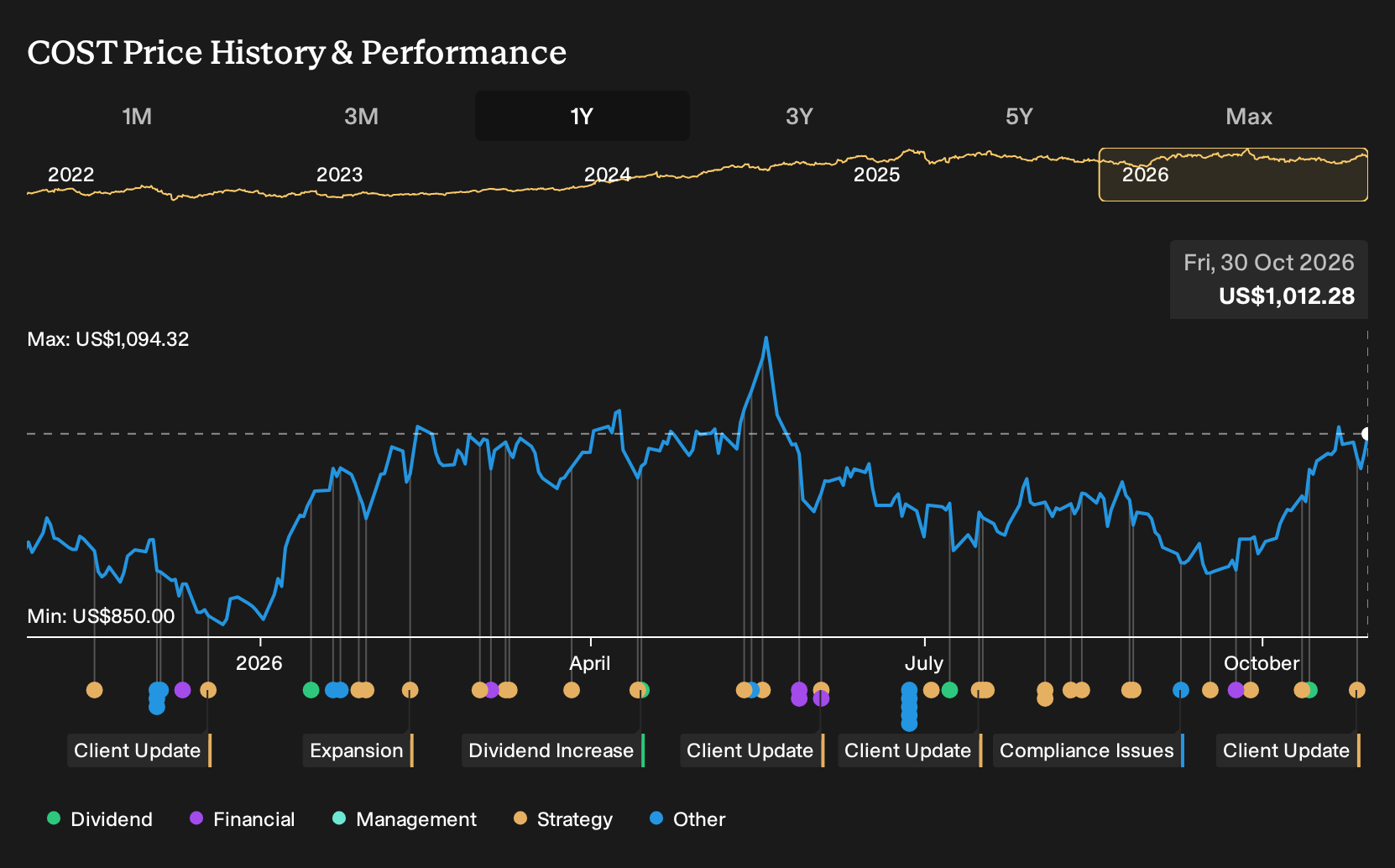
Forecasts are not uniform, however. The average target price sits at US$1,057.94 per share, with the most optimistic estimate at US$1,315.00 and the lowest at US$770.00. With the stock at US$924.59 as of early November 2026, that consensus target is 12.6% higher than the current quote. This shows how much weight the market places on the projected store rollout, digital growth and ancillary lines discussed earlier in the article.
Costco Wholesale's narrative points to forecast revenue of US$377.5b and earnings of US$12.2b by 2029. This is based on analysts assuming 7.6% yearly revenue growth and an earnings increase of roughly US$3.0b from current earnings of US$9.2b.
Uncover why Costco Wholesale's fair value indicates a 5% potential upside to its current price, a margin that could narrow quickly.
Exploring Other Perspectives
You might read this Costco Wholesale news and focus on one catalyst that bearish analysts treat very cautiously. They worry that slower membership growth caps fee income, which was tied to revenue of about US$365.1b and earnings of US$11.8b in 2029 before this deal. Their US$770.00 floor target shows how far opinions can spread, so treat this health benefits integration as a fresh reason to compare several viewpoints and decide which narrative feels closer to your own expectations.
Explore 12 other Costco Wholesale fair value estimates, including one that suggests as much as 45% downside from the current price!
Reach Your Own Conclusion
Disagree with existing narratives? Extraordinary investment returns rarely come from following the herd, so go with your instincts.
- A great starting point for your Costco Wholesale research is our analysis highlighting 2 key rewards and 1 important warning sign that could impact your investment decision.
- See our latest analysis for Costco Wholesale. The report includes a comprehensive fundamental analysis summarized in a single visual, the Snowflake, making it easy to evaluate Costco Wholesale's overall financial health at a glance.
Looking for more Costco Wholesale investment ideas?
If the Costco Wholesale story has you thinking about portfolio balance, it can help to compare this retailer with other businesses that have different risk, income and valuation profiles. The Simply Wall St screener lets you scan a wider field in minutes so you can pressure test whether Costco Wholesale still earns its place alongside other opportunities on your watchlist.
- For investors who want a focus on financial resilience, start by checking companies that appear on the 29 resilient stocks with low risk scores.
- If income is a priority and you care about cash returns today, review the 5 dividend fortresses to see which stocks currently offer higher yields.
- To broaden your opportunity set beyond well known large caps, look over the 19 high quality undiscovered gems and see which under followed businesses match your criteria.
Have feedback on this article? Concerned about the content? Get in touch with us directly. Alternatively, email editorial-team@simplywallst.com