
Does Rate Case Progress Change The Bull Case For Avista Stock (AVA)?
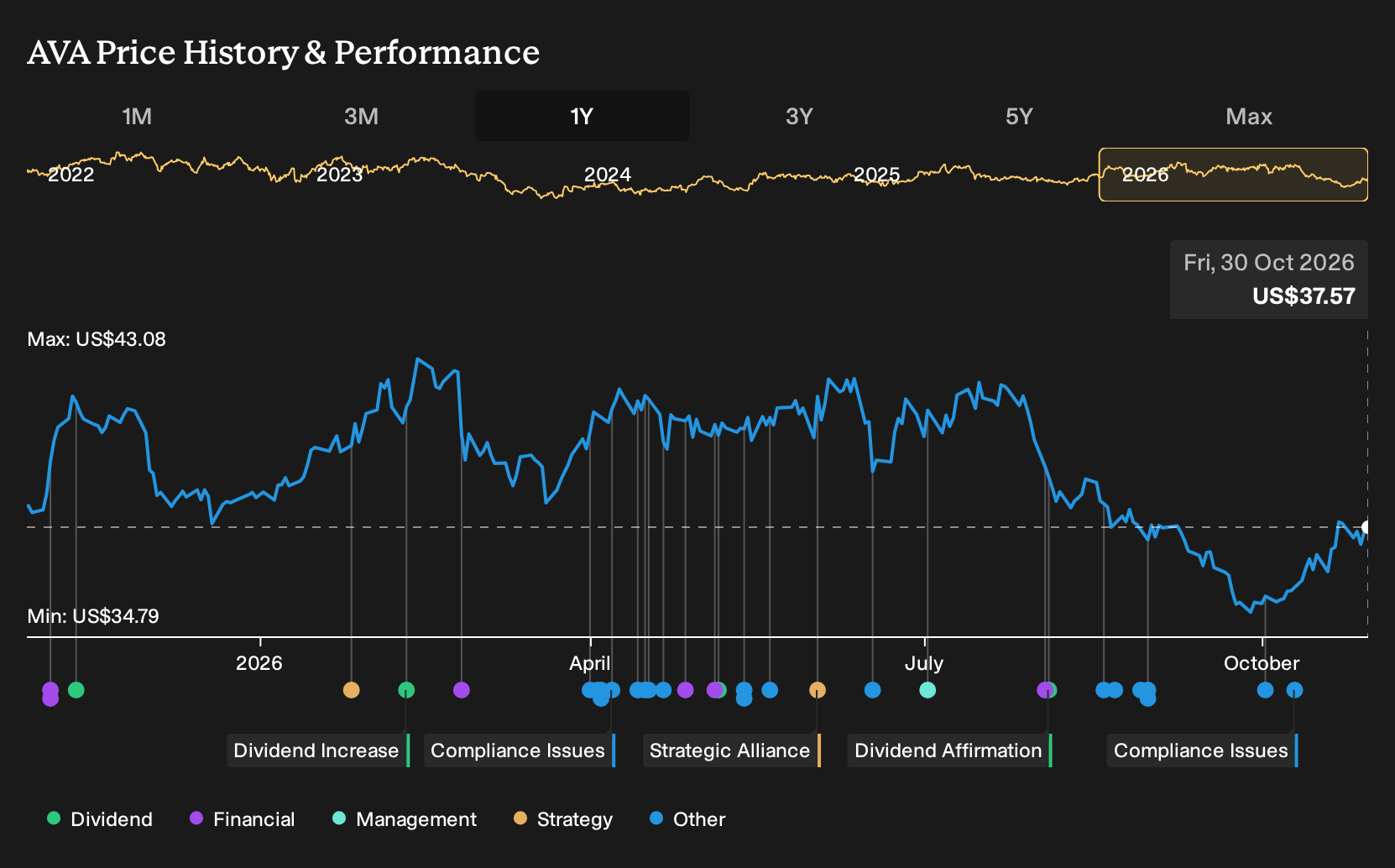
- Avista recently reported progress in its Washington electricity rate case, with regulators signaling support for most of the requested increase to fund regulated utility operations, dividends and grid investment.
- The advancing rate approval process directly affects Avista's ability to recover capital and operating costs, which shapes how sustainably it can support its current dividend and long term infrastructure plans.
- This review examines how Avista's investment narrative is affected by Washington's rate case progress and what that may mean for investors.
Scan regulated utilities that are benefiting from similar rate case momentum and yield stories as Avista, with a focused set of 5 dividend fortresses
Avista Investment Narrative Recap
To own Avista, you need to be comfortable with a regulated utility that leans on constructive rate frameworks, a heavy capital plan and a meaningful dividend. The Washington rate case progress directly ties into that story. Support for most of the requested increase helps in the short term by improving visibility on cost recovery and by reducing pressure on near term utility earnings.
The biggest swing factor right now is execution on the US$3.4b capital program for 2026 to 2030, plus wildfire and grid resilience spending, without eroding returns through higher funding costs. On the risk side, wildfire exposure and power cost volatility still threaten margins, and the recent news does not fully resolve those issues.
The most relevant development for this rate case backdrop is the shift toward longer general rate plans in Washington, with mechanisms such as cost deferrals and a higher long term utility return on equity expectation of about 9%. For Avista, that framework can reduce regulatory lag and make earnings from new grid projects more predictable if the allowed returns are actually achieved.
That matters when you connect it back to catalysts such as the large load pipeline of roughly 1,100 megawatts and the US$350m of potential incremental capital tied to those customers. If projects like the data center opportunity move ahead under these regulatory terms, investors can watch how quickly those assets move into rate base, how wildfire mitigation plans affect reliability, and whether dividend coverage and interest costs stay manageable through the funding cycle.
What The Avista Forecasts Assume
Avista's narrative projects US$2.2b in revenue and US$261.9m in earnings by 2029. Analysts are assuming revenue growth of 4.4% per year and an earnings increase of about US$34.9m from current earnings of US$227.0m, to reach that 2029 consensus level.
Uncover why Avista's fair value indicates a 10% potential upside to its current price that could close sooner than income investors expect.
Exploring Other Perspectives
One alternate angle on Avista focuses on weaker large project earnings. The most pessimistic analysts expected only 1.4% annual revenue growth to about US$2.0b and earnings of US$255.3m by 2029, before this rate case news. That view paints a slower path, so explore how your own expectations differ from both narratives.
Explore another Avista fair value estimate, including one that suggests as much as 6% downside from the current price.
Decide For Yourself
Disagree with existing narratives? Extraordinary investment returns rarely come from following the herd, so trust your own analysis.
- A great starting point for your Avista research is our analysis highlighting 4 key rewards and 2 important warning signs that could impact your investment decision.
- See our latest analysis for Avista. The report includes a comprehensive fundamental analysis summarized in a single visual, the Snowflake, making it easy to evaluate Avista's overall financial health at a glance.
Looking for more investment ideas beyond Avista?
If Avista has sharpened your thinking around regulated returns, income and balance sheet resilience, it can be useful to compare it with other opportunities using the Simply Wall St Screener.
- For investors who care most about resilient income and balance sheet strength, take a look at companies in the 5 dividend fortresses that combine higher yields with more robust financial profiles.
- If you want potential mispriced opportunities alongside Avista, scan the 36 high quality undervalued stocks to see which businesses the model highlights as quality available at a lower price.
- For a calmer experience through market swings, compare Avista with companies in the 29 resilient stocks with low risk scores that screen well on financial health and risk scoring.
Have feedback on this article? Concerned about the content? Get in touch with us directly. Alternatively, email editorial-team@simplywallst.com