
Prediction: Defense Stocks Like Lockheed Martin, RTX, and Boeing Are Set to Soar
Key Points
Fixed-price development contracts have challenged the defense sector in recent years, leading to significant losses for defense contractors.
An improving working relationship between the government and the defense sector is likely to derisk the sector, leading to share price appreciation.
Defense stocks have always relied on government spending for their revenue, and that's historically been a good thing. When buying defense stocks, investors trade off strong growth for a reliable, steady stream of income from defense spending. Unfortunately, that relationship has been challenged in recent years by the U.S. Department of Defense push for fixed-price development contracts for increasingly complex defense solutions.
However, based on the latest updates from Lockheed Martin (NYSE: LMT), I would argue there's clear evidence of a positive shift in the relationship, and that's great news for the company as well as other defense contractors like RTX (NYSE: RTX) and Boeing (NYSE: BA).
Missed Nvidia in 2009? This Rare Signal Is Flashing Again. In 2009, a "Double Down" signal flashed for a little-known chipmaker called Nvidia. For the first time in years, that same "Total Conviction" signal is flashing for a company 1/100th the size of Nvidia. Continue »
The defense sector is derisking
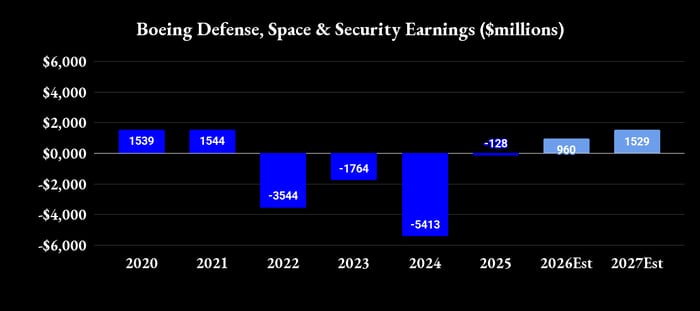
It's hard to understand the impact of these fixed-price development contracts on defense companies, and Boeing's defense business has arguably been the worst hit. To illustrate how problematic these contracts are, here's a look at Boeing's defense business (Boeing Defense, Space & Security, or BDS) earnings in recent years.
Image source: Getty Images.
As incredible as it might seem, the losses largely stem from a few fixed-price development contracts (including the KC-46 tanker, Air Force One, the MQ-25 drone tanker, and the T-7 Red Hawk trainer) that account for no more than 15% of BDS revenue. Management has previously noted that the rest of BDS is profitable, with the core business, representing 60% of revenue, having "mid- to high single-digit" profit margins.RTX recorded a $575 million charge in the second quarter of 2024 for the termination of a technically challenging fixed-price development contract with a foreign customer.
Meanwhile, Lockheed Martin took a $1.4 billion loss on a classified missile program in 2024and, in the same report, noted a cumulative $825 million loss on a highly complex fixed-price aeronautics contract.
Data source: Boeing presentations, chart by author. 2026 & 2027 Wall Street consensus from S&P Global Market Intelligence.
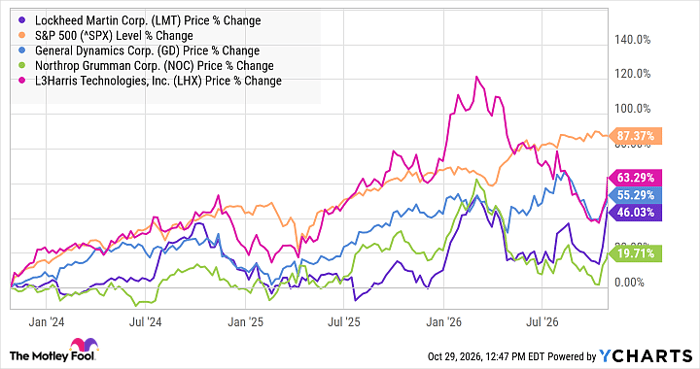
These issues have led to a somewhat confusing situation in which companies with heavy defense exposure (for reference, RTX and Boeing have the majority of their revenue and earnings in commercial aerospace) have underperformed the market even as defense spending has soared and geopolitical tensions have increased, accompanied by commitments by NATO allies to increase spending.
Why the environment is improving
The optimism over improvement for all three comes from different, but related angles. Starting with Boeing, it's taken a long time. Still, as you can see above, BDS is set to return to profitability in 2026 as it works through key milestones on the problematic programs and CEO Kelly Ortberg installs a new discipline in its estimate at completion (EACs). In fact, Ortberg believes the KC-46 Tanker (its most problematic contract) now "feels very low risk for the EACs going forward."
The case for RTX is based on the idea that it and Lockheed Martin are growing their backlogs in less-technically demanding, relatively mature missile programs.
Moreover, Lockheed Martin's management discussed the recent long-term agreements it made with the government over PAC-3 missiles and for 850 new F-35 fighter aircraft, with CEO Jim Taiclet outlining four key provisions it had secured for the agreements:
- Long-term agreements (seven years for missiles and 10 years for the F-35) that will ensure Lockheed and its suppliers can invest in and maintain employees with confidence over the long term.
- Inflation adjustments on the contracts in the form of an escalator, which includes an index based on defense industry costs rather than a general index.
- "Cash flow neutrality" provisions that allow the government to make advance payments so that Lockheed's initial capital spending doesn't result in cash outflows.
- A recovery mechanism whereby Lockheed can recover investments made to support, say, the production of A missiles or B aircraft, if a new administration comes in and decides to adjust the agreements downward to X missiles or Y aircraft.

Image source: Getty Images.
What it means to Lockheed Martin, Boeing, and RTX investors
The provisions that Lockheed secured in the new agreements signal a more mutually beneficial relationship between the Department of Defense and Lockheed Martin and, as a reliable signal, should also derisk future contracts for RTX and Boeing's BDS. As such, defense stocks could receive a valuation rerating in the coming years. That, combined with soaring backlogs, would send the stocks materially higher.
Lee Samaha has no position in any of the stocks mentioned. The Motley Fool has positions in and recommends Boeing, L3Harris Technologies, Lockheed Martin, Northrop Grumman, and RTX. The Motley Fool has a disclosure policy.