
Postal Savings Bank Of China (SEHK:1658) Posted Stronger Q3 Earnings, But Is The Stock Still Cheap?
Q3 earnings event puts Postal Savings Bank of China in focus
Postal Savings Bank of China (SEHK:1658) moved into the spotlight after its 30 October 2026 earnings release, which reported higher third quarter and nine month net interest income and net profit compared with a year earlier.
The latest earnings release appears to sit behind a clear shift in sentiment, with the 1-day share price return of 1.72% and 7-day move of 4.08% adding to a 90-day gain of 11.19% as investors digest stronger net interest income and profit. That near term momentum builds on a 1-year total shareholder return of 7.70%, and a very large 3-year total shareholder return of about 8x, signalling that Postal Savings Bank of China has already rewarded patient holders, while shorter term price action suggests interest is picking up again around the HK$5.615 level.
Scan how Postal Savings Bank of China’s earnings-driven move compares with other financials showing resilient balance sheets and steady profitability in our hand-picked 217 resilient stocks with low risk scores today.
Bulls point to Postal Savings Bank of China’s earnings progress and long run shareholder gains, while bears question how much of that is already in the HK$5.615 price. Which side does current valuation support?
Preferred Price-to-Earnings of 6.8x: Is it justified?
On Simply Wall St’s numbers, Postal Savings Bank of China trades on a P/E of 6.8x at a last close of HK$5.615, and that level screens as good value compared with its own history and the platform’s fair-value workup.
The P/E ratio links the current share price to earnings per share and, for a lender like Postal Savings Bank of China, it gives a quick read on how much investors are paying for each unit of profit the bank currently generates.
Postal Savings Bank of China is flagged as good value on a P/E of 6.8x versus a peer average of 8.3x. This points to the market applying a lower earnings multiple than similar companies, even though Simply Wall St’s model suggests the fair P/E for this stock is 7.1x. That tighter fair ratio indicates that the current valuation may converge toward that level if sentiment and fundamentals remain aligned with the model’s inputs.
Compared with the broader Hong Kong Banks industry average P/E of 5.1x, Postal Savings Bank of China trades on a richer multiple, so investors in this stock are currently paying a higher price for each dollar of earnings than the sector overall.
Explore the SWS fair ratio for Postal Savings Bank of China.
Result: Price-to-earnings of 6.8x (UNDERVALUED)
Still, the Postal Savings Bank of China story can change quickly if credit quality weakens or if funding costs shift and reduce that P/E support.
Find out about the key risks to this Postal Savings Bank of China narrative.
Another view on Postal Savings Bank of China’s value
The P/E discussion presents Postal Savings Bank of China as modestly cheap, while the SWS DCF model takes a far more aggressive stance. With an estimated future cash flow value of HK$11.14 versus a HK$5.62 share price, this approach frames the stock as heavily undervalued. Which analytical lens do you rely on when the signals diverge this far?
Look into how the SWS DCF model arrives at its fair value.
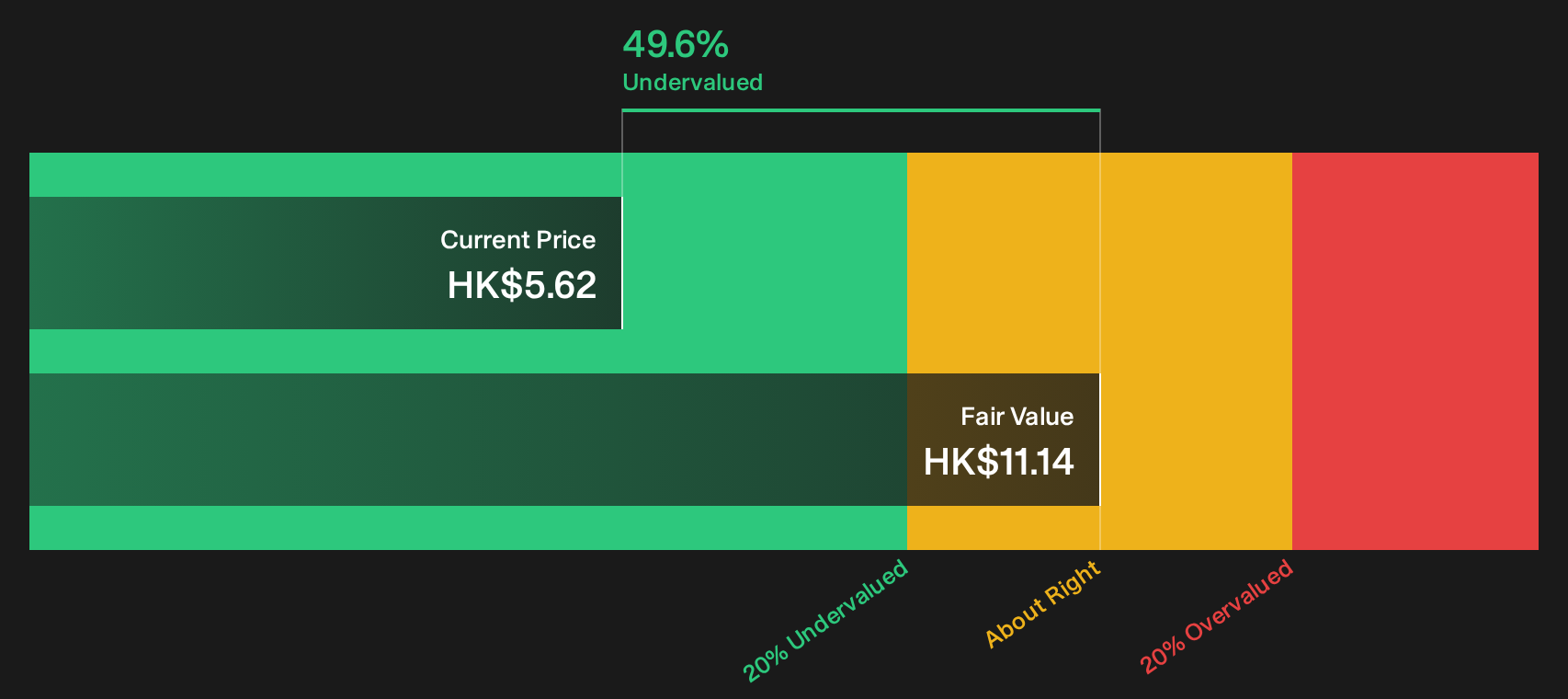
Simply Wall St performs a discounted cash flow (DCF) on every stock in the world every day (check out Postal Savings Bank of China for example). We show the entire calculation in full. You can track the result in your watchlist or portfolio and be alerted when this changes, or use our stock screener to discover 196 high quality undervalued stocks. If you save a screener we even alert you when new companies match - so you never miss a potential opportunity.
Next Steps
If this mix of rewards and risks around Postal Savings Bank of China feels finely balanced, do not just take the headline view. Weigh the numbers, factor in your own tolerance for both upside and downside, then stress test your thesis with the 3 key rewards and 1 important warning sign.
Looking for more investment ideas beyond Postal Savings Bank of China?
Do not stop your research with Postal Savings Bank of China. The next opportunity might sit just outside your current watchlist, and you will only spot it if you keep scanning fresh ideas.
- Target resilience first and focus on businesses that pair lower perceived risk with quality fundamentals through the 217 resilient stocks with low risk scores.
- Pursue value opportunities by searching for companies that combine solid financial quality with attractive pricing using the 196 high quality undervalued stocks.
- Strengthen your income plan and look for potential high yield payers with staying power via the 226 dividend fortresses.
Have feedback on this article? Concerned about the content? Get in touch with us directly. Alternatively, email editorial-team@simplywallst.com