
After plummeting more than 40%, it was once again bearish! Citi warns that the outlook for battery demand is deteriorating, and lithium prices will still be difficult to recover in the short term
The Zhitong Finance App learned that Citi lowered its lithium price target for the next two years due to concerns about slowing battery demand growth, rising trade uncertainty, and broader macroeconomic headwinds. Citi analysts, including Shreyas Madabushi, warned in a report that concerns about deteriorating demand for lithium next year have triggered a round of “lithium market reset” (lithium reset), and lithium prices will remain sluggish in the short term.
Citi said in the report: “As supply is expected to improve in 2027 and demand uncertainty rises further next year, consumers may delay procurement and maintain lean inventory. In the short term, market sentiment and positions are likely to continue to be the dominant factors, causing risk to remain biased downward.”
This means that after the lithium market has experienced the previous round of drastic adjustments, the key to whether prices can stabilize in the short term depends not only on changes in mining and refining production capacity, but also on when battery manufacturers, automobile manufacturers, and energy storage companies restart and replenish their stocks. If downstream enterprises continue to adopt prudent procurement strategies, industrial chain inventories may remain low, further suppressing price performance in the spot market.
Changes in automotive industry policies, trade barriers, and NEV subsidy policies may have a direct or indirect impact on lithium demand. Recently, plans surrounding restrictions on exports of Chinese hybrid vehicles to the European Union and other factors have heightened market concerns about demand for automotive batteries and large-scale energy storage systems. At the same time, the slowdown in global macroeconomic growth may also prompt consumers to delay the purchase of new energy vehicles and cause automobile manufacturers to adopt more conservative inventory strategies in battery procurement.
From the supply side, the market is gradually entering another critical phase. Previously, the lithium industry experienced large-scale expansion of production. As some new mines, salt lakes, and refining projects gradually release production capacity, supply growth may once again exceed the growth rate of demand. Goldman Sachs Group predicted last month that the lithium market will shift from a shortage of supply to a state of near balance this quarter, followed by an oversupply over the next two years.
If this judgment is implemented, the lithium market may shift from the logic of tight supply driving price increases in the past few years to a pattern of “supply growth+slowing demand” to jointly suppress prices. For producers, this means the importance of the cost curve will rise further, and high-cost mines and marginal projects may face greater profit pressure. For downstream battery companies and new energy vehicle manufacturers, falling lithium prices are expected to reduce battery raw material costs and improve profit margins to a certain extent.
Price performance already reflects a marked weakening in market sentiment. The most actively traded lithium carbonate contract on the Guangzhou Futures Exchange rose 1.2% to 91.16 million yuan ($13,710) per ton in early trading. However, the contract has accumulated a cumulative decline of more than 40% since the end of August.
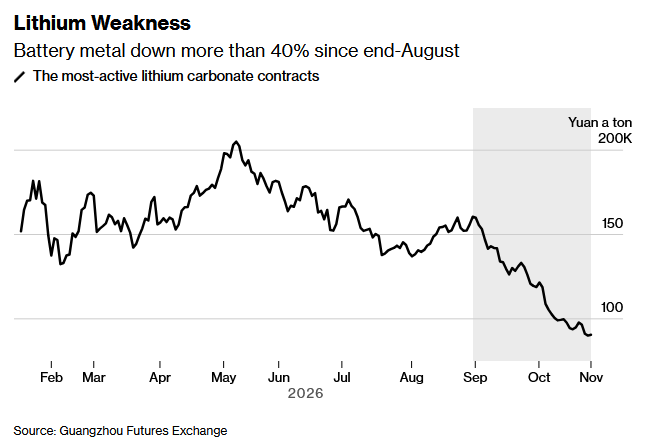
Lithium prices have fallen by more than 40% since the end of August
Citi lowered the price targets for lithium carbonate and lithium hydroxide for the next three months from 20,000 US dollars and 17,000 US dollars per ton to 12,000 US dollars, respectively, and also lowered the price forecast for spodumene from 2,000 US dollars to 1,200 US dollars per ton. The bank also lowered its forecast for these three battery raw materials until the end of 2028.
Citi's overall forecast reduction shows that the bank believes that the pressure on the lithium market may not be short-term fluctuations, but part of a readjustment of the supply-demand relationship. In particular, as the supply side continues to expand, even if the NEV and energy storage industries continue to grow, as long as the growth rate of demand is insufficient to absorb the new supply, lithium prices may still be under pressure for a long time.
However, the continued decline in lithium prices may also bring a new rebalancing mechanism to the market. As prices fall to levels where it is difficult for some high-cost producers to profit, mine production cuts, project delays, or capital expenditure cuts may gradually occur, thereby curbing future supply growth. If sales of new energy vehicles continue to grow, or demand for energy storage exceeds expectations, the relationship between supply and demand may tighten again and push lithium prices to bottom out and rebound.
Therefore, the core variables of the future lithium market will focus on two directions: on the one hand, sales of new energy vehicles in China and the world, actual demand for hybrid vehicles, and large-scale energy storage projects; on the other hand, the rate of release of new lithium mines, salt lakes, and refining production capacity around the world. At the same time, trade policies, inventory cycles, and producers' responses to the low price environment will also determine the duration and extent of lithium price adjustments.
In the current market environment, lithium prices may still face significant downward pressure in the short term, but if prices continue to fall below the cost affordability of producers, active supply-side adjustments may eventually become an important force in market rebalancing. For investors, what they need to focus on in the future is not only lithium prices themselves, but also global NEV sales, energy storage installations, industrial chain inventories, and production adjustments of major lithium producers.