
Does Earnings Beat Change The Bull Case For BP (LSE:BP.)?
- BP reported third quarter 2026 sales of US$67,857 million and net income of US$4,696 million, with higher basic and diluted earnings per share than a year earlier, alongside confirmed upstream production guidance for the fourth quarter and full year 2026.
- The board also affirmed an interim dividend of 8.660 cents per ordinary share for payment in December 2026, with no scrip alternative, which highlights BP's current preference for cash returns over share issuance.
- We will now see how BP's stronger third quarter earnings profile could influence the investment narrative that analysts had outlined earlier.
Scan how BP's earnings strength and cash dividend stance compare with other potential opportunities by reviewing our curated list of 14 high quality undervalued stocks.
BP Investment Narrative Recap
To own BP, you need to believe the current project pipeline, cost program and portfolio reshaping can keep turning its integrated model into resilient cash generation, even as headline earnings forecasts point to declines over the next few years. The third quarter beat on profits strengthens that story, but the biggest short term swing factor still sits in execution on large upstream projects and trading performance rather than this single quarter.
The main operational risk has not moved much with this update. There is still pressure around safety incidents, refinery reliability and the chance that low carbon and biogas assets see further impairments, which would weigh on returns. Management also flagged that underlying operating expenditure is not falling as quickly as planned, so inflation and complexity remain live headwinds.
The clearest link between the news and the existing thesis is the confirmed upstream production guidance for the fourth quarter and full year 2026. Reported upstream production is expected in the 2,090 to 2,230 mboe/d range for the quarter and 2,210 to 2,250 mboe/d for the year. Those volumes sit just below the 2025 level of 2,312 mboe/d, which keeps attention on how the project pipeline replaces barrels efficiently.
For a business that leans heavily on new fields in Brazil, the Gulf of Mexico, the Middle East and elsewhere, the guidance frames the near term production base that has to support dividends and any further balance sheet clean up. Strong third quarter earnings and the cash dividend decision help show current financial capacity, but the more important question for you is whether this production path and cost work leave enough room for acceptable returns if impairments and operating issues persist.
BP Consensus Assumptions and Valuation Check
BP's current analyst narrative hangs on a very specific set of numbers that you can use as a reference point rather than a forecast to blindly accept.
BP's narrative projects US$197.6 billion revenue and US$10.3 billion earnings by 2029. This assumes revenue declines by 2.8% per year and an earnings increase of about US$4.9 billion from US$5.4 billion today.
On the earnings side, the analyst group is effectively assuming that profit almost doubles over the next few years as margins widen from 2.5% today to 5.2% in 2029 on a smaller revenue base. That combination matters for you because it means the story is less about chasing top line expansion and more about pushing a higher share of every dollar of sales through to the bottom line.
The same consensus view also implies that BP's earnings climb to US$10.3 billion in 2029 while trading on a P/E multiple of 16.2x, compared with 23.7x today and a sector marker around 13.9x. Taken together, the picture is of a business that analysts treat as maturing into higher profitability, yet still priced at a premium to the broader GB oil and gas peer group on those projected numbers.
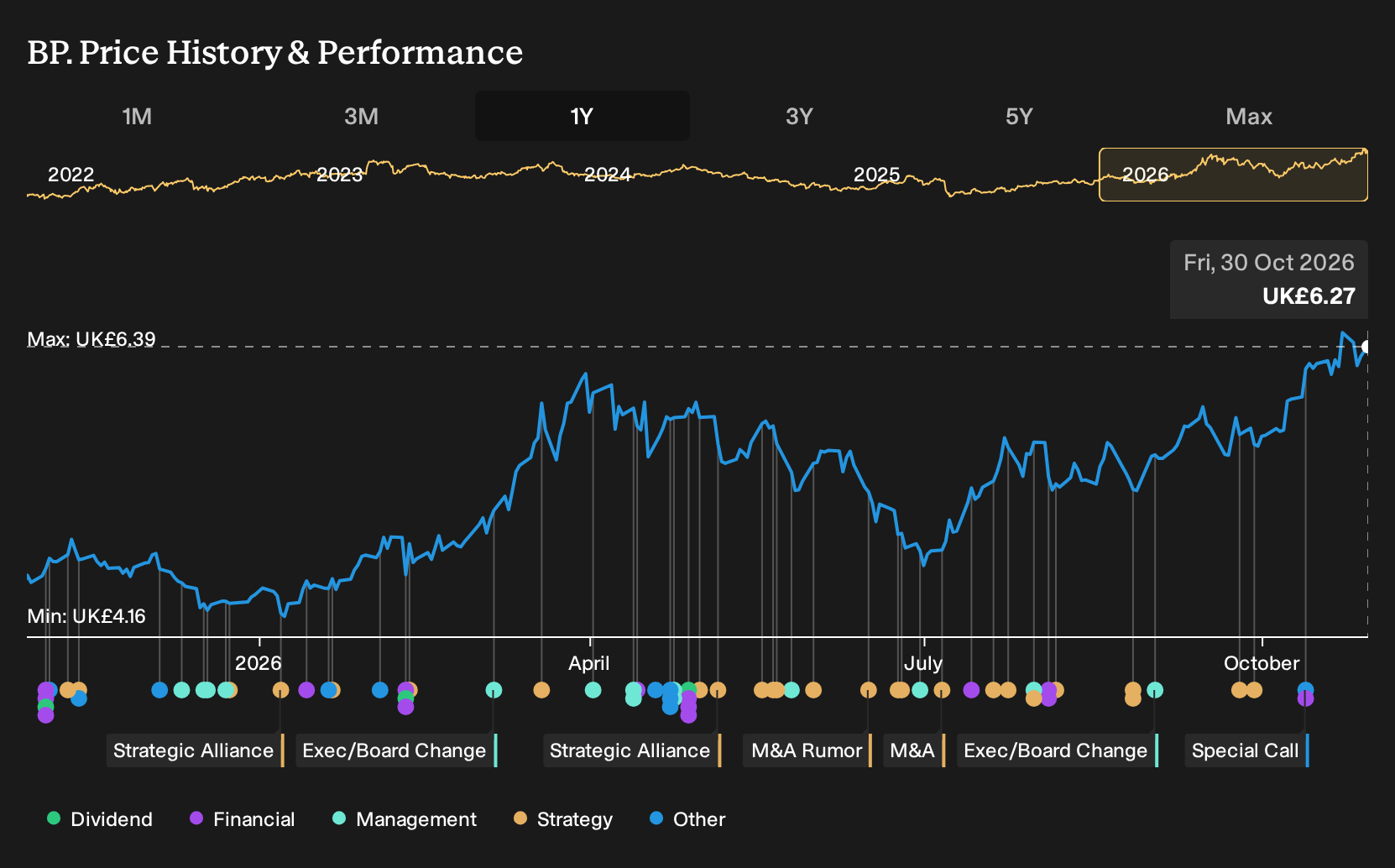
That framework puts the current share price of £6.23 almost on top of the average target of £6.42, a gap of just 3.0%. For you as an investor, that narrow spread suggests the market is already broadly aligned with the analyst base case for BP. Any change in your view will likely come from how you rate the probability of the margin expansion and earnings trajectory, rather than from a simple view that the stock looks obviously cheap or expensive on consensus alone.
Uncover how BP's fair value aligns with its current price.
Exploring Other Perspectives
Some analysts took BP’s old numbers much further, arguing that strong project reliability could justify revenue of about US$244.6b and earnings of US$12.4b by 2029. You now have a higher dividend in cash and firmer production guidance on the table. That may push these optimistic voices to rethink, and you can compare those assumptions with your own.
Explore 4 other BP fair value estimates, including one that suggests as much as 58% upside from the current price.
Decide For Yourself
Disagree with existing narratives? Extraordinary investment returns rarely come from following the herd, so trust your own analysis and judgment.
- A great starting point for your BP research is our analysis highlighting 2 key rewards and 3 important warning signs that could impact your investment decision.
- See our latest analysis for BP. The report includes a comprehensive fundamental analysis summarized in a single visual, the Snowflake, making it easy to evaluate BP's overall financial health at a glance.
Looking for more BP investment ideas beyond this stock?
If this BP update has sharpened your thinking and you want to pressure test that view against other companies, the Simply Wall St Screener can help you scan the market using the same kind of cash flow, balance sheet and risk filters.
- Prefer resilient businesses that aim to limit downside risk first? Start with a focused set of 5 resilient stocks with low risk scores that score well on financial strength and volatility.
- If dependable balance sheets matter most to you, filter for companies on our list of solid balance sheet and fundamentals (10 results) and compare how they stack up on debt, cash and profitability.
- Looking for under followed stories with solid fundamentals? Use the 5 high quality undiscovered gems to surface companies that may not be widely tracked yet still show robust metrics.
Have feedback on this article? Concerned about the content? Get in touch with us directly. Alternatively, email editorial-team@simplywallst.com