
How Tech Investments Will Impact Berkshire Hathaway (BRK.A) Investors
- Berkshire Hathaway has been increasing its technology exposure, including a 4% stake in Italian tech group Bending Spoons, while also deploying about $23.5b into equities after reporting strong earnings.
- The mix of a long standing Coca-Cola holding that now generates about $848m in annual dividends and new tech focused positions shows Berkshire Hathaway leaning on both legacy cash generators and fresher AI related themes without changing its core earnings drivers.
- We will now look at how Berkshire Hathaway’s expanding technology exposure may reshape the existing investment narrative around its diversification.
Scan how Berkshire Hathaway’s blend of steady dividend payers and fresh AI exposure compares with other potential opportunities in our curated list of 19 high quality undiscovered gems.
Berkshire Hathaway Investment Narrative Recap
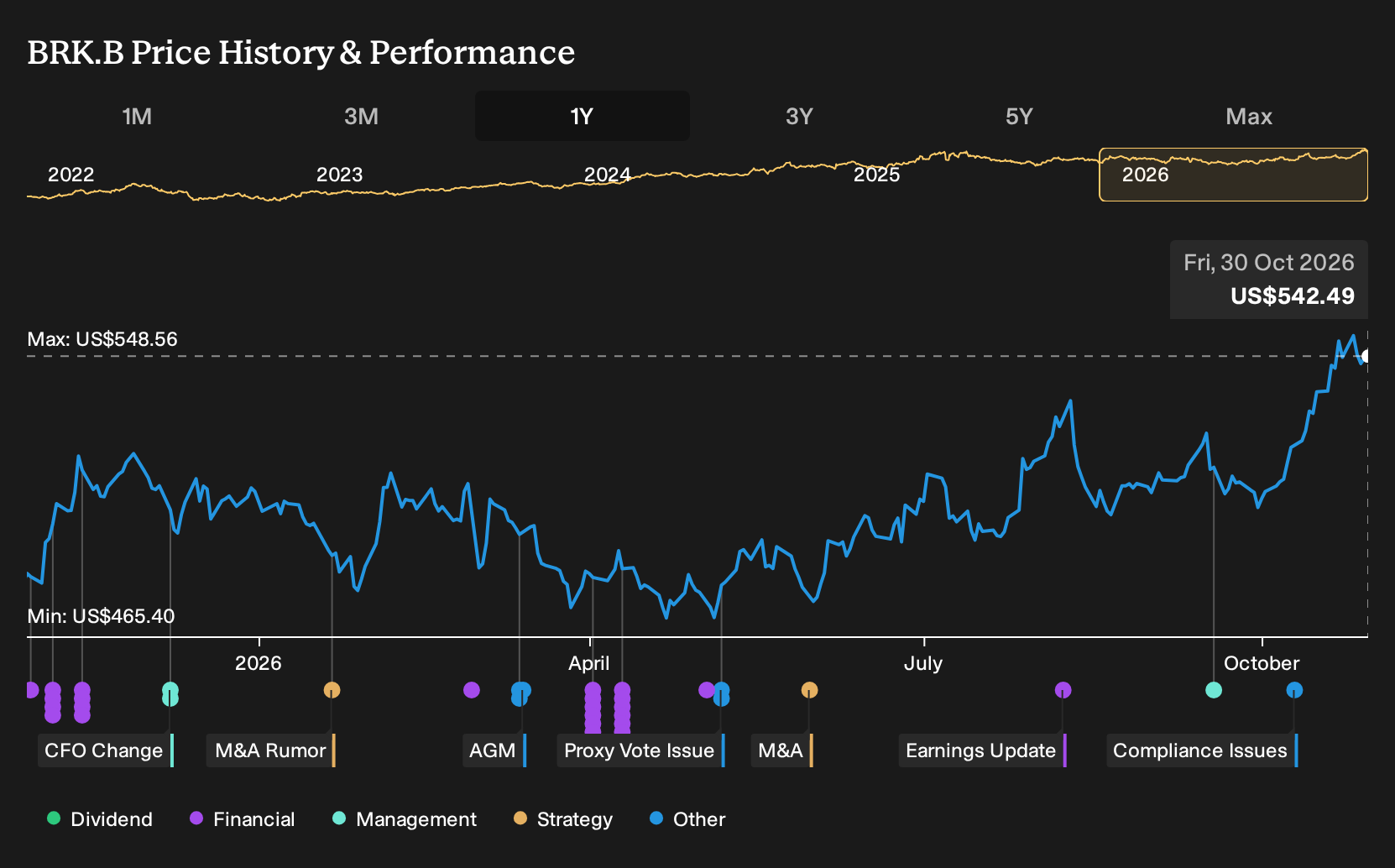
To own Berkshire Hathaway, you need to be comfortable with a conglomerate whose engine is still insurance, rail, energy, and a concentrated equity book, even as it adds more technology exposure. The recent stretch where Berkshire climbed while chip stocks fell looks more like a sentiment quirk than a shift in how the group earns money. It does not materially change the near term story.
The key short term swing factor remains how well Berkshire deploys its large cash position after becoming a net buyer of about US$23.5b in equities. The biggest risk is confidence around the leadership transition to Greg Abel and future capital allocation, especially if data center or utility growth or large equity stakes run into political or regulatory pushback.
The fresh 4% stake in Italian tech group Bending Spoons is the clearest operational tie in to the recent move to treat Berkshire Hathaway as a defensive way to gain some AI exposure. This is still small against a roughly US$1.16t market value, so portfolio earnings are not transformed by this single position.
It does, however, sit alongside the long held Coca Cola investment, the Alphabet stake and Japanese trading houses. Together these give Berkshire a mix of steady dividends and indirect links to AI and global trade. For you as a shareholder, the practical questions are execution on these holdings, any volatility they introduce, and how comfortably management can balance them with housing, utilities and insurance catalysts.
Berkshire Hathaway Analyst Expectations In Context
Berkshire Hathaway's analyst narrative leans heavily on a detailed set of assumptions that tie its old economy cash engines to newer technology exposure, without treating the tech tilt as the main driver of future results. The forecasts you see around utilities, insurance, housing and the equity portfolio are all bundled into a single earnings path that analysts use to frame where the stock might be by the end of this decade.
Consensus estimates link that story to specific numbers. Analysts are working off a view that total revenue can grow at 5.3% a year over the next few years while profit margins shrink from 22.3% today to 11.8% by around 2029. In practical terms, that means the top line is expected to rise, yet a thinner slice of each sales dollar would flow through to profit, which partially offsets the benefit of revenue growth when you think about Berkshire Hathaway as a long term holding.
Earnings expectations pull in the various moving parts investors focus on, from data center related power demand to housing exposure and large equity positions. The consensus view has earnings at US$85.8b today and US$53.1b by about 2029, which implies a decline of roughly US$32.7b over that period even as revenue is forecast to expand. That tension between a growing business footprint and lower projected profit reflects the assumption that pricing, mix, and reinvestment needs could weigh on profitability.
On top of that, analysts are assuming the share count edges down by about 0.77% each year for the next 3 years as Berkshire Hathaway continues to buy back stock. A lower share base can support earnings per share even when total profit is under pressure, which is one reason some investors still look at Berkshire as a patient compounding vehicle tied to disciplined capital allocation, rather than a pure earnings growth story driven by AI or any single sector.
Valuation expectations build another layer. The consensus has Berkshire Hathaway trading on a P/E of 12.7x today and needing to reach 26.1x on those 2029 earnings of US$53.1b for the current analyst price target to line up with the model. That future multiple is higher than the current 17.2x P/E seen across the US diversified financial peer group, so anyone relying on these scenarios is implicitly assuming that investors are comfortable paying more for each dollar of Berkshire earnings in a few years than they do for similar businesses right now.
Analysts fold those cash flow paths into a current value using a discount rate around 7.5%. That rate acts like the hurdle you would require to compensate for the timing and risk of the future earnings stream, and it influences how heavily late decade profit, including from tech exposed assets and legacy holdings, really matters for someone considering the stock today.
Berkshire Hathaway's narrative projects US$448.5b revenue and US$53.1b earnings by 2029. This rests on 5.3% yearly revenue growth and assumes earnings move from US$85.8b today to US$53.1b, a decline of about US$32.7b over that period.
Uncover why Berkshire Hathaway's fair value is essentially aligned with its current price.
Exploring Other Perspectives
Four fair value estimates from the Simply Wall St Community cluster between about US$799,503 and US$1,186,948, which leaves Berkshire Hathaway looking cheap to some members and stretched to others. When you set that spread against leadership succession risk and possible pushback on data center growth, it becomes clear opinions differ sharply. Explore those alternative views before deciding where you sit.
Explore 3 other Berkshire Hathaway fair value estimates, including one that suggests it could be worth just $799503.
Reach Your Own Conclusion
Disagree with existing narratives? Extraordinary investment returns rarely come from following the herd, so go with your instincts.
- A great starting point for your Berkshire Hathaway research is our analysis highlighting 3 key rewards and 1 important warning sign that could impact your investment decision.
- See our latest analysis for Berkshire Hathaway. The report includes a comprehensive fundamental analysis summarized in a single visual, the Snowflake, making it easy to evaluate Berkshire Hathaway's overall financial health at a glance.
Looking For More Investment Ideas Beyond Berkshire Hathaway?
Once you have built your own view on Berkshire Hathaway, it can help to line it up against other listed businesses with different income profiles, balance sheet strength, or risk levels. The Simply Wall St Screener lets you do that side by side so you can see where this conglomerate fits in your wider watchlist.
- If you want income to do more of the work for you, check out a group of higher yielding payers in our 5 dividend fortresses.
- If resilience matters more than rapid growth, compare Berkshire Hathaway with companies in our 29 resilient stocks with low risk scores that score well on stability metrics.
- If you are hunting for under followed opportunities with solid fundamentals, line up Berkshire against the stocks in our 19 high quality undiscovered gems.
Have feedback on this article? Concerned about the content? Get in touch with us directly. Alternatively, email editorial-team@simplywallst.com