
UniFirst (UNF) Raises Dividends As Investors Ask If The Stock Is Already Fully Valued
UniFirst (UNF) just put fresh attention on its shareholder payouts. The board approved higher quarterly cash dividends on both Common and Class B shares, following its late October earnings release.
UniFirst’s latest dividend move comes after a mixed period for the shares, with the 7-day share price return down 9.40% and the 90-day share price return down 13.02%. At the same time, the year-to-date share price return is up 31.63% and the 1-year total shareholder return is 66.12%. This suggests that long-term holders have been rewarded, while short-term momentum has cooled.
Scan beyond UniFirst and see how other companies with solid dividend stories and established operations stack up using our curated list of list of solid balance sheet and fundamentals (25 results).
UniFirst now trades at a mid single digit discount to both analyst targets and some fair value estimates, even after the dividend bump and softer earnings. Is that a cautious market overreacting, or a reasonable price for slower profit progress?
Most Popular Narrative: 7% Undervalued
On Simply Wall St's most followed thesis, UniFirst screens as modestly undervalued, with a fair value of $273.33 against a last close of $254.84. That gap rests heavily on execution of its long running upgrade and integration plans.
The main thing that has to go right is that UniFirst converts its heavy ERP and sales and service investments, along with the planned Cintas integration, into better profitability over time despite current cost and tariff headwinds.
UniFirst’s current valuation and this narrative’s fairly valued, bullish stance together imply that the share price already reflects meaningful long term benefits from digital transformation, higher organic growth and the proposed Cintas merger synergies.
See why 2 investors see UniFirst as 7% undervalued.
Result: Fair Value of $273.33 (UNDERVALUED)
Still, the UniFirst story leans heavily on smooth ERP execution and planned Cintas synergies. Delays, higher costs or weaker benefits could quickly challenge this upbeat case.
Find out about the key risks to this UniFirst narrative.
Another View: UniFirst Looks Pricey On Earnings
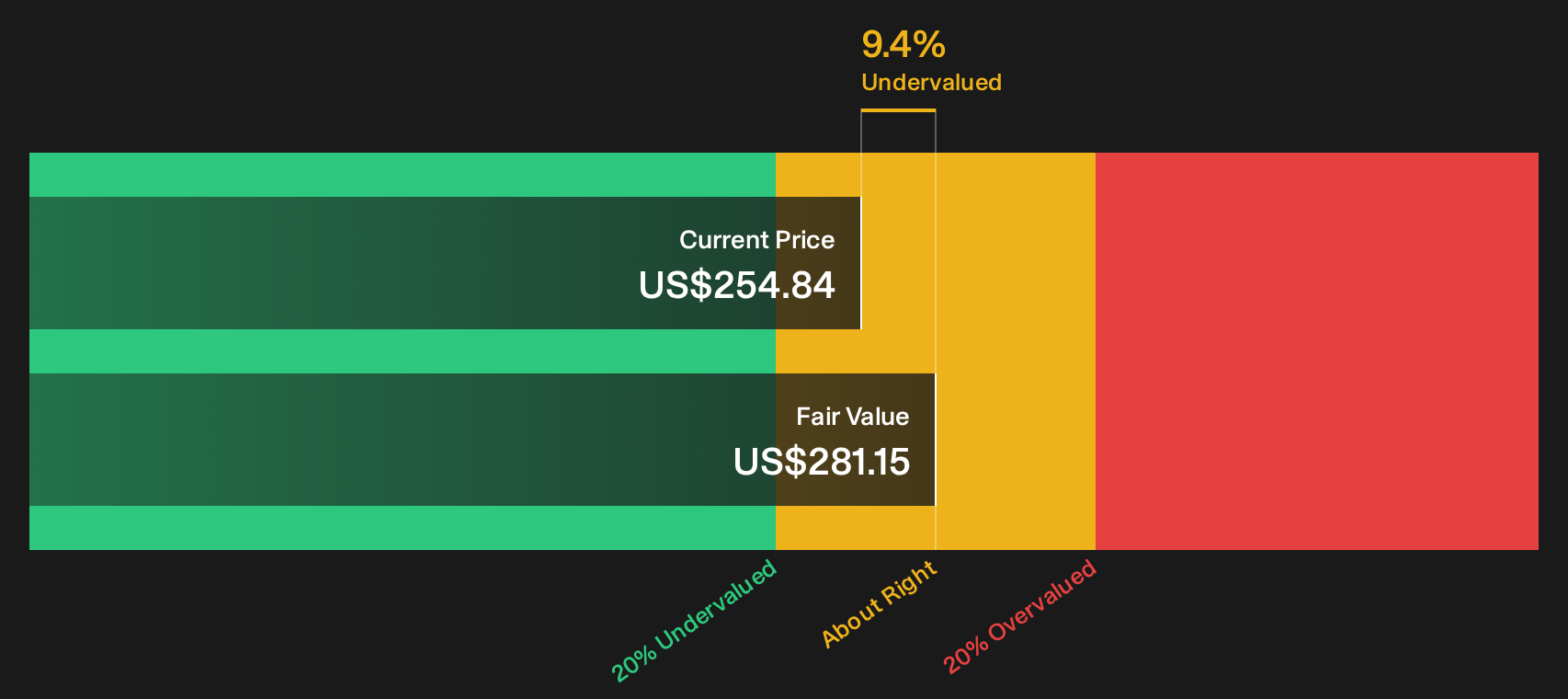
While the SWS DCF model suggests UniFirst trades about 9.4% below future cash flow value, the P/E story cuts the other way. The stock changes hands at 42.1x earnings against a fair ratio of 20.5x, and above both peers at 28.7x and the Commercial Services industry on 19x. Is the market paying up too far for an execution story that still has moving parts?
Investors who want to pressure test this earnings based view against cash flow assumptions can review how the SWS DCF model treats UniFirst’s future cash generation in detail. They can then decide which lens feels more realistic for their own portfolio construction. Look into how the SWS DCF model arrives at its fair value.
Next Steps
Plenty in this UniFirst story cuts both ways, with execution hopes set against clear pressure points. To weigh that mix for yourself, start with the 2 key rewards and 1 important warning sign.
Looking for more UniFirst sized investment ideas?
Do not stop with UniFirst. Use the Simply Wall St screener to hunt for fresh opportunities that fit how you like to build a portfolio.
- Target resilience by focusing on businesses with strong finances and durable operations through our list of solid balance sheet and fundamentals (25 results).
- Pursue value by zeroing in on quality companies that trade below their estimated worth using the 29 high quality undervalued stocks.
- Broaden your watchlist by reviewing a curated set of lesser known opportunities with solid fundamentals through the 18 high quality undiscovered gems.
Have feedback on this article? Concerned about the content? Get in touch with us directly. Alternatively, email editorial-team@simplywallst.com