
Does Improved Earnings Change The Bull Case For Randstad Stock (ENXTAM:RAND)?
- Randstad reported third quarter 2026 sales of €6,115 million and net income of €110 million, with higher basic and diluted earnings per share from continuing operations than a year earlier.
- Over the first nine months of 2026, Randstad’s sales reached €17,525 million and net income €258 million, which may matter for views on efficiency, pricing power, and client demand across its HR services portfolio.
- We will now look at how Randstad's higher earnings per share could influence the existing investment narrative built around digital delivery.
Scan how Randstad’s higher earnings per share compares with other staffing and HR-linked stocks by reviewing our hand picked list of solid balance sheet and fundamentals (203 results).
Randstad Investment Narrative Recap
To own Randstad, you need to believe that its mix of digital platforms, large enterprise contracts and regional exposure can turn a fairly cyclical staffing model into steadier earnings. The latest quarterly numbers show higher earnings per share alongside only modest sales movement, which points you toward efficiency and mix rather than volume as the near term story.
The key short term swing factor is whether digital and centralized delivery keep offsetting temp gross margin pressure and a relatively high tax rate. If client demand softens further in higher value permanent and professional roles, that margin equation could become tougher. The earnings beat alone does not remove that risk.
Among recent information, the most relevant piece for this update is the Q3 2026 earnings release itself. It ties directly into the existing catalyst around digital delivery, because higher basic and diluted EPS from continuing operations came alongside only slightly higher revenue for both the quarter and the nine month period.
That gap between top line and earnings leads you to focus on operating costs, productivity and business mix as the practical near term levers. For your own thesis, the question is whether Randstad can keep squeezing more profit out of broadly similar volumes without further temp gross margin erosion or a persistently higher effective tax rate eating into the benefit.
What The Randstad Analyst Scenarios Assume
Randstad's narrative projects €25.1 billion revenue and €571.5 million earnings by 2029. This implies 2.5% yearly revenue growth and an earnings increase of about €231.5 million from €340.0 million today.
Analysts are effectively baking in a world where Randstad keeps leaning on its digital delivery engine, yet does so with only low single digit top line expansion each year. The 2.5% annual revenue growth assumption is not especially punchy for a global HR group, so the bigger swing factor in the model is the shift in profit margin from 1.5% today to 2.3% by 2029.
That jump in profitability would take earnings from €340.0 million today to €571.5 million on those projected revenues, with the consensus view sitting between bullish forecasts of €727.1 million and more cautious estimates of €428.4 million. The spread between those bookends indicates there is genuine disagreement about how much of the digital and large client story will translate into bottom line power.
To support the current analyst targets, the stock would also need to move from a P/E of 21.0x today to 14.2x on the 2029 earnings estimate. For context, that future multiple is below the cited 18.9x for the GB Professional Services industry. The scenario therefore combines higher profit with a lower valuation multiple rather than assuming investors keep paying the same premium.
On the revenue side, the consensus case pins 2029 sales at €25.1 billion with only a slight increase in the share count, as analysts model 0.13% yearly growth in shares outstanding. That modest dilution means most of the earnings uplift in the scenario would need to come from higher margins and mix, not from financial engineering.
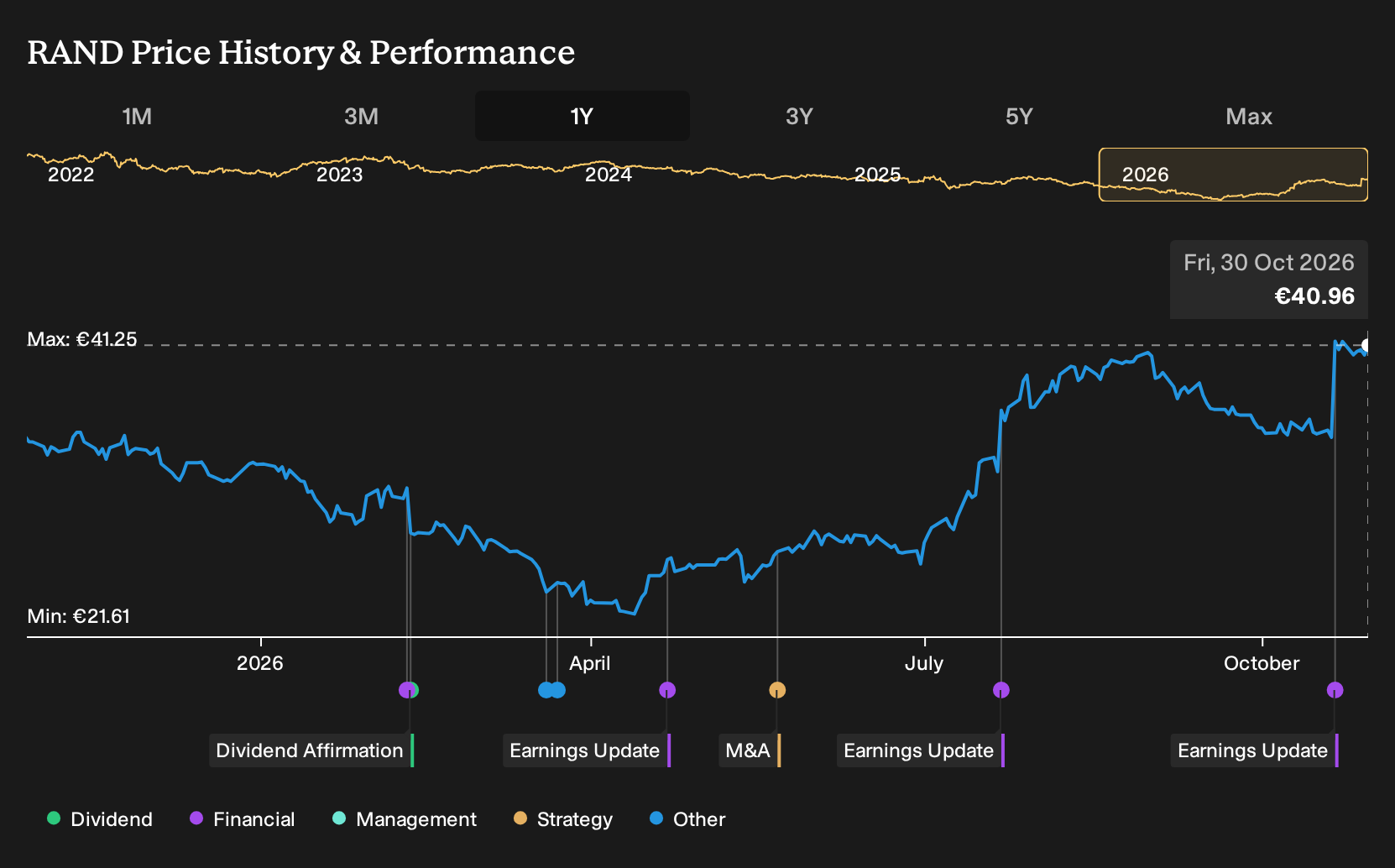
Given the current share price of €40.63 and a consensus target of €38.33, the implied 6.0% lower target price suggests analysts as a group see Randstad as roughly fairly valued on these inputs. For anyone building a thesis today, the key judgment is whether the combination of digital platforms, cost discipline and large enterprise exposure can reasonably deliver €571.5 million of earnings on €25.1 billion of revenue by 2029.
Uncover why Randstad's fair value indicates a 6% potential downside to its current price, which leaves little room for error.
Exploring Other Perspectives
One alternate view leans hard into Randstad’s earnings potential from digital delivery. The most optimistic analysts were already sketching out about €26.6b of revenue and roughly €722.9m of earnings by 2029, well above the consensus path, and the latest EPS jump could either reinforce or challenge that story once forecasts are refreshed.
Explore 3 other Randstad fair value estimates, including one that suggests as much as 89% upside from the current price.
Decide For Yourself
Don't just follow the ticker; dig into the data and build a conviction that's truly your own.
- A great starting point for your Randstad research is our analysis highlighting 3 key rewards and 2 important warning signs that could impact your investment decision.
- See our latest analysis for Randstad. The report includes a comprehensive fundamental analysis summarized in a single visual, the Snowflake, making it easy to evaluate Randstad's overall financial health at a glance.
Looking For More Investment Ideas Beyond Randstad?
If Randstad has sharpened your thinking about earnings quality and valuation, it can be useful to line it up against other listed businesses with different profiles and risk levels. The Simply Wall St Screener lets you do exactly that in a structured, data led way.
- If you want potential upside with strict attention to financial resilience, scan our 602 high quality undiscovered gems for companies that pair fundamental strength with lower market attention.
- If capital preservation sits high on your checklist, you can filter for steadier balance sheets and business models through our 218 resilient stocks with low risk scores to see which stocks fit that profile.
- If income is a priority for your portfolio, you can shortlist yield focused opportunities starting with our 221 dividend fortresses and compare payout strength, coverage and consistency side by side.
Have feedback on this article? Concerned about the content? Get in touch with us directly. Alternatively, email editorial-team@simplywallst.com