
How India Running Shoe Launch At Nike (NKE) Has Changed Its Investment Story
- Nike has launched Vegam Run, a running shoe tailored for India and priced at ₹3,795, targeting the country's expanding fitness and running market through Flipkart and select retailers from early November.
- The India specific Vegam Run highlights Nike's push into localized product design as it looks for new demand pockets, while Greater China remains under pressure and restructuring continues.
- This article examines how Nike's investment narrative is affected by this India focused Vegam Run launch and its broader localization strategy.
Scan how Nike's India focused push compares with other consumer stocks looking for new growth pockets by running your own shortlist with the 18 high quality undiscovered gems.
NIKE Investment Narrative Recap
To own Nike, you need to believe the reset in its core footwear and apparel engine can offset softer demand in key regions while the product mix leans more toward performance. The near term story still hinges on whether Performance franchises and cleaner inventory can keep earnings from drifting lower as FY27 revenue and EBIT are both expected to decline.
Right now, the biggest swing factor remains execution in North America, EMEA and especially Greater China, where digital and Sportswear weakness has been weighing on results. The Vegam Run launch in India feels directionally helpful but not yet large enough to change the main risk, which is prolonged pressure in those major markets.
The Vegam Run India launch lines up closely with Nike’s stated push toward sport performance and local product creation. It fits the idea that performance focused lines can support the mix as the group aims for a US$16b Performance portfolio by FY26, while also testing more localized designs in markets outside Greater China.
For catalysts, this matters if Vegam Run and similar concepts eventually scale into meaningful performance revenue and healthier full price sell through. The announcement also sits next to ongoing restructuring, including resetting classic Sportswear and Jordan franchises and tightening wholesale and digital distribution, which are all operational levers investors are watching heading into the 2026 Investor Day.
What The Vegam Run Means For NIKE’s Long Game
The India specific Vegam Run sits against a NIKE investment story that still leans on relatively flat global revenue expectations and stable profitability rather than aggressive expansion. Analysts in the latest consensus expect the group to hold profit margins near 6.7% over the next few years, with earnings today around US$3.1b and forecast to be roughly US$3.0b by 2029, even as the product engine tilts toward performance and more targeted regional concepts like Vegam Run.
That outlook effectively treats projects such as Vegam Run as a way to protect earnings quality and brand strength while the business deals with softer demand in North America, EMEA and Greater China. India focused running shoes priced at mass premium levels could help broaden the performance customer base, but they sit inside a wider reset that also includes tighter digital distribution, fewer discount led online partners and ongoing work to reduce classic Sportswear inventory.
For you as an investor, the important tension is simple. NIKE is putting more weight on performance oriented franchises and locally tuned designs like Vegam Run, but the consensus numbers still build in cautious assumptions on overall growth and margin expansion. That gap between on the ground product activity and relatively muted financial expectations creates room for both positive and negative surprises if localized projects either catch on with consumers or fail to move the needle against the much larger global backdrop.
NIKE's narrative projects US$45.4b revenue and US$3.0b earnings by 2029. This implies fairly flat yearly revenue performance and a US$0.1b earnings decline from US$3.1b today.
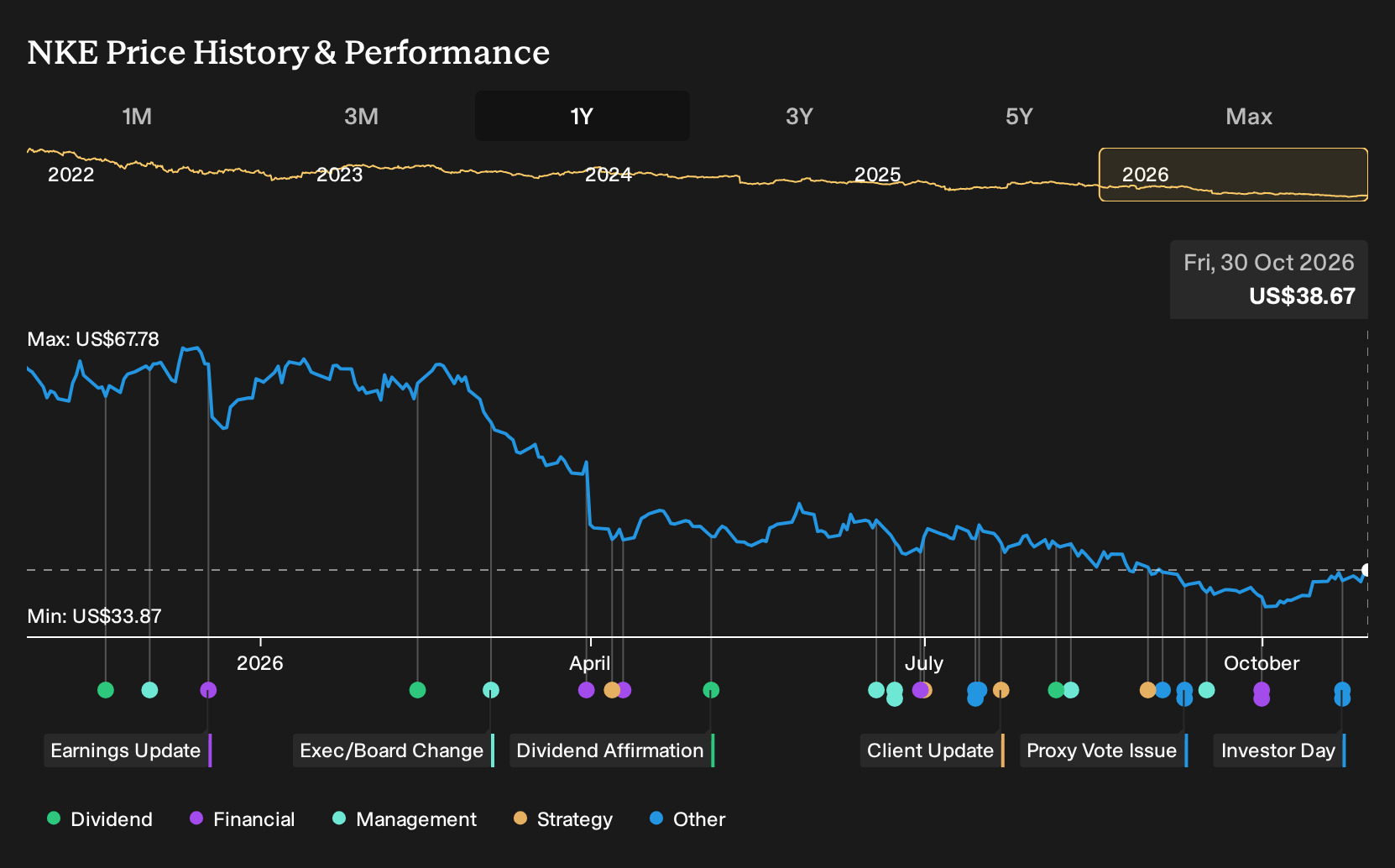
Uncover why NIKE's fair value indicates a 6% potential downside to its current price, which leaves little room for error.
Exploring Other Perspectives
One alternate angle treats localization as a risk, not a catalyst. The most bearish analysts were modeling NIKE revenue at about US$40.6b and earnings near US$1.9b by 2029 before Vegam Run existed. You can read that as a warning that projects like India specific running shoes may or may not shift a much harsher earnings path. Use that spread in opinions as a prompt to compare several scenarios before deciding how this launch might reshape your own view.
Explore 11 other NIKE fair value estimates, including one that suggests up to 6% downside from the current price.
Decide For Yourself
Disagree with existing narratives? Extraordinary investment returns rarely come from following the herd, so consider trusting your own analysis.
- A great starting point for your NIKE research is our analysis highlighting 1 key reward and 1 important warning sign that could impact your investment decision.
- See our latest analysis for NIKE. The report includes a comprehensive fundamental analysis summarized in a single visual, the Snowflake, making it easy to evaluate NIKE's overall financial health at a glance.
Looking For More Investment Ideas Beyond NIKE?
If the Vegam Run story has you rethinking how you build a portfolio around different consumer and performance themes, it can help to broaden the lens beyond NIKE and scan for other businesses that match your risk, quality and income preferences.
- For investors who want quality and value to line up, run a shortlist using 29 high quality undervalued stocks that already combine stronger fundamentals with pricing that may look appealing on closer inspection.
- If capital preservation ranks high for you, filter the market by financial strength using a list of solid balance sheet and fundamentals (25 results) and focus only on companies that carry sturdier balance sheets.
- Those hunting for income ideas can zero in on higher yielding opportunities by screening through 5 dividend fortresses and concentrating on businesses with payouts that match their return targets.
Have feedback on this article? Concerned about the content? Get in touch with us directly. Alternatively, email editorial-team@simplywallst.com