
How Investors Are Reacting To Couche Tard Stock Stronger Fuel Margins
- Alimentation Couche-Tard reported higher fuel margins and rising revenues in its first quarter of fiscal 2027, while Canadian same-store sales were flat and the quarterly dividend of C$0.215 per share was maintained.
- The combination of strong fuel profitability, softer in-store performance in Canada and a relatively modest dividend payout highlights how much the investment case leans on fuel economics and cash discipline rather than broad-based merchandise momentum.
- The focus now turns to how Alimentation Couche-Tard's investment narrative absorbs stronger fuel margins while Canadian in-store demand remains flat.
Compare how Alimentation Couche-Tard balances fuel margins, flat in-store trends and a modest payout ratio with a curated 3 high quality undervalued stocks that pair disciplined cash use with stronger operating momentum.
Alimentation Couche-Tard Investment Narrative Recap
The big belief with Alimentation Couche-Tard is that a fuel heavy model, wide store base and tight cost control can support earnings even when some in-store categories feel sluggish. Higher fuel margins and rising revenue in Q1 back that idea. Flat Canadian same store sales and softer carbonated drinks and snacks keep the near term focus on mix rather than raw volume.
The most important short term catalyst is progress in growing higher margin foodservice, energy drinks and digital driven traffic to offset pressure in older categories. The key risk is that value offers and weaker legacy beverages keep merchandise margins under strain while fuel profitability normalizes.
The upcoming Q2 2027 results release on 24 November 2026 sits right on top of this fuel versus merchandise debate. Investors get another data point on whether food, bundles and newer beverage lines are gaining enough traction to move same store sales back toward the 2% to 3% target band.
That update also matters for the Żabka integration story and for comfort around debt levels. Any fresh detail on synergy progress, SG&A discipline and distribution center rollouts will feed into how durable the current dividend looks when fuel margins shift and value focused promotions remain sharp.
Alimentation Couche-Tard's current narrative anchors on analysts expecting revenues of $86.6b and earnings of $3.7b by 2029. This lines up with a 2.3% yearly revenue growth rate and an earnings increase of about $0.5b from $3.2b today.
Uncover why Alimentation Couche-Tard's fair value indicates a 26% potential upside to its current price, and why that discount may not last long.
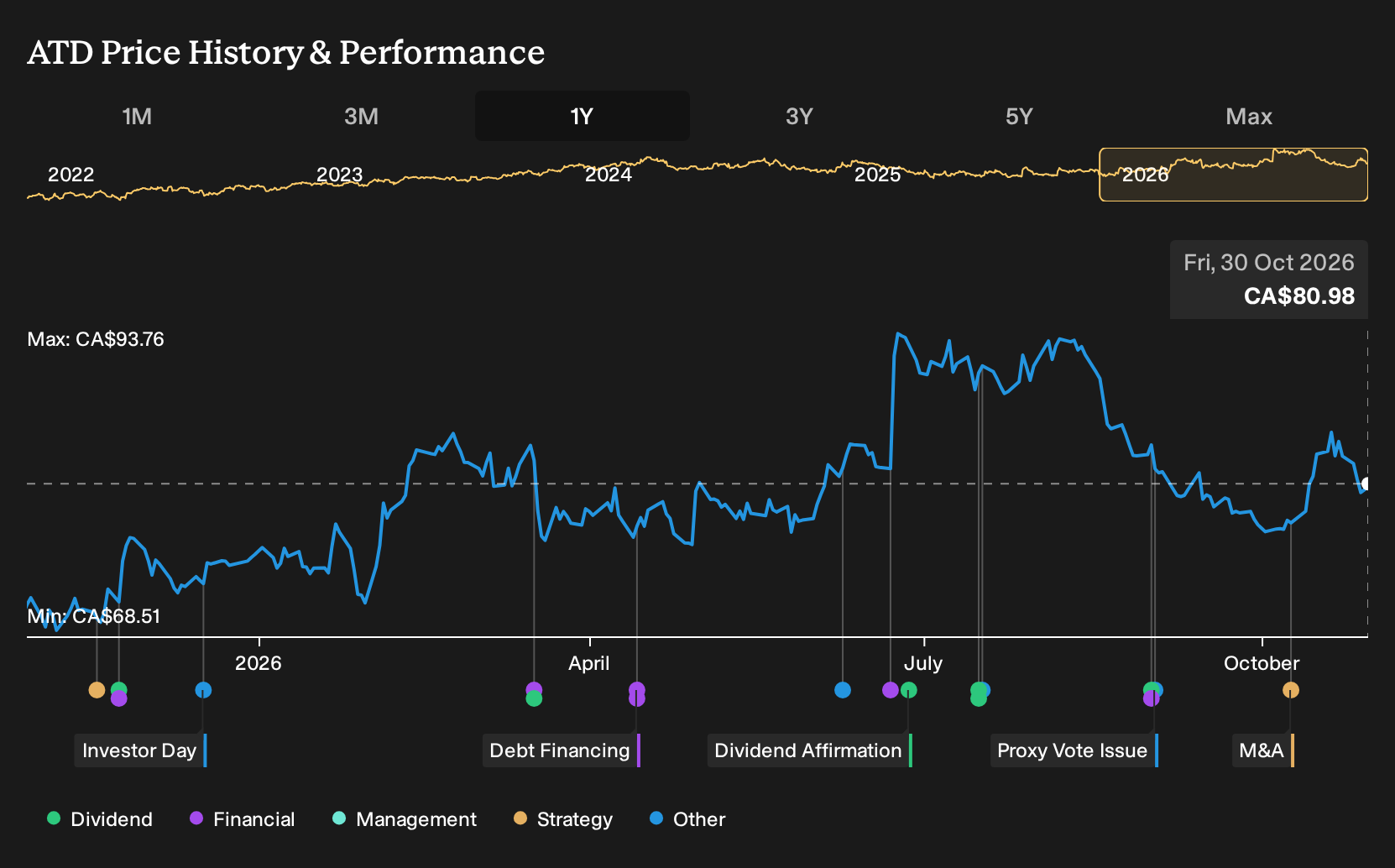
Exploring Other Perspectives
Three fair value estimates from the Simply Wall St Community span roughly US$101 to US$167. This wide spread reflects how differently retail investors assess Alimentation Couche-Tard. Set that against upcoming Q2 2027 earnings and the Żabka integration, and you get plenty of scope for views to shift. Explore several angles before deciding where you land.
Explore 2 other Alimentation Couche-Tard fair value estimates, including one that suggests as much as 106% upside from the current price!
Form Your Own Verdict
Disagree with existing narratives? Extraordinary investment returns rarely come from following the herd, so go with your instincts.
- A great starting point for your Alimentation Couche-Tard research is our analysis highlighting 5 key rewards and 1 important warning sign that could impact your investment decision.
- See our latest analysis for Alimentation Couche-Tard. The report includes a comprehensive fundamental analysis summarized in a single visual, the Snowflake, which makes it easy to evaluate Alimentation Couche-Tard's overall financial health at a glance.
Looking For More Alimentation Couche-Tard Style Ideas?
If the way Alimentation Couche-Tard balances fuel profitability, store economics and cash discipline appeals to you, it can help to line it up against other opportunities that share similar traits or offer a different risk profile.
- For investors who want income with some buffer around the payout, scan for higher yielding stocks that resemble dividend workhorses using 3 dividend fortresses.
- If capital preservation sits high on your list, compare this retailer with other businesses that currently screen as sturdier using a 7 resilient stocks with low risk scores to help keep potential drawdowns in check.
- If you prefer resilient balance sheets and clean fundamentals, especially when fuel margins or consumer demand can swing, then build a wider watchlist using the list of solid balance sheet and fundamentals (6 results).
Have feedback on this article? Concerned about the content? Get in touch with us directly. Alternatively, email editorial-team@simplywallst.com