
LOS ANGELES, CA / ACCESS Newswire / October 30, 2026 / A kidney appointment often begins with questions that a laboratory report cannot answer on its own. What does a change in kidney function mean? Is a medication still appropriate? Which symptoms should be reported? What happens if dialysis becomes necessary? For Spanish-speaking patients and their families, being able to discuss those questions clearly can be an important part of participating in care.
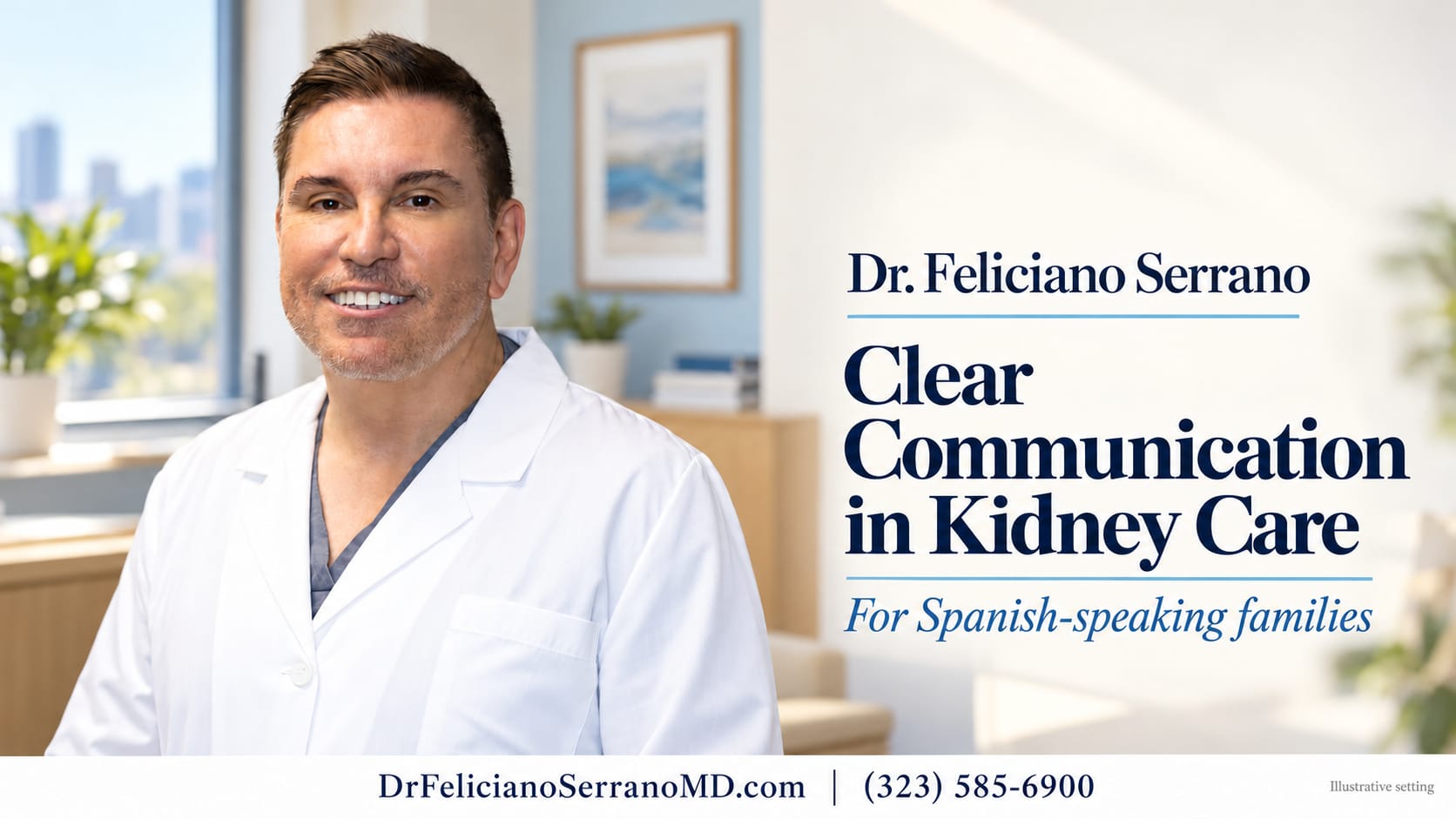
Dr. Feliciano Serrano, a Los Angeles native based in Huntington Park, communicates with patients in English and Spanish. His expanded practice website brings together his education, research, clinical interests, and community history while offering patients a starting point for conversations about kidney and vascular health. The English and Spanish biography pages provide consistent information about his background.
The update presents a broader picture of a physician whose career has combined kidney medicine with vascular access care. It also highlights an everyday part of medical practice that is easy to overlook: patients need understandable explanations, realistic expectations, and a clear plan for what comes next.
Understanding the conversation around kidney health
Kidney care can involve blood tests, urine tests, blood pressure management, medication reviews, and repeated assessments over time. A result may need to be interpreted alongside earlier results, medical history, current symptoms, and other conditions. Patients should ask their treating clinician what the findings mean in their individual situation.
For a family helping a relative navigate appointments, the challenge can extend beyond learning medical terms. They may need to know which records to bring, whether an insurance authorization is required, how to contact the office, and which clinician is responsible for follow-up. Clear communication supports those practical steps as well as the clinical discussion.
Serrano's website describes direct communication in Spanish about kidney disease, vascular conditions, treatment choices, and follow-up care. A patient's preferred language should be established at the start of an appointment. When interpretation is needed, families can ask the healthcare organization about qualified language assistance rather than assuming that a relative must interpret every medical conversation.
Family involvement should reflect the patient's preferences and permission. A caregiver can be helpful without replacing the patient's own voice. The aim is to make room for questions and help the patient understand the decisions being discussed.
Preparing for a specialist visit
A productive kidney consultation starts with an organized account of what has happened so far. Useful items often include a list of prescription medicines, over-the-counter products and supplements, allergies, recent laboratory results, prior imaging or procedure reports, and the names of other treating clinicians. Patients should ask the office which records are needed for their specific appointment.
Writing down questions can help families use the visit well. A patient might ask what the diagnosis means, whether more testing is needed, what changes should be monitored, and when follow-up should occur. If a new medicine is recommended, the discussion can include its purpose, possible side effects, and whether kidney function affects its use.
Patients can also ask the clinician to explain the next steps in plain language and provide written instructions in their preferred language when available. Repeating the plan back in their own words can reveal a misunderstanding before they leave. A clear plan should identify whom to contact with questions and which changes need urgent attention.
Education and training across several institutions
Serrano's education began with a Bachelor of Science in Biological Sciences at the University of Southern California. He earned his Doctor of Medicine from USC's Keck School of Medicine in 2002, followed by an internal medicine residency at White Memorial Medical Center in Los Angeles from 2002 to 2005.
His professional profile lists nephrology fellowship training at the University of Vermont Medical Center from 2006 to 2008. His biography and interviews also describe additional fellowship training in interventional nephrology and vascular procedures at the University of Arizona College of Medicine.
His reported experience connected with Harvard and Brigham and Women's Hospital involved research and lecturing. The updated biography distinguishes that experience from his medical degree at USC and his nephrology fellowship at Vermont, giving readers a clearer account of the different stages of his preparation.
Published research on kidney disease and clotting
The relationship between kidney disease and vascular health also appears in Serrano's research record. He was first author of a 2007 Thrombosis Journal paper examining platelet expression and reactivity in patients with end-stage renal disease. The paper lists a University of Vermont affiliation and describes his participation in study design, patient recruitment, data collection, analysis, and manuscript preparation.
His publication record also includes a 2007 American Journal of Cardiology paper involving platelet function testing and a 2008 American Journal of Kidney Diseases case series on electrolyte and acid-base disorders in patients with ileostomies. These publications document specific research contributions spanning kidney medicine and platelet function.
Community service with a Latino focus
Serrano's biography describes growing up in Los Angeles and being influenced by parents who emphasized helping people with fewer resources. His public community history includes charitable support for children and families as well as cultural philanthropy.
A 2014 announcement about a celebration for cancer survivor Frida Lagunas identified Serrano as a member of Los Compadres, a Latino philanthropic group supporting Children's Hospital Los Angeles. The announcement reported his $10,000 donation to the hospital in Frida's honor to benefit children and families facing serious medical conditions.
In 2012, the Los Angeles Times reported Dr. Serrano's $50,000 contribution to the Antonio Aguilar monument in Los Angeles.
His website also describes past charitable medical work. Published interviews discuss pro bono care for underserved and homeless patients and recognition from the City of Los Angeles. These accounts add context to the community focus described in his biography.
Historical Spanish language outreach
A separate example appears in a 2017 BioCorRx announcement describing plans for Serrano KVAC, working with CereCare, to introduce a Spanish-language addiction recovery program for the Hispanic community in Los Angeles. The announcement is part of the historical record of his community outreach. It should not be interpreted as confirmation that the program remains active or that addiction treatment is currently available through the practice.
Taken together, these accounts show several ways his public professional history has intersected with Latino communities: language access in clinical conversations, charitable giving, cultural support, and historical outreach. Each activity has its own date and context, and the current website separates that history from present service information.
A starting point for patients and caregivers
Patients considering a consultation can use the website to learn about Serrano's background and review the topics covered by the practice. The next step is a conversation with the office about the individual's needs, appointment availability, referral requirements, coverage, and records. Information online does not determine eligibility for a treatment or replace a medical assessment.
For Spanish-speaking families, the practical value is the opportunity to ask questions directly and understand the plan. For any patient, the measure of a useful consultation is whether the discussion leaves them better able to explain what is known, what remains uncertain, and what they should do next.
About Dr Feliciano Serrano
Dr. Feliciano Serrano provides nephrology and vascular care at Serrano Kidney & Vascular Access Center in Huntington Park, California. He communicates with patients in English and Spanish. Information about his background and services is available at DrFelicianoSerranoMD.com.
Media Contact Details
Dr Feliciano Serrano
info@DrFelicianoSerranoMD.com
(323) 585-6900
https://drfelicianoserranomd.com/
SOURCE: Dr Feliciano Serrano
View the original press release on ACCESS Newswire