
Relative restraint in capital expenditure was favored by the market Apple (AAPL.US) surpassed Nvidia (NVDA.US) to regain the top position in global market capitalization
The Zhitong Finance App learned that as Wall Street's concerns about the tech giant's huge return on investment in artificial intelligence (AI) continue to heat up, Apple (AAPL.US) surpassed Nvidia (NVDA.US) on Friday to become the listed company with the highest market capitalization in the world. At a time when technology stocks are generally being sold off, Apple has become a more defensive technology stock in the eyes of investors due to its relatively restrained capital expenditure and strong cash flow performance.
On Friday, Apple's stock price fell 1.2%, closing at about $5.03 trillion; Nvidia's stock price fell 4.2%, falling to 4.93 trillion US dollars. This is the first time since surpassing Nvidia for a short time at the end of July this year that Apple has once again reached the top of the global market capitalization list.
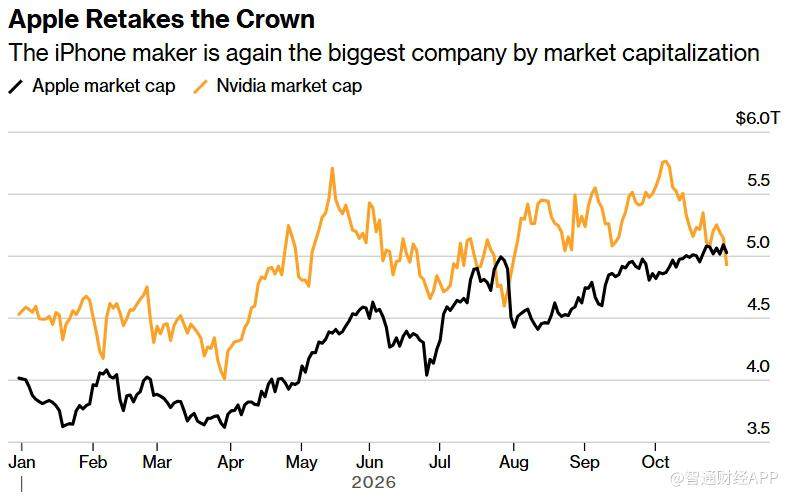
What is behind Apple's return to number one market capitalization is the changing attitude of the market towards the prospects for tech giants to invest in AI. Recently, large technology companies such as Intel (INTC.US), Amazon (AMZN.US), Alphabet (GOOGL.US, GOOG.US), and Meta (META.US) have successively released disappointing financial reports or performance guidelines, causing investors to worry about the growth prospects of the technology industry and the return on AI investment.
What is particularly noteworthy is that as large technology companies continue to invest huge sums of money to build AI data centers and other computing infrastructure, the market is beginning to question whether these investments can generate sufficient revenue and profits within a reasonable period of time.
The scale of capital expenditure of some tech giants has already exceeded the cash flow generated by their operating activities, leading to negative free cash flow. Alphabet and Amazon have both experienced this situation and are increasingly relying on the bond market to fund investments. At the same time, rising interest rates have further boosted corporate financing costs.
In contrast, Apple did not invest heavily in AI infrastructure like other tech giants, but instead maintained a relatively restrained capital expenditure strategy. This has won the favor of investors as the market re-examines AI investment risks.
According to the data, Apple's stock price has risen 27% since this year. Not only is it the best-performing stock among the “Big Seven” US stocks, the increase is more than double that of Nvidia, which is ranked second. At the same time, Apple's cash flow performance is also clearly superior to that of some of its tech peers. The market anticipates that in the 2026 fiscal year ending September 30, Apple's free cash flow will increase 38% year over year to reach 142 billion US dollars.
Strong cash flow means that Apple can support its own business development and shareholder returns without having to borrow on a large scale like some of its competitors. Against the backdrop of rising interest rates and rising financing costs for technology companies, this advantage is receiving more attention from investors.
As Apple regains the top market capitalization in the world, the US stock technology sector is undergoing a round of significant adjustments. Dragged down by large technology companies' financial reports falling short of expectations and concerns about the return on AI investment, the Nasdaq 100 index fell 6.7% in October, the worst monthly performance since March 2025. Among them, AI infrastructure-related stocks have experienced a particularly serious sell-off. Data center operators Coreweave (CRWV.US) and Nebius Group (NBIS.US), which provide AI computing services, both fell more than 30% in October.
Intel's decline was even more intense. After the stock price plummeted on Friday, the stock had a cumulative decline of more than 45% in October, the biggest monthly decline in more than 40 years compiled by Bloomberg.
Overall, Apple has surpassed Nvidia again, reflecting changes in investors' evaluation criteria for large technology companies. Previously, the market favored companies that actively invested in AI infrastructure and could benefit from the AI boom; now, as capital expenditure continues to rise and financing costs rise, investors are beginning to pay more attention to the cash flow, profitability, and financial soundness of enterprises. In this context, Apple's relatively conservative AI investment strategy has instead become an important advantage that distinguishes it from other tech giants.