
Why Dumping Uber Stock Before Q3 Earnings May Not Be the Smartest Move
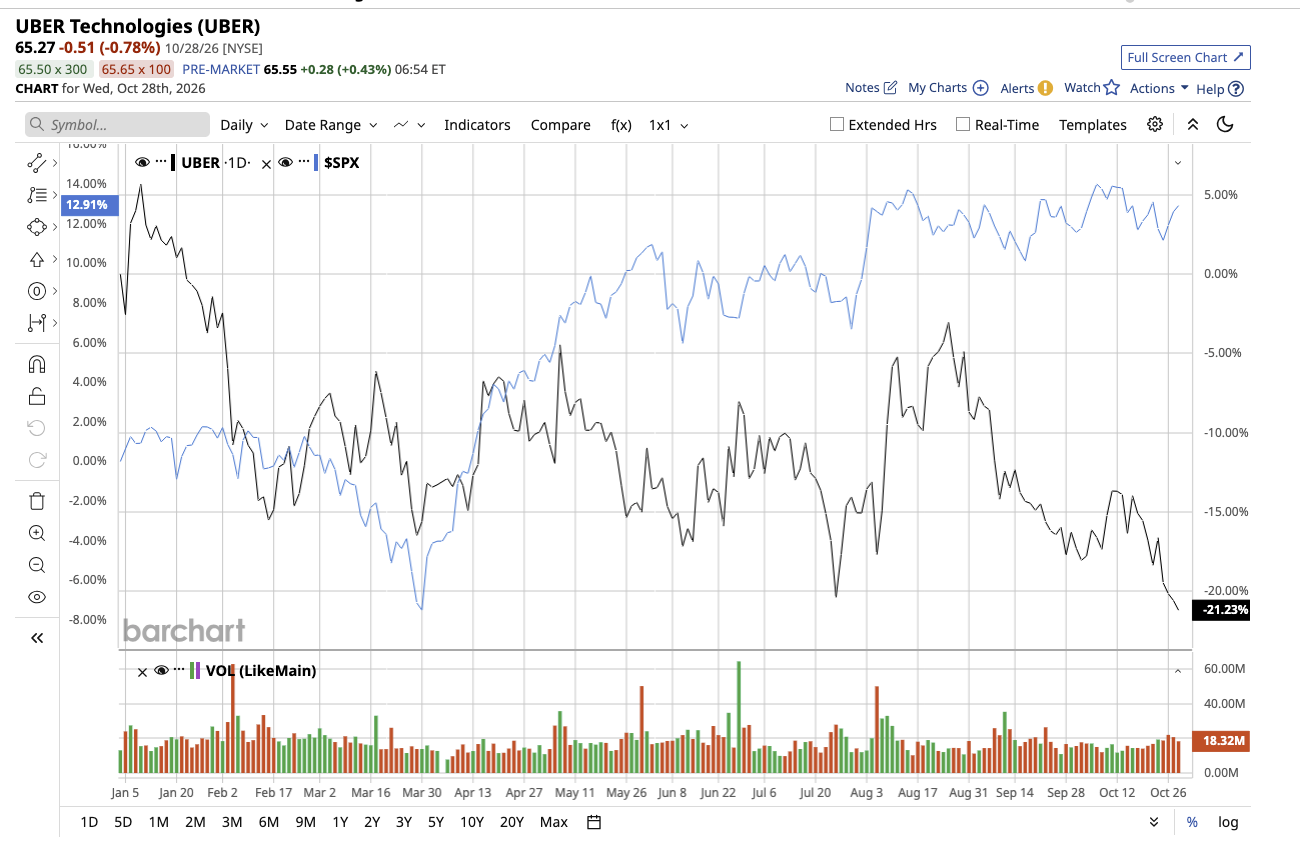
Uber Technologies (UBER) stock has taken a beating this year, dropping 20% year-to-date (YTD), even as the company keeps expanding and generating billions in cash. The disconnect is hard to ignore, as Uber continues to grow bookings, revenue, and earnings while its ride-hailing and delivery businesses open up new opportunities for growth. Now, with third-quarter earnings scheduled for Nov. 4, are investors overlooking the strength of Uber's business?
Here's why dumping UBER stock before Q3 earnings may not be the smartest move.
Uber’s Q2 Was Stronger Than Its Stock Shows
The 20% stock dip so far this year might imply Uber is losing steam. However, that’s not the case. The company released a solid Q2 report in August, with gross bookings climbing 22% year-over-year (YOY) on a constant-currency basis to $58 billion. Gross bookings grew more than 20% for the fourth consecutive quarter. Monthly active platform consumers also rose 16% YOY to $208 million. Revenue increased 12% YOY to $14.2 billion, while adjusted EPS climbed 35% YOY to $0.81.
Mobility revenue rose 1% to $7.36 billion, while mobility operating income rose 28%. Delivery revenue also increased 28% YOY to $5.25 billion, while delivery operating income grew 38%. Freight remained loss-making, with a $24 million operating loss despite a 26% YOY increase in revenue to $1.58 billion.
The key takeaway is that Uber's largest segments and core operations are generating more profit as they scale. Uber’s free cash flow exceeded $10 billion over the trailing 12 months. This gives it substantial capacity to fund operations, invest in growth, and return capital to shareholders. By mid-2026, Uber had repurchased approximately $3.5 billion of its shares. Management said that Uber intends to resume share repurchases over the coming months.
Autonomous Vehicles Offer Potential, But the Payoff Is Uncertain
Uber is gearing itself for a future in which self-driving vehicles play a larger role in ride-hailing. Management discussed about $10 billion in multiyear autonomous vehicle (AV) investments, and Uber is building its AV strategy around partnerships rather than betting on a single tech company. Collaborators include Waymo rival Wayve, robotaxi developer Zoox, Baidu (BIDU), and the Lucid (LCID) and Nuro partnership. Uber also expects to work with Rivian (RIVN) and Nvidia (NVDA) on future autonomous deployments. CEO Dara Khosrowshahi said the company operates in seven cities with autonomous vehicle partners and aims to reach 15 by the end of 2026.
For investors, the partnerships offer a potential long-term growth opportunity, but it remains to be seen whether Uber can make it profitable.
Don't Confuse a Falling Stock With a Broken Business
Uber enters its Q3 earnings report with plenty going for it. Management expects gross bookings to increase by around 18% to 22%, with adjusted EPS increasing by 28% to 35% to between $0.84 and $0.88. As its Mobility and Delivery segments keep gaining ground, Uber’s core strength appears far greater than its current share price suggests.
Selling UBER stock simply because shares are down could mean overlooking the progress the business is making. Ultimately, the Q3 print should give investors a clearer picture of whether Uber can sustain its strong growth and profitability, and whether the stock's steep decline is justified.
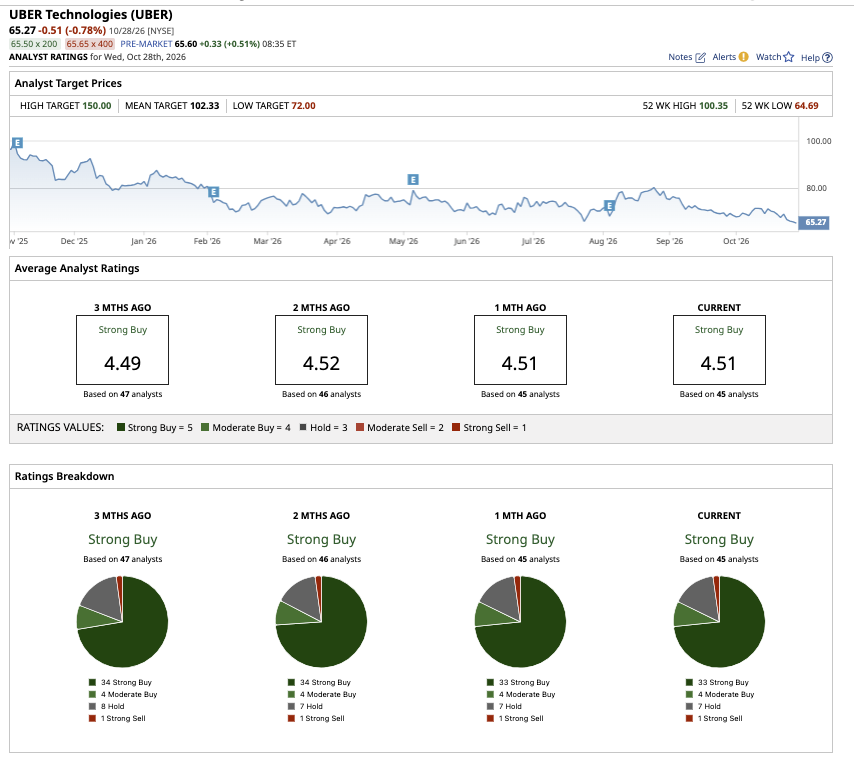
Overall, Wall Street remains strongly bullish about Uber’s long-term prospects. Of the 45 analysts covering UBER stock, 33 have a “Strong Buy” recommendation, four have a “Moderate Buy” rating, seven suggest a “Hold,” and one analyst has a “Strong Sell” rating. Based on the average price target of $102.33, UBER stock has potential upside of roughly 57% from current levels. Plus, the Street-high price estimate of $150 implies potential upside of 130% over the next 12 months.
On the date of publication, Sushree Mohanty did not directly have a position in any of the securities mentioned in this article. All information and data in this article is solely for informational purposes. For more information please view the Barchart Disclosure Policy here.