
Can UnitedHealth Group (UNH) Stay Undervalued If Medicare Margins Improve?
UnitedHealth Group has delivered solid gains over the past year, which puts a spotlight on whether the recent share price still lines up with what the insurer actually earns. With fresh headlines on Medicare Advantage pricing changes and questions around how regulators treat tokenized trading of its shares, the market is effectively asking what level of earnings justifies today's valuation.
- UnitedHealth Group has returned 22.3% over the past year, so anyone looking at the stock today is really asking whether its earnings power is strong enough to underwrite that kind of move.
- Planned Medicare cost increases and benefit adjustments from 2027 can support profitability for the health insurance segment, which matters because even modest shifts in policy terms can have an outsized impact on how much earnings investors are paying for right now.
- The analysts covering UnitedHealth Group have run their own numbers. See what analysts think UnitedHealth Group's shares could be worth.
The issue now is whether UnitedHealth Group's current share price is adequately supported by its earnings when stacked against the Fair Ratio benchmark.
If you want a broader watchlist alongside UnitedHealth Group while you weigh how earnings stack up against price, a focused screen of solid balance sheet and fundamentals stocks screener (23 results) may be useful.
Is UnitedHealth Group Still Cheap on Earnings?
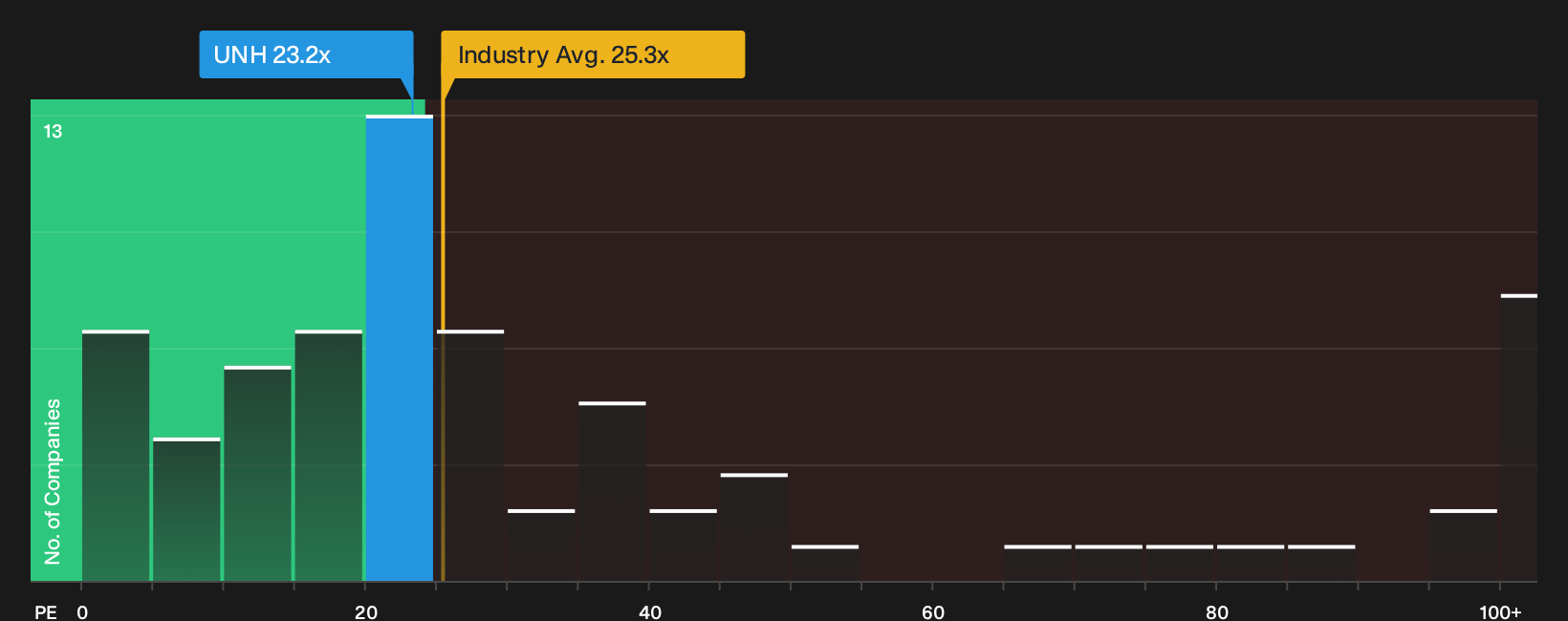
The P/E ratio suits UnitedHealth Group because investors tend to focus on the earnings power of large insurers. On this yardstick, the stock trades on a P/E of 23.0x, which is below the broader Healthcare sector average of 25.3x and also under the peer group mark of 29.0x. That gap means you are paying less per dollar of reported profit than for many comparable insurers and healthcare operators.
The Fair Ratio, which blends in factors like sector, size, margins and risk, points to a higher P/E than where UnitedHealth Group currently trades, so the shares screen as undervalued on this framework. Because the recent Medicare Advantage pricing shifts are expected to support profitability for major providers, the current discount comes despite headlines that have already drawn attention to the earnings outlook for UnitedHealth Group. For anyone weighing whether the recent share price move has run too far, this multiple suggests the market is not paying a stretch valuation for the insurer's earnings base. Explore the numbers behind UnitedHealth Group's P/E valuation.
The UnitedHealth Group Narrative: What Would Justify Today's Price?
Simply Wall St Narratives for UnitedHealth Group pick up where this valuation puzzle leaves off by spelling out which paths for future growth, profit margins and earnings would need to play out for the stock to be worth materially more or less than today's price on the Community page. Rather than relying on a single P/E or model output, each scenario lays out the assumptions behind its view of fair value so you can later compare those inputs with actual results as they are reported.
The UnitedHealth Group community is split between investors who see underappreciated earnings power and others who think the integrated model already carries a rich tag.
Bull case: 16% undervalued
"The company continues to invest in technology that improves physician workflows and digital engagement, and the current AI program that targets billions of dollars of G&A savings…"
Discover why this Narrative puts UnitedHealth Group at 16% undervalued.
Bear case: 32% overvalued
"Regulators and policymakers increasingly question whether vertically integrated insurers reduce competition or steer patients in ways that limit choice…"
Explore why this Narrative puts UnitedHealth Group at 32% overvalued.
One more UnitedHealth Group check before you rely on the sticker price
Price, earnings and policy shifts only tell part of the UnitedHealth Group story, since the research screen has also flagged specific concerns that deserve a closer look before you lean on any valuation work. Take a closer look at 1 warning sign before settling on a valuation.
Have feedback on this article? Concerned about the content? Get in touch with us directly. Alternatively, email editorial-team@simplywallst.com