
How Q3 Earnings At Wells Fargo Stock Has Changed Its Investment Story
- Wells Fargo reported Q3 2026 earnings with US$1.87 in earnings per share, solid loan and deposit growth, efficiency gains, and credit quality that management described as healthy, while margin pressure and higher credit card related costs weighed on profitability.
- The bank leaned harder into higher fee wealth and advisory businesses in the quarter, using cost efficiencies to support returns near a roughly 16% adjusted return on tangible common equity despite those funding and card headwinds.
- We will now look at how Wells Fargo's investment narrative aligns with Q3's mix of loan growth, fee expansion and margin pressure.
Scan how Wells Fargo's Q3 mix of earnings, dividend income and fresh bond issuance compares with other large financials by running your filters through the 30 high quality undervalued stocks.
Wells Fargo Investment Narrative Recap
To own Wells Fargo, you need to believe the bank can keep turning a larger balance sheet, growing fee businesses and ongoing efficiency work into solid returns while managing pressure on net interest margin and card economics. Q3 showed that mix in action, with healthy credit quality and a roughly 16% adjusted return on tangible common equity.
The near term swing factor is still how funding costs and card related expenses blend with loan and fee growth. The recent earnings miss versus expectations and slight share price rise suggest the news does not materially change the immediate catalyst. Margin compression and card vintages remain the key risks to watch.
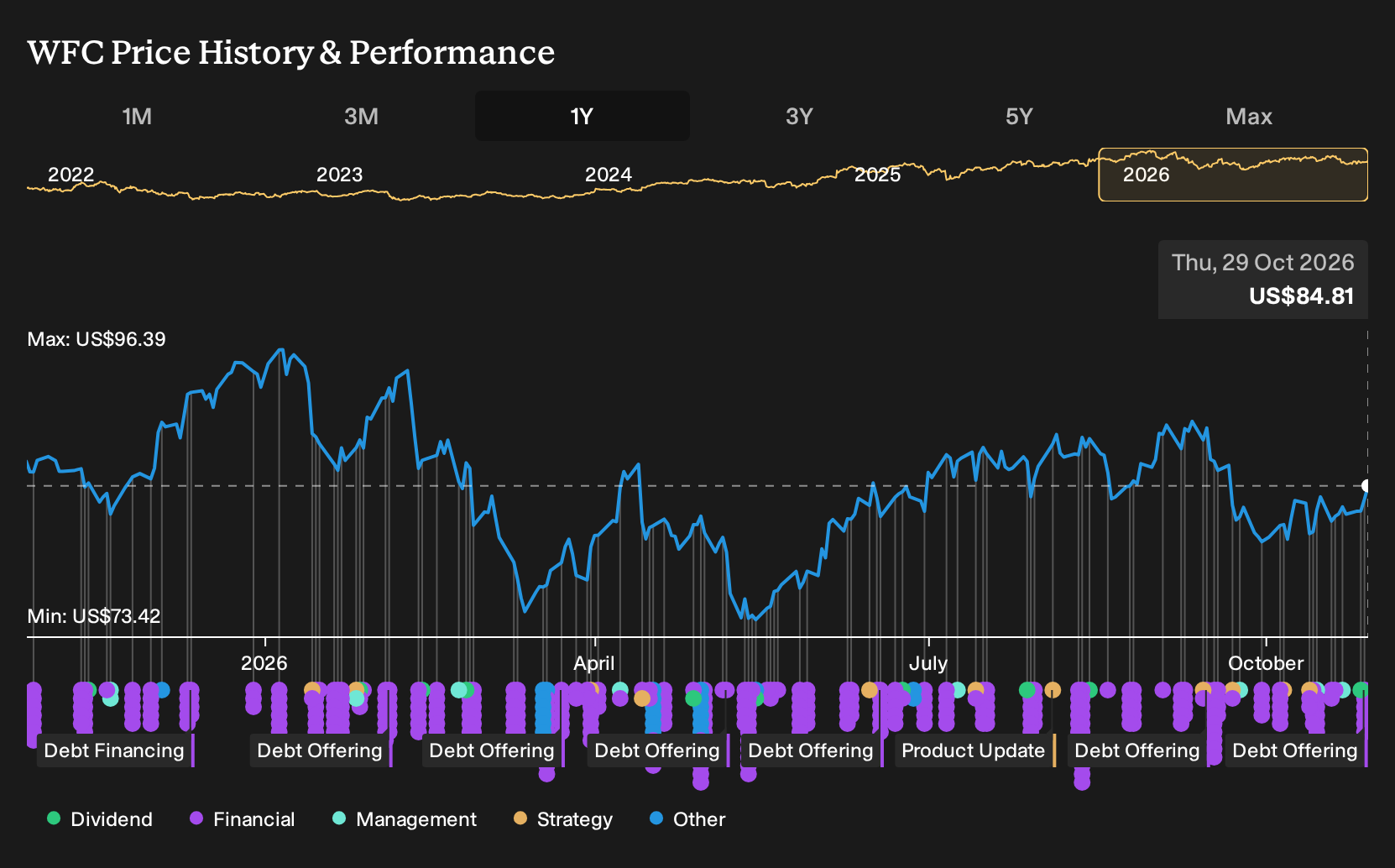
The most relevant fresh datapoint for this story is Wells Fargo’s new fixed income offerings in late October 2026. These include multiple senior unsecured notes with coupons between 5.55% and 6.25% and maturities spanning 2030 to 2046. This kind of term funding helps shape the liability mix that ultimately feeds into net interest income.
For you as a shareholder, these bond issues sit right next to the main catalysts and risks. Funding raised at these fixed rates meets a balance sheet that already faces pressure from interest bearing deposits and lower spread markets financing. How effectively Wells Fargo prices new lending and grows fee income against this cost of debt will influence returns over the next few years.
What Analysts Are Building Into The Wells Fargo Story
Wells Fargo's longer term script in the analyst models leans heavily on steady expansion of the top line and only modestly lower profitability. Forecasts point to revenue growth of 7.7% per year over the next three years and an earnings profile that moves from US$22.0b today to a consensus of US$24.0b by 2029, which is an earnings increase of about US$2.0b. That uplift, against slightly slimmer profit margins, sits at the center of how analysts frame the trade off between growth, efficiency work and the cost of funding that showed up in Q3 2026.
Those same models anchor on 2029 as the key reference year, with projected revenue of US$103.9b and earnings of US$24.0b. To line that up with current pricing, analysts are effectively asking you to assume the stock trades on a P/E of 13.7x in 2029, compared with roughly 11.0x today and 11.4x for the broader US banks group based on the report excerpt. That higher multiple, on top of the earnings path, is what underpins the consensus price target of US$97.9 against a current share price of US$80.9.
For anyone following Wells Fargo through this Q3 print, the question is less about pinning down a single fair value and more about whether these building blocks feel reasonable. The revenue outlook assumes the business can keep scaling lending, wealth, corporate banking and markets fees without giving up too much on margins that are already under pressure from funding costs and credit card acquisition spend. The earnings bridge from US$22.0b to US$24.0b by 2029 also bakes in ongoing share repurchases, since analysts model the share count falling by about 4.38% a year for the next three years, which lifts earnings per share even if profit growth is relatively measured.
For Wells Fargo, the tension between the Q3 reality and these longer dated forecasts sits in the mix, not the headline numbers. New bond issuance in October 2026 locks in funding costs for years, while deposit pricing and card rewards already squeeze net interest margin. That makes pricing power in loans and continued growth in fee based activities more important if the bank is going to match the earnings path analysts are using in their targets without leaning too hard on cost cutting alone.
Wells Fargo's narrative projects US$103.9b revenue and US$24.0b earnings by 2029, which implies 7.7% yearly revenue growth and an earnings increase of about US$2.0b from US$22.0b today.
Learn why Wells Fargo's fair value points to a 17% potential upside to its current price, which may materialize sooner than many investors anticipate.
Exploring Other Perspectives
You are not seeing one unified view of Wells Fargo here. Three members of the Simply Wall St Community mark fair value between about US$97.90 and US$141.66, a wide span for the same stock. When you layer that against rising fixed coupon debt, fresh euro notes and an AI focused leadership shift, you get very different performance stories. Opinions can differ sharply, so explore several of these viewpoints before deciding how Wells Fargo fits your own portfolio logic.
Explore 2 other Wells Fargo fair value estimates, including one that suggests up to 70% upside from the current price.
Form Your Own Verdict
Disagree with existing narratives? Extraordinary investment returns rarely come from following the herd, so go with your instincts.
- A great starting point for your Wells Fargo research is our analysis highlighting 3 key rewards and 1 important warning sign that could impact your investment decision.
- See our latest analysis for Wells Fargo. The report includes a comprehensive fundamental analysis summarized in a single visual, the Snowflake, making it easy to evaluate Wells Fargo's overall financial health at a glance.
Looking For More Investment Ideas Beyond Wells Fargo?
If the Wells Fargo narrative has you thinking about portfolio balance, use this momentum to widen your opportunity set with the Simply Wall St Screener. You can zero in on very different types of businesses, each filtered for specific qualities that might complement a large financial like WFC.
- For investors hunting earlier stage potential with tighter fundamentals, scan a curated group of 10 elite penny stocks with strong financials that meet stricter financial criteria than most micro caps.
- If resilience and balance sheet strength matter most to you, filter for companies on our list of solid balance sheet and fundamentals (23 results) and compare their financial profiles side by side.
- When you want quality that flies under the radar, use the 18 high quality undiscovered gems to surface lesser known businesses that still show robust underlying metrics.
Have feedback on this article? Concerned about the content? Get in touch with us directly. Alternatively, email editorial-team@simplywallst.com