
HubSpot (HUBS) Stock Looks Fully Priced As Shares Fell 71%
HubSpot has seen its share price fall hard in recent years, yet investors are still being asked to judge whether the current US$239.57 price reflects what the business earns. With the stock moving around sharp headlines and shifting sentiment, the open question is how today’s valuation lines up with the company’s earnings power.
- Over the past 5 years, HubSpot shares have declined 70.8%, which puts the focus squarely on whether the earnings profile now supports the remaining equity value.
- Recent selling pressure linked to concerns about funding AI investments and higher interest costs may affect how investors think about HubSpot’s future profitability and the timing of its cash generation.
- Your read on HubSpot is one view; the desks covering it have another. See what analysts think HubSpot's shares could be worth.
The issue now is whether HubSpot’s current share price is justified by the earnings that the business is generating today and is expected to produce over time.
If you want to stress test this same earnings question beyond HubSpot, you can benchmark it against a wider set of 30 high quality undervalued stocks.
Is HubSpot Getting Expensive on Earnings?
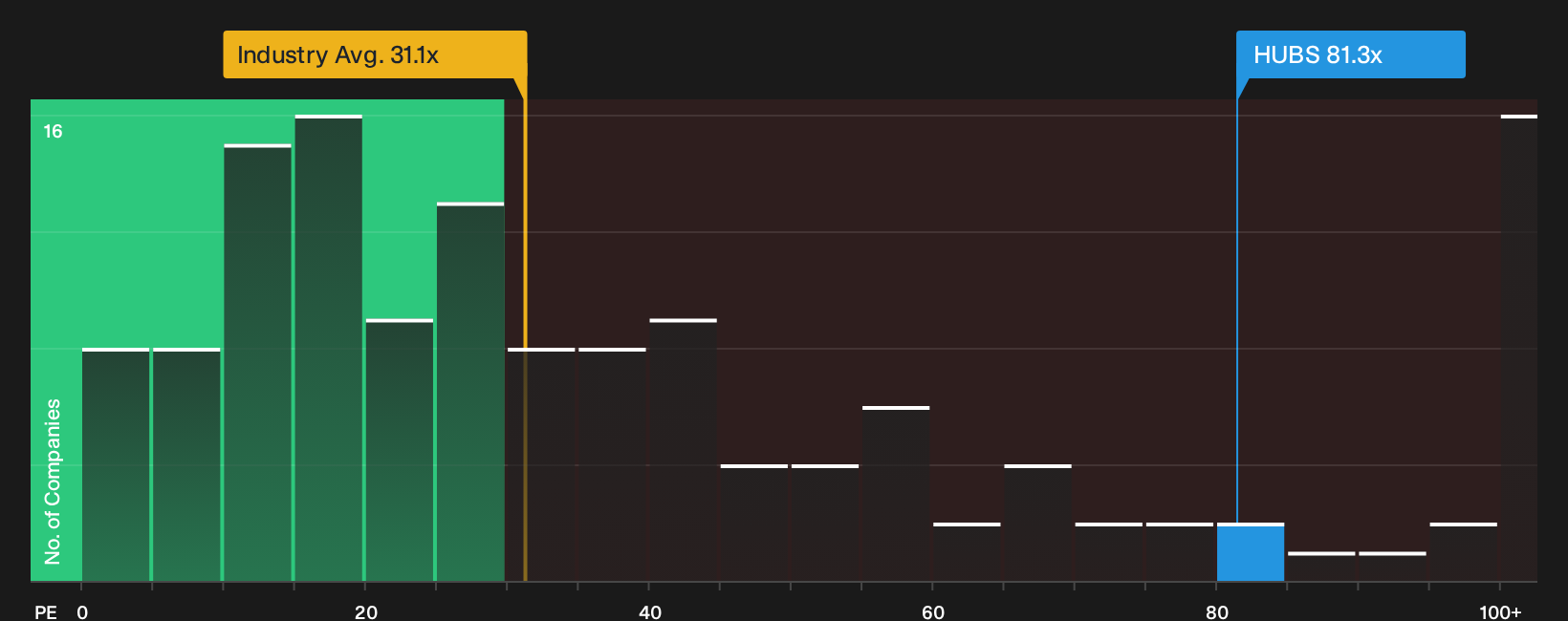
The P/E ratio fits HubSpot because the discussion here is squarely about what investors pay for each dollar of accounting profit. On that measure, HubSpot trades at about 81.3x earnings, which is far above the broader software industry average of roughly 31.1x. Compared with closer peers on roughly 57.8x, the gap remains wide. The market is attaching a richer earnings tag to this stock than to many software rivals.
A fair value framework that blends HubSpot specific factors such as growth outlook, profitability profile and risk points to a lower P/E than the current 81.3x. This suggests the shares screen overvalued on this earnings gauge. Because the recent tech sell off has focused attention on how companies will fund AI and manage higher interest costs, that premium P/E implies investors are still willing to pay up for HubSpot despite those concerns. For anyone weighing the stock, the question is whether the business can deliver enough future earnings to justify paying this kind of multiple today. Explore the numbers behind HubSpot's P/E valuation.
The HubSpot Narrative: What Would Justify Today's Price?
Simply Wall St Narratives pick up where the P/E debate for HubSpot leaves off. They spell out which paths for revenue growth, margins and earnings would need to play out for the stock to justify a meaningfully higher or lower price than today. Each one treats fair value as a hypothesis about HubSpot's business that you can track over time on the Community page, rather than a one off label on the current share price.
Community views on HubSpot are split between a gradual compounding story and a thesis that the current price already bakes in a lot of good news.
Bull case: 27% undervalued
"HubSpot is a leading, product-led CRM platform for SMBs and mid-market companies that bundles marketing, sales, service, operations and commerce capabilities in an easy-to-adopt cloud suite..."
Discover why this Narrative puts HubSpot at 27% undervalued.
Bear case: 26% overvalued
"The numbers suggest that HubSpot's share price already reflects strong adoption of AI agents, multi-hub usage, international exposure, and margin expansion targets, which leaves limited room for disappointment..."
Explore why this Narrative puts HubSpot at 26% overvalued.
For HubSpot, the share price is only one piece of the puzzle
The leaders setting HubSpot's priorities and the way they are rewarded can either support or undercut everything implied by the current valuation, and that alignment question has not been addressed here. See who runs HubSpot and how they are paid.
Have feedback on this article? Concerned about the content? Get in touch with us directly. Alternatively, email editorial-team@simplywallst.com