
Does Prime Rate Hike Change The Bull Case For BMO Stock?
- Bank of Montreal lifted its Canadian prime lending rate from 4.45% to 4.70% on October 29, 2026, following the Bank of Canada policy move, while also issuing fixed coupon, senior unsecured callable notes in late October.
- The prime rate reset directly affects loan pricing, funding costs and net interest income at Bank of Montreal, putting day to day profitability drivers under closer investor scrutiny.
- The focus now is on how Bank of Montreal's investment narrative intersects with this prime rate hike and its impact on lending economics.
Scan how Bank of Montreal’s rate move and bond issuance compare with peers by reviewing a curated list of solid balance sheet and fundamentals (6 results) that investors are watching closely for funding and lending resilience.
Bank of Montreal Investment Narrative Recap
To own Bank of Montreal, you need to be comfortable with a large North American lender that is leaning on core retail and commercial banking, plus ongoing digital and AI programs, to grind out efficiency and fee income. The prime rate move and recent bond deals mainly tweak funding mix and loan pricing, rather than altering that core thesis.
In the near term, the key swing factor is how net interest income and credit costs respond as rates reset through the book. The main risk is that sluggish Canadian demand or rising insolvencies push up provisions while technology and compliance spending stay heavy. That combination would keep pressure on operating leverage.
The fixed income offerings in late October, including the 6% senior unsecured notes maturing in 2031 and 2032, sit right beside the prime rate hike in the story. Taken together, they show Bank of Montreal actively refreshing term funding while repricing loans. This matters for spread resilience around the next earnings updates.
For you as a shareholder, those callable Eurobonds and Eurodollar bonds tie into capital flexibility and interest rate risk management at a time when BMO is also recycling capital from non core sales. Execution on this balance sheet reshaping, while keeping impaired loans contained despite a relatively low allowance level, is an important catalyst to watch.
Bank of Montreal Analyst Assumptions Behind The Story
Analysts looking at Bank of Montreal are effectively sketching out a world where a relatively traditional lender leans on technology, expense discipline and capital returns to support bigger profit pools without relying on breakneck loan growth. The rate hike and fresh senior notes plug straight into that picture because they influence funding costs, net interest spreads and, ultimately, how realistic those earnings milestones look.
The consensus framework is built on a forecast that revenue grows by 6.7% per year over the next few years while profit margins shift from 24.4% today toward 26.8% by around 2029. In simple terms, that set of numbers assumes Bank of Montreal squeezes more profit out of each dollar of business through mix, pricing and cost work rather than pure volume. That fits with a prime rate reset that may reprice loans more quickly than deposits in some pockets of the book, although higher funding costs on new bond deals can eat into that benefit if not managed carefully.
Earnings sit at about CA$8.7b today and the analyst group expects that to reach roughly CA$11.6b by 2029, a change of about CA$2.9b. For a lender already at scale, that is a meaningful step up in absolute profit, even before thinking about the projected 1.66% annual decline in the share count that would lift earnings per share. When you line those expectations up beside the October prime move and the 6% senior unsecured notes maturing in 2031 and 2032, the common thread is a balance between paying a fair price for term funding and using higher benchmark rates to protect spread income through the cycle.
There is also a valuation hinge in this story. To reach the analyst price targets, the consensus view has Bank of Montreal trading on a P/E of 18.0x those 2029 earnings, down slightly from about 18.6x today but still above the Canadian banks sector at 17.1x. That gap implies investors would still be paying a modest premium for the stock relative to domestic peers, which puts extra focus on whether management can keep credit losses around guided ranges while digesting higher coupon debt and a higher prime rate without letting costs run hot.
Bank of Montreal's narrative projects CA$43.3b revenue and CA$11.6b earnings by 2029. This assumes 6.7% yearly revenue growth and an earnings increase of about CA$2.9b from CA$8.7b today.
How The Valuation Ties Back To The Prime Rate And Funding Mix
Price targets around Bank of Montreal are not being set in a vacuum. They rest on those revenue and earnings forecasts and on how investors weigh the risk that higher policy rates, and the bank's own prime hike to 4.70%, could crimp loan growth or credit quality while the cost of wholesale debt steps higher through instruments like the new 6% notes.
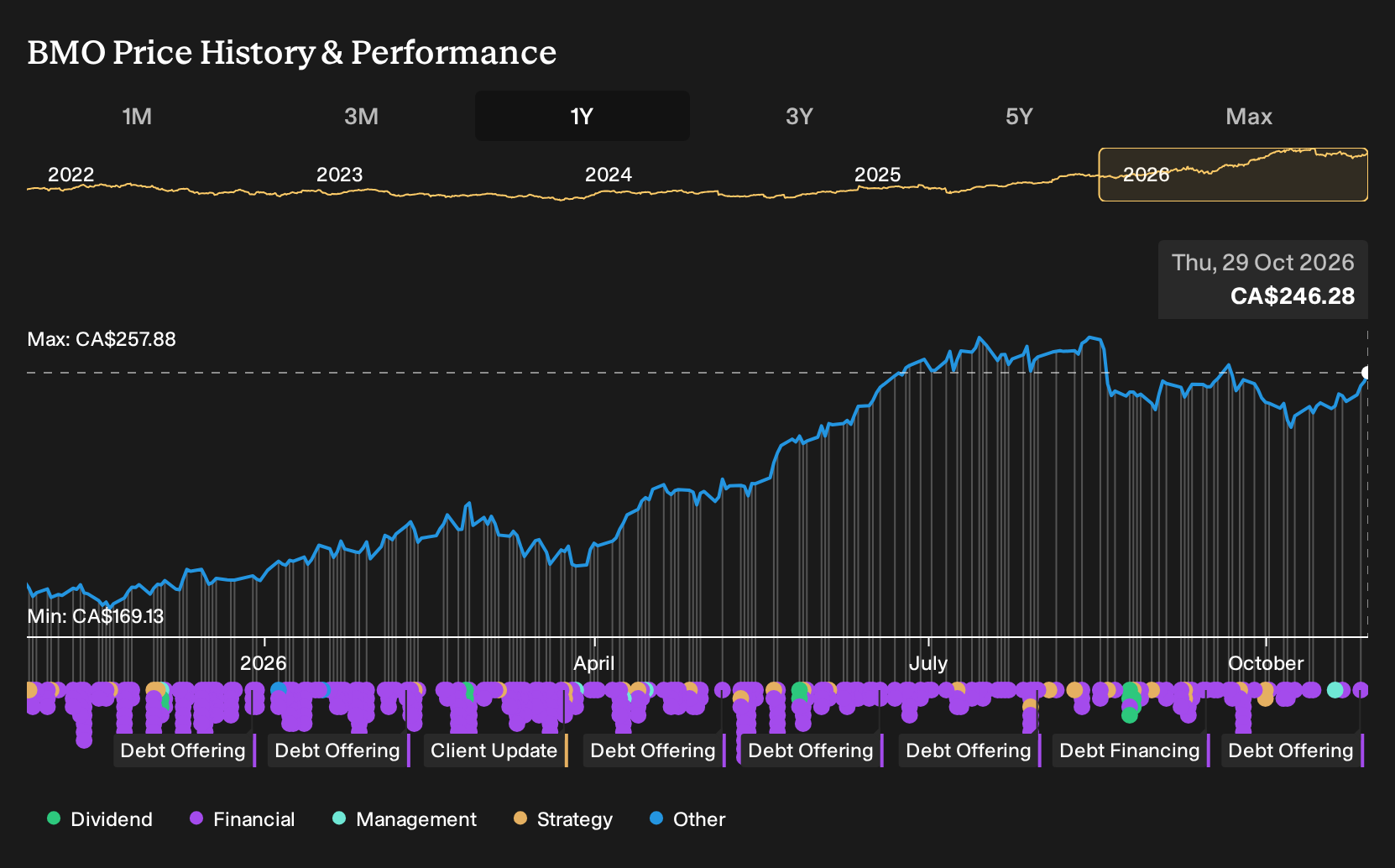
On the numbers provided, the analyst group clusters around a consensus target of CA$255.07 per share, with a spread from CA$206.00 at the low end to CA$295.00 at the top. Against a recent price of CA$232.10, that central estimate is only 9% higher, which signals that many professionals see Bank of Montreal as roughly fairly valued on their base case for revenue, earnings and risk. That limited upside cushion leaves less room for disappointment if net interest income or credit costs respond poorly to the latest rate and funding moves.
To share that view, you would need to be comfortable with a 2029 setup that includes CA$43.3b in revenue, CA$11.6b in earnings and a P/E multiple around 18.0x using a discount rate of about 7.3%. Prime and wholesale funding both feed into whether that package looks credible. If higher benchmark rates support spreads more than they strain borrowers, the bond issuance and prime reset can look like a clean way to lock in term capital at a known cost. If insolvencies or arrears trend poorly, the same combination raises questions about whether the stock still deserves a premium multiple over the broader Canadian banking group.
For you as an investor, the key takeaway is that the rate and bond activity does not sit off to the side as a technical footnote. It shapes how easily Bank of Montreal can hit the revenue and earnings bars that underpin current valuation work and whether the stock continues to justify trading at or above sector P/E levels while analysts only see moderate upside from here.
Uncover how Bank of Montreal's fair value indicates a 4% potential upside to its current price that may not last much longer.
Exploring Other Perspectives
Three fair value estimates from the Simply Wall St Community cluster between about CA$255 and CA$302 per share, so some retail investors see Bank of Montreal close to current levels while others pencil in a much richer outcome. You now need to weigh that spread against fresh catalysts like the 6% callable notes, U.S. leadership changes and capital recycling, then decide which story feels more convincing. Investor opinions can differ sharply, so exploring several alternative viewpoints before acting is essential.
Explore 2 other Bank of Montreal fair value estimates, including one that suggests it could be worth just CA$255.07.
Reach Your Own Conclusion
Don't just follow the ticker. Dig into the data and build a conviction that's truly your own.
- A great starting point for your Bank of Montreal research is our analysis highlighting 3 key rewards and 1 important warning sign that could impact your investment decision.
- See our latest analysis for Bank of Montreal. The report includes a comprehensive fundamental analysis summarized in a single visual, the Snowflake, making it easy to evaluate Bank of Montreal's overall financial health at a glance.
Looking for more Bank of Montreal style ideas?
If the Bank of Montreal story has sharpened your view on risk, reward and balance sheets, it can be useful to line it up against other listed businesses that fit clear, disciplined criteria.
- For investors who want potential upside without ignoring quality, scan a curated group of 8 high quality undiscovered gems that combine strong fundamentals with lower market attention.
- If capital preservation comes first for you, compare Bank of Montreal with a 8 resilient stocks with low risk scores that screens for resilient financial profiles and fewer red flags.
- Income focused readers can benchmark BMO's payout against a 3 dividend fortresses built around companies offering higher yields with an emphasis on durability.
Have feedback on this article? Concerned about the content? Get in touch with us directly. Alternatively, email editorial-team@simplywallst.com