
AbbVie (NYSE:ABBV) posts Q3 2026 sales in line with estimates

Pharmaceutical company AbbVie (NYSE:ABBV) met Wall Street’s revenue expectations in Q3 2026, with revenue rising 10.3% year on year to $17.4 billion. Its non-GAAP profit of $3.82 per share was 1.3% above analysts’ consensus estimates.
For more on AbbVie, read the full research report, available free.
AbbVie (ABBV) Q3 2026 highlights:
- Revenue $17.4 billion vs S&P analysts’ consensus estimates of $17.34 billion (10.3% year-on-year growth, in line)
- Adjusted EPS $3.82 vs S&P analysts’ consensus estimates of $3.77 (1.3% beat)
- Adjusted EPS guidance Management raised and narrowed its full-year adjusted EPS guidance of $13.97 at the midpoint
- Operating margin 36%, up from 12.1% in the same quarter last year
- Market capitalization $513.9 billion
"AbbVie continues to deliver outstanding results, reflecting solid execution across our diverse portfolio," said Robert A. Michael, chairman and chief executive officer, AbbVie. "We also enhanced our long-term growth potential by securing key regulatory approvals, generating differentiated clinical data and completing the acquisition of Apogee Therapeutics. Given our strong outlook and significant momentum, we are once again increasing AbbVie's full-year guidance and raising our quarterly dividend."
Revenue growth
A company’s long-term revenue performance is one signal of its overall quality. Any business can deliver a good quarter or two, but the best consistently grow over the long term. Over the last five years, AbbVie grew its revenue at a tepid 3.7% compounded annual growth rate, an underwhelming result compared with the rest of the healthcare sector. Still, there are things to like about AbbVie.
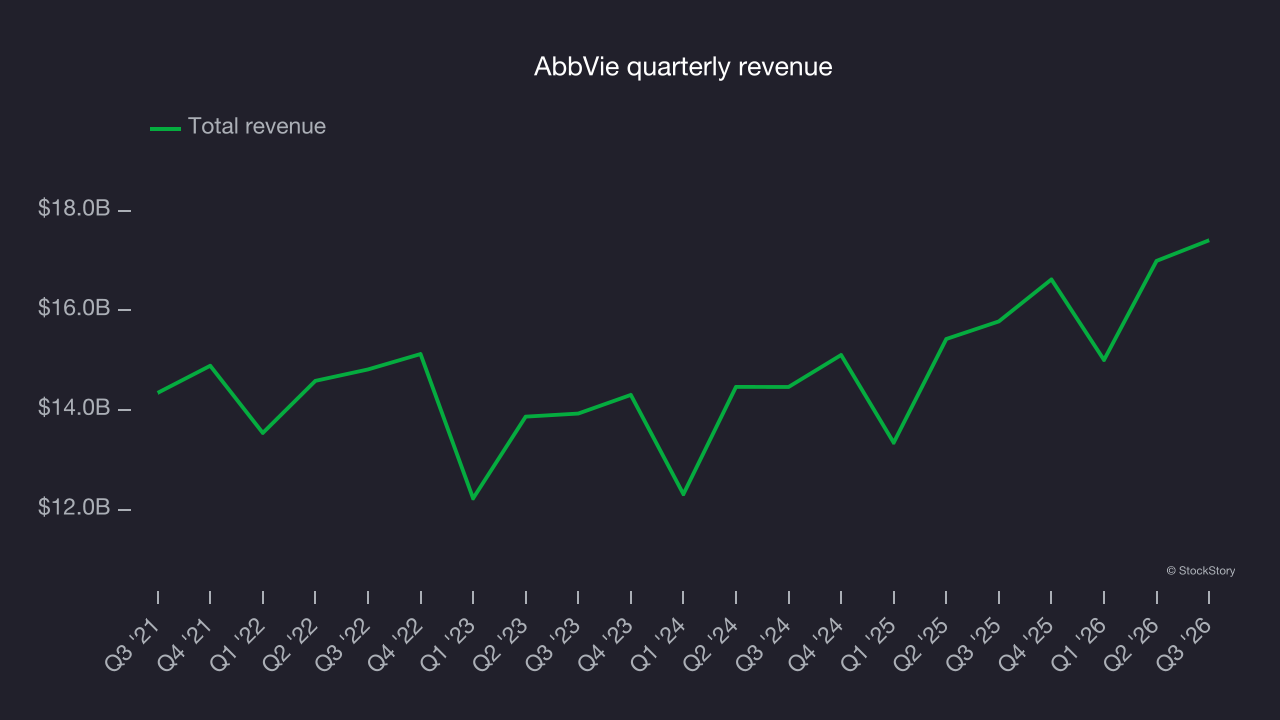
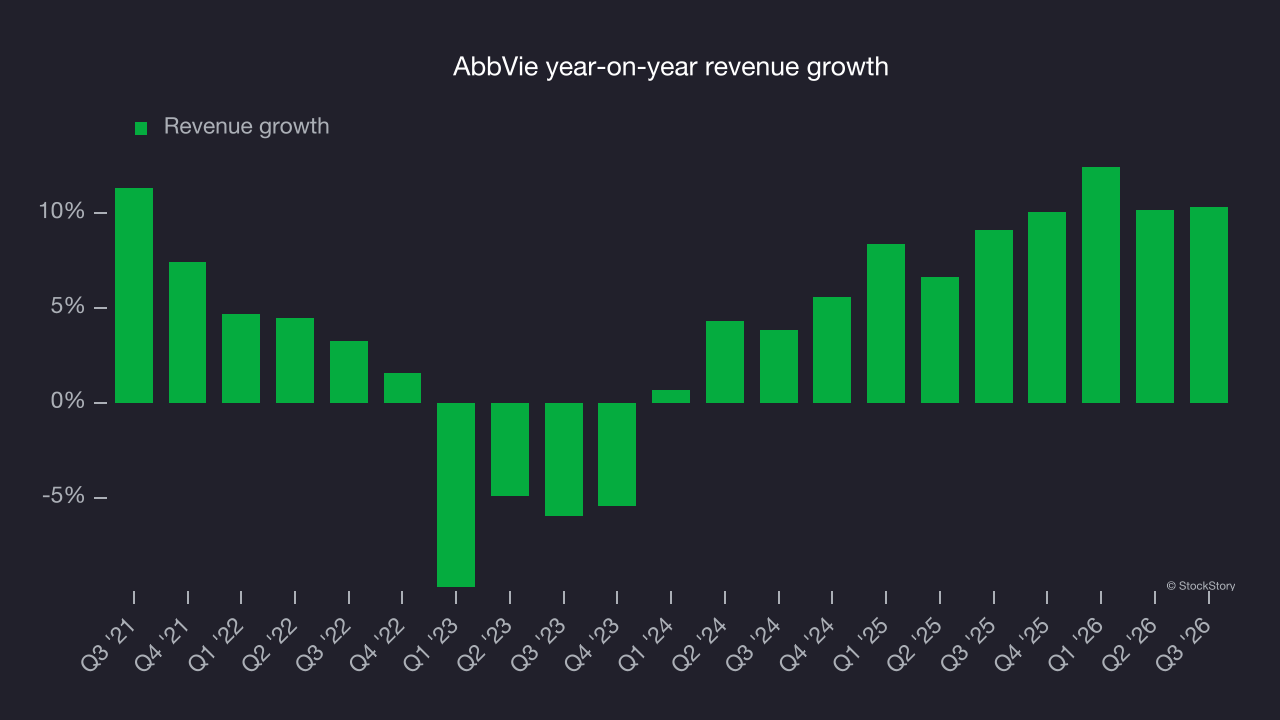
This quarter, AbbVie’s year-on-year revenue growth was 10.3%, and its $17.4 billion of revenue was in line with Wall Street’s consensus estimates.
Looking ahead, sell-side analysts expect revenue to grow 8.8% over the next 12 months, according to S&P, similar to its two-year rate. This projection is particularly noteworthy for a company of its scale and suggests the market expects success for its products and services.
Adjusted operating margin
Adjusted operating margin is a key measure of profitability. Think of it as net income (the bottom line) excluding the impact of non-recurring expenses, taxes and interest on debt – metrics less connected to business fundamentals.
AbbVie has performed well over the last five years. It demonstrated high profitability for a healthcare business, with an average adjusted operating margin of 44%.
Looking at the trend in its profitability, AbbVie’s adjusted operating margin decreased by 9.7 percentage points over the last five years. The company’s two-year trajectory also shows it failed to restore profitability to its peak as its margin fell by 3 percentage points. This was a poor performance, indicating its expenses were rising and it couldn’t pass those costs on to its customers.
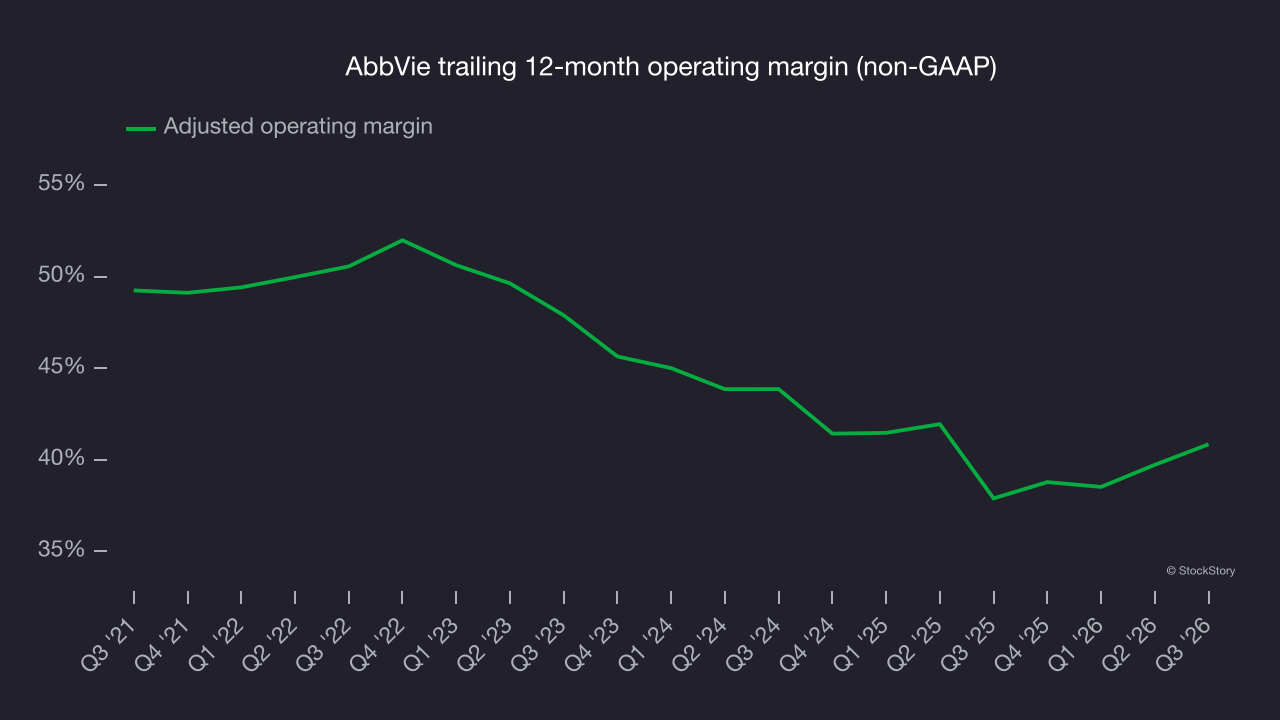
This quarter, AbbVie generated an adjusted operating margin of 36%, up 5.1 percentage points year on year. This increase was a positive development and shows it was more efficient.
Earnings per share
We track the long-term change in earnings per share (EPS) for the same reason as long-term revenue growth. Compared to revenue, however, EPS highlights whether a company’s growth is profitable.
AbbVie’s flat EPS over the last five years was below its 3.7% annualized revenue growth. This tells us the company became less profitable on a per-share basis as it expanded.
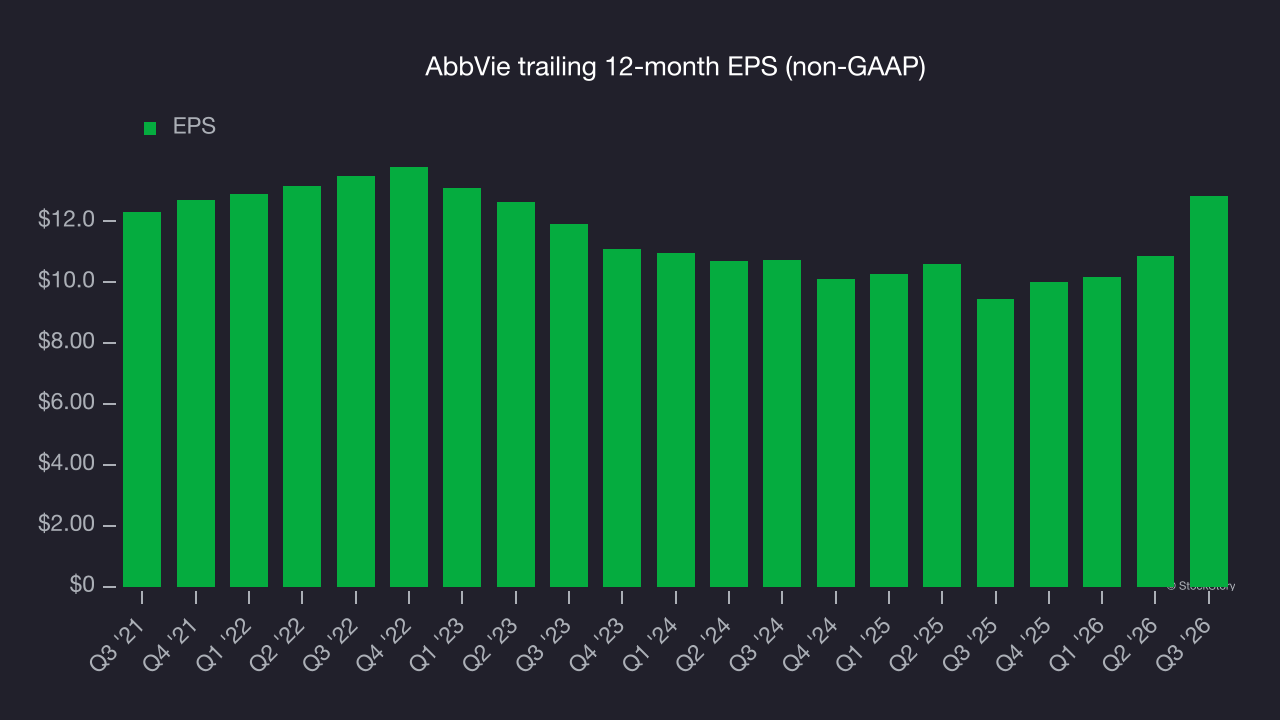
A closer look at AbbVie’s earnings helps explain the drivers of its performance. As noted earlier, AbbVie’s adjusted operating margin expanded this quarter but declined by 9.7 percentage points over the last five years. This was the most relevant factor (aside from the revenue impact) behind its lower earnings; interest expenses and taxes can also affect EPS but don’t tell us as much about a company’s fundamentals.
In Q3, AbbVie reported adjusted EPS of $3.82, up from $1.86 in the same quarter last year. This result beat analysts’ consensus estimates by 1.3%. Over the next 12 months, Wall Street expects AbbVie’s full-year EPS to grow 21.2% from $12.83 to $15.54, according to S&P.
Key takeaways from AbbVie’s Q3 results
AbbVie delivered a mixed third quarter with few positives to highlight. Shares remained flat at $289.68 immediately after the report.
When deciding whether to invest in AbbVie, it’s important to consider its valuation, business qualities and latest quarterly results. For more on these factors, read the full research report here (it’s free).