
Regeneron (NASDAQ:REGN) surprises with strong Q3 2026, stock soars

Biotech company Regeneron (NASDAQ:REGN) reported revenue ahead of Wall Street’s expectations in Q3 2026, with revenue up 36.3% year on year to $5.12 billion. Its non-GAAP profit of $20.07 per share was 23.5% above analysts’ consensus estimates.
For more on Regeneron, read the full research report for free.
Regeneron (REGN) Q3 2026 highlights:
- Revenue $5.12 billion vs S&P analysts’ consensus estimates of $4.60 billion (36.3% year-on-year growth, 11.1% beat)
- Adjusted EPS $20.07 vs S&P analysts’ consensus estimates of $16.25 (23.5% beat)
- Operating margin 40%, rising from 27.3% in the same quarter last year
- Free cash flow margin 29%, declining from 37.8% in the same quarter last year
- Market capitalization $81.76 billion
"This was an outstanding quarter for Regeneron, with Dupixent, EYLEA HD, and Libtayo each achieving record net sales," said Leonard S. Schleifer, M.D., Ph.D., Board co-Chair, President and Chief Executive Officer of Regeneron. "Our pipeline of about 50 product candidates is rapidly advancing. We expect an FDA decision for cemdisiran in generalized myasthenia gravis next month; our Phase 3 programs in multiple myeloma, lymphoma, anticoagulation, and obesity continue to advance; and we have generated encouraging early data in MASH, POTS, and ovarian cancer. Finally, we expanded our alliance with Sanofi to include four Regeneron-invented, next-generation, long-acting antibodies designed to build on the success of Dupixent."
Revenue growth
A company’s long-term performance is an indicator of its overall quality. Any business can put up a good quarter or two, but many enduring ones grow for years. Regeneron’s revenue grew at a mediocre 4.5% compounded annual growth rate over the last five years, falling short of the healthcare sector standard.
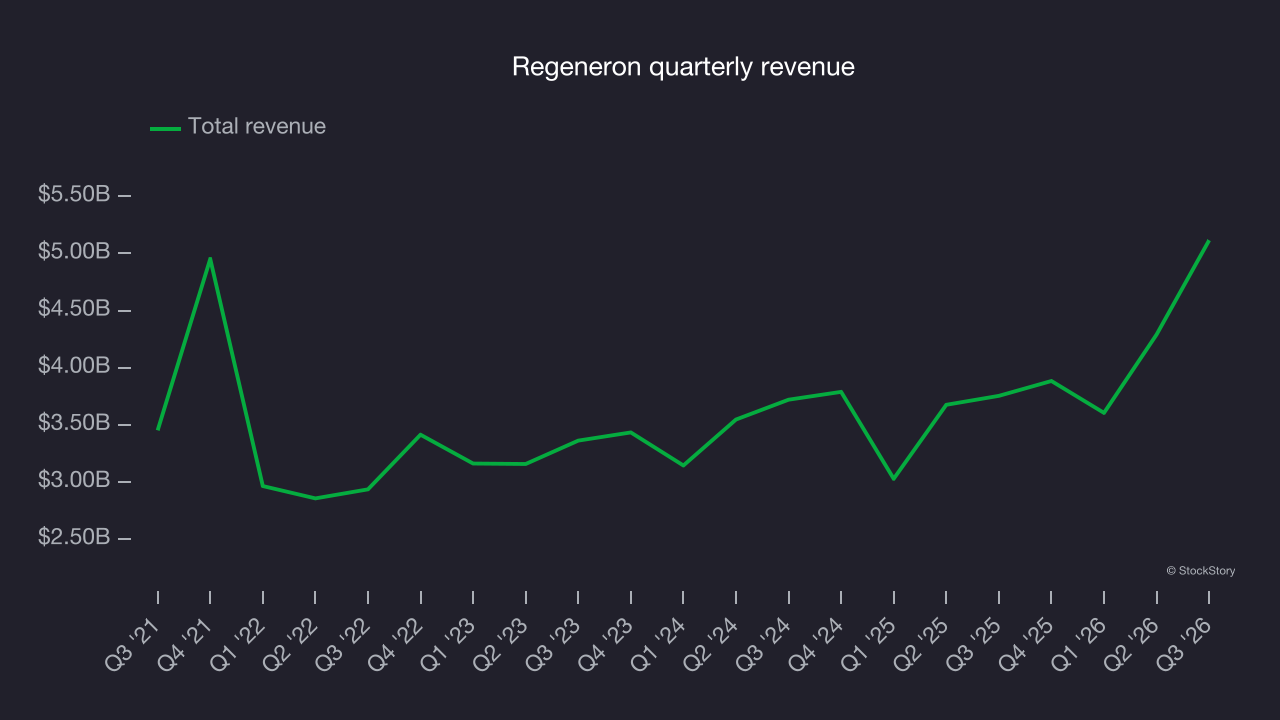
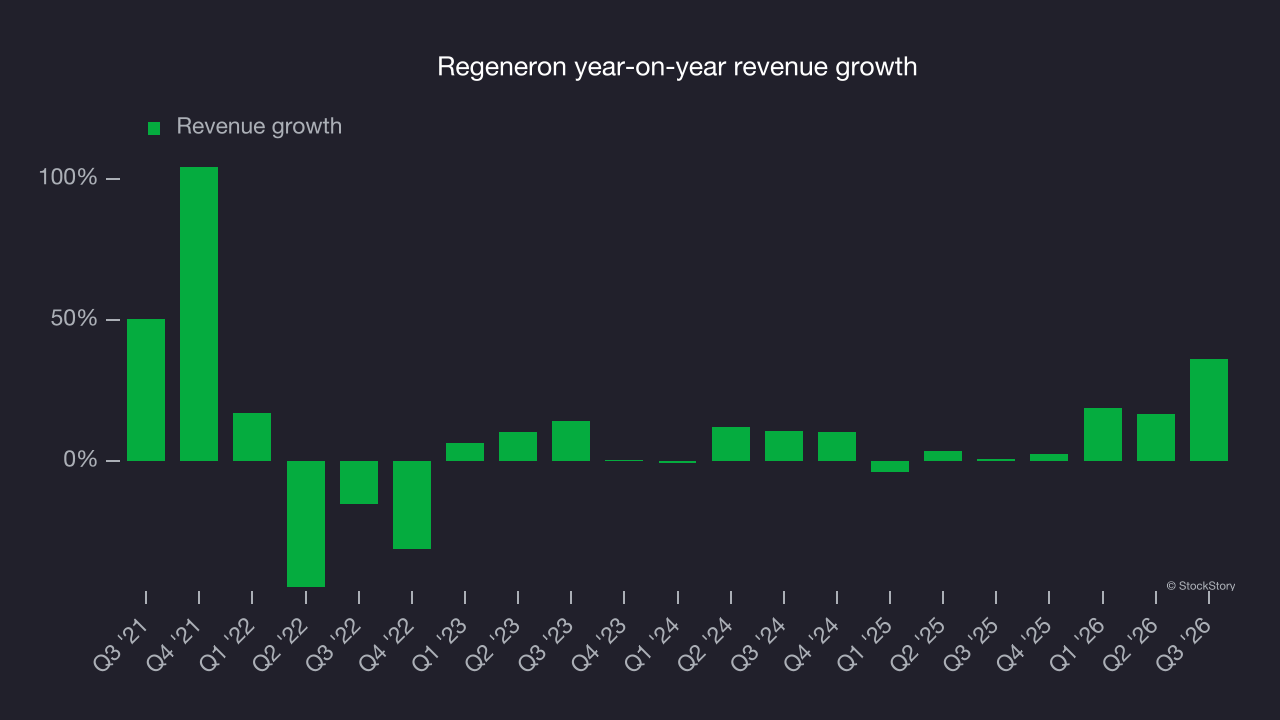
This quarter, Regeneron reported strong year-on-year revenue growth of 36.3%, and its $5.12 billion of revenue exceeded Wall Street’s consensus estimates by 11.1%.
Looking ahead, sell-side analysts expect revenue to grow 13.9% over the next 12 months, according to S&P, an improvement versus the last two years. This projection is particularly healthy for a company of its scale and indicates its newer products and services will catalyze better top-line performance.
Adjusted operating margin
Adjusted operating margin is an important measure of profitability as it shows the portion of revenue left after accounting for all core expenses, from the cost of goods sold to advertising and wages. It’s also useful for comparing profitability across companies because it excludes non-recurring expenses, interest on debt and taxes.
Regeneron has performed well over the last five years. It demonstrated high profitability for a healthcare business, with an average adjusted operating margin of 40%.
Regeneron’s adjusted operating margin decreased by 16.9 percentage points over the last five years. The company’s two-year trajectory also shows it failed to return to peak profitability as its margin fell by 1.2 percentage points. This poor performance shows its expenses were rising and it couldn’t pass those costs on to its customers.
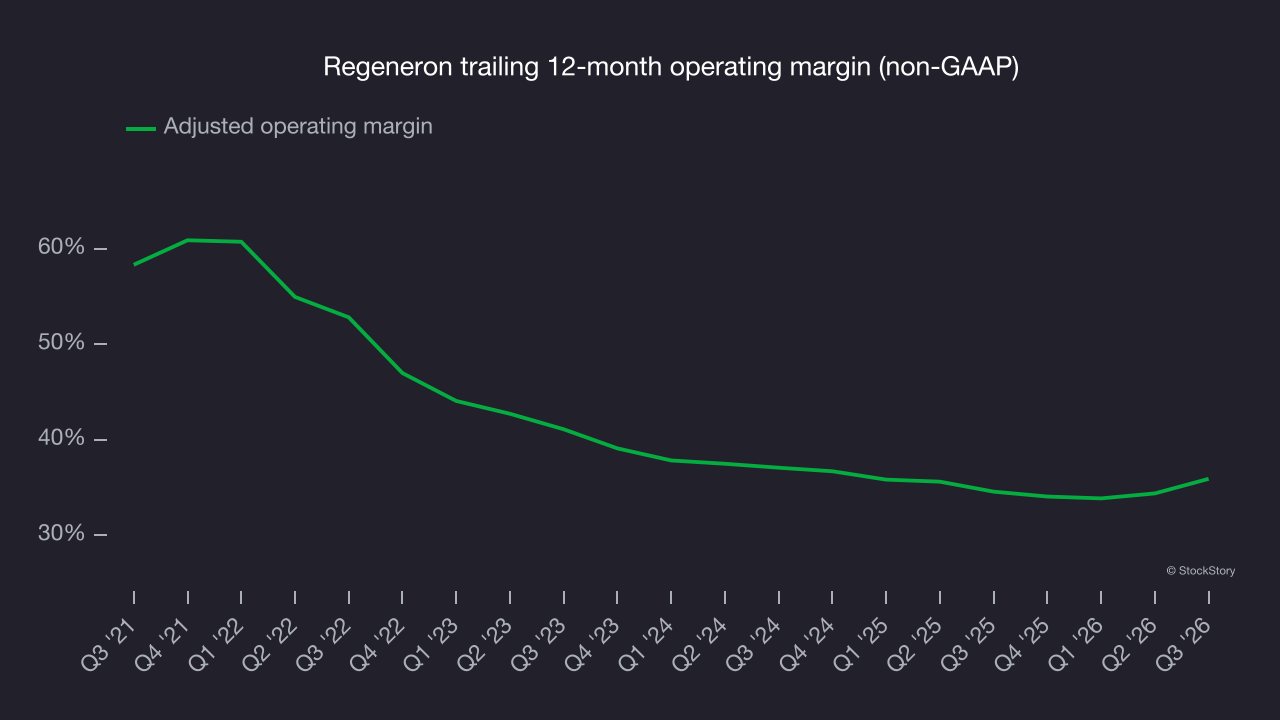
In Q3, Regeneron generated an adjusted operating margin of 40%, up 4.8 percentage points year on year. This increase was a positive development, reflecting greater efficiency.
Earnings per share
Long-term changes in earnings per share (EPS) matter for the same reason as long-term revenue growth. Compared to revenue, however, EPS highlights whether a company’s growth is profitable.
Regeneron’s EPS declined by 1.8% annually over the last five years while its revenue grew by 4.5%. This indicates the company became less profitable on a per-share basis as it expanded due to non-fundamental factors such as interest expenses and taxes.
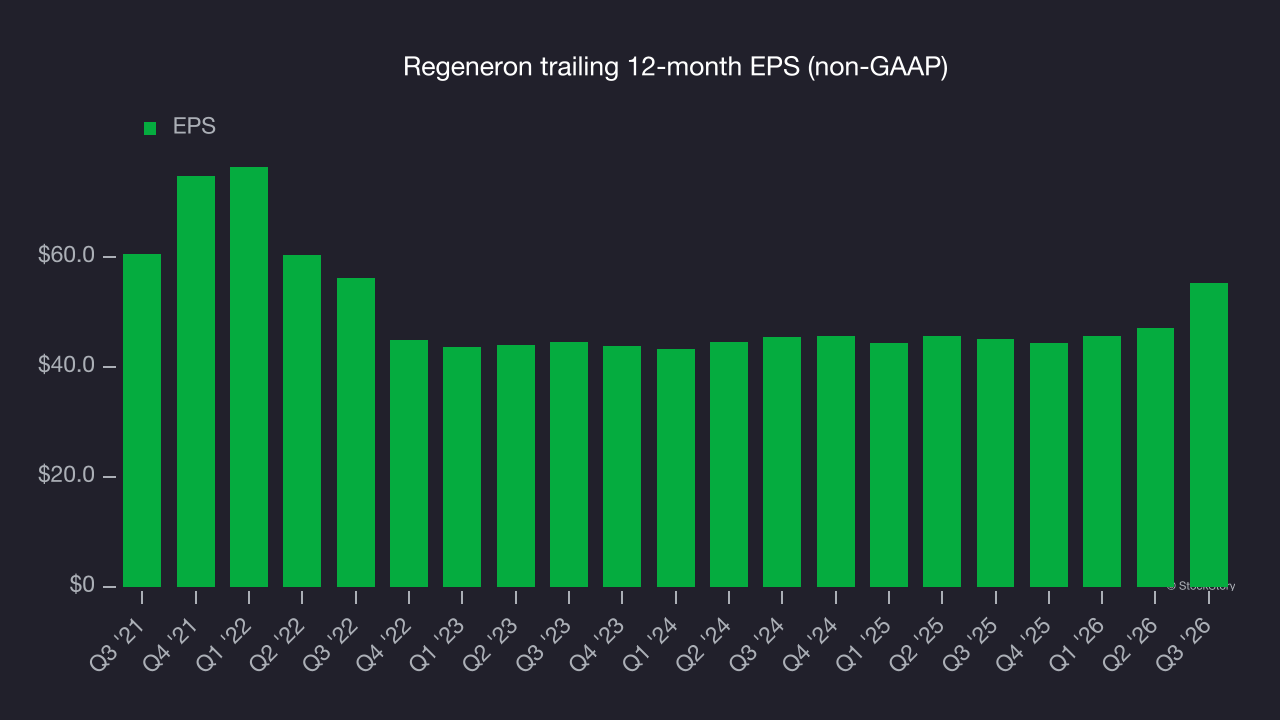
A closer look at Regeneron’s earnings helps explain the drivers of its performance. As mentioned earlier, Regeneron’s adjusted operating margin expanded this quarter but declined by 16.9 percentage points over the last five years. This was the most relevant factor (aside from the revenue impact) behind its lower earnings; interest expenses and taxes can also affect EPS but don’t tell us as much about a company’s fundamentals.
In Q3, Regeneron reported adjusted EPS of $20.07, up from $11.83 in the same quarter last year. The result comfortably beat analysts’ consensus estimates, a positive for shareholders. Over the next 12 months, Wall Street expects Regeneron’s full-year EPS to grow 21.4% from $55.27 to $67.08, according to S&P.
Key takeaways from Regeneron’s Q3 results
Regeneron delivered a solid Q3 with clear positives: Revenue came in well above analysts’ consensus estimates, and EPS also topped Wall Street’s consensus. Shares surged 7% to $876.27 immediately after the results.
Regeneron had a solid quarter, but one earnings result doesn’t necessarily make the stock a buy. That decision should take into account valuation and business quality as well as the latest earnings. For more on Regeneron, read our full research report here (it’s free).