
Is Connecticut Sales Settlement Altering The Investment Case For Sunrun (RUN)?
- Sunrun has agreed to a settlement with the Connecticut Attorney General over past deceptive residential solar sales practices, paying $300,000 to the state and committing to investigate fraud claims within 60 days, with no cap on restitution and a range of remedies for affected customers.
- The requirement for Sunrun to review consumer complaints case by case and potentially cancel contracts or remove systems highlights operational and reputational pressure around how the business acquires and services customers.
- Investors will now be watching how Sunrun's legal settlement obligations could influence the investment narrative around its upcoming earnings release.
Stress test your thesis on Sunrun by comparing it with a curated 30 resilient stocks with low risk scores that have cleaner compliance records and more resilient business profiles.
Sunrun Investment Narrative Recap
To own Sunrun, you need to believe residential solar and storage can still compound steadily even as tax credits evolve, financing stays available and customer demand proves resilient. The Connecticut settlement shines a light on customer acquisition quality and compliance, but on its own it does not change the operational thesis around storage growth, grid services or equipment cost efficiencies.
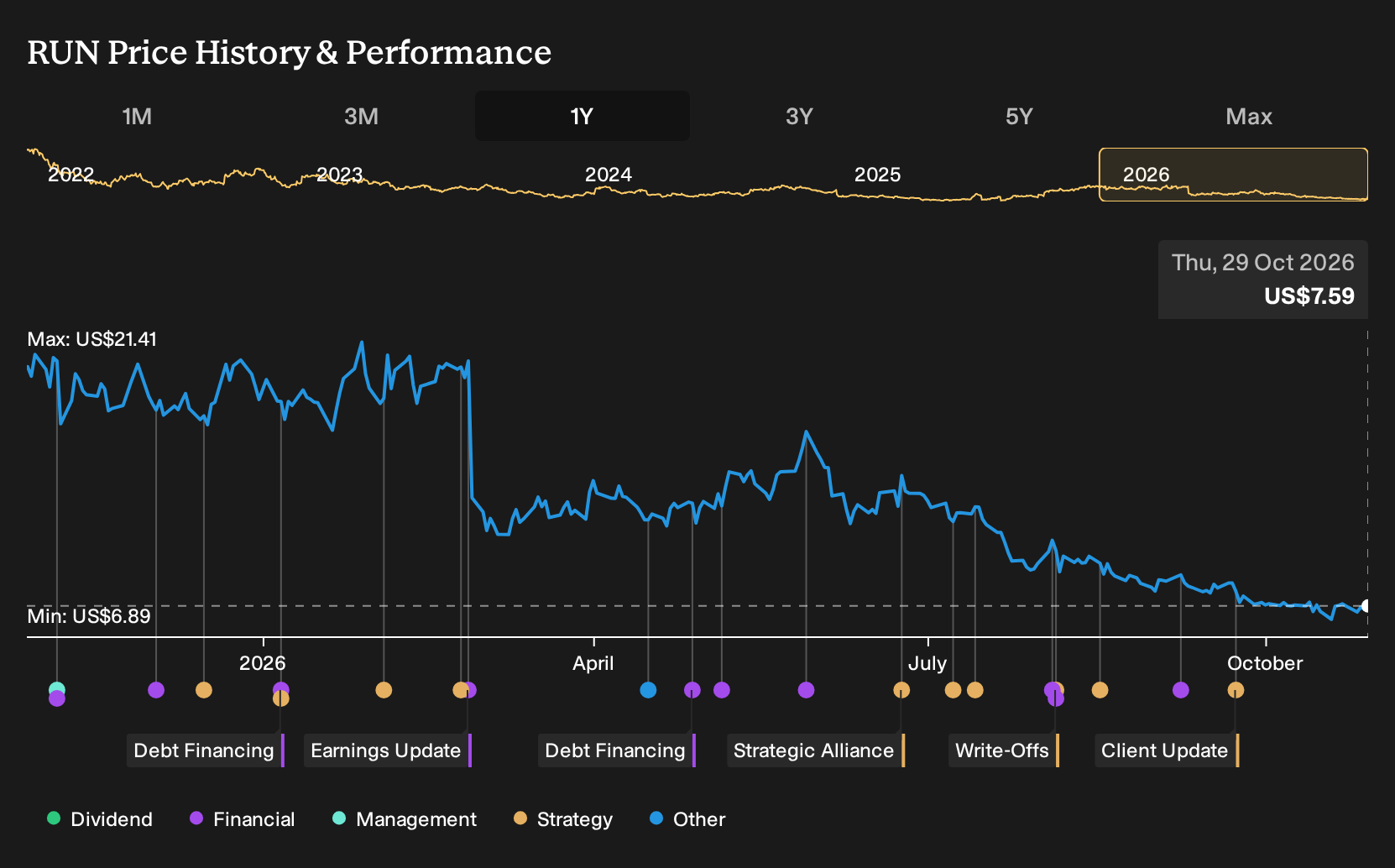
The more immediate swing factor sits with execution on installations and storage attach rates into the next few quarters, especially with earnings due on 4 November 2026. The largest near term risk is that legal, regulatory and financing pressures combine with higher acquisition costs, which could squeeze returns on new projects and stress a capital intensive balance sheet.
The upcoming earnings release is the key near term announcement tied to this moment. Management will have to show how Sunrun is balancing growth in residential solar and batteries with tighter controls on sales practices and complaint handling after the Connecticut agreement, and how that filters through to customer acquisition costs and unit economics.
Investors will likely focus on whether the earnings print and outlook still support the idea of growing storage, grid services and recurring revenue while carrying a leveraged structure and interest costs that are not well covered by earnings. Any extra disclosure on compliance processes, complaint trends or future remediation could shape how much weight you put on regulatory and reputational risk in your Sunrun thesis.
Sunrun's current analyst framework points to revenue of $3.6b and earnings of $616.1m by 2029, based on an assumed 1.1% yearly revenue growth rate. That outlook implies an earnings increase of about $215m from $400.7m today to the 2029 consensus figure.
Uncover why Sunrun's fair value indicates a 93% potential upside to its current price, which could narrow quickly.
Exploring Other Perspectives
One alternate view on Sunrun zooms in on interest rates rather than compliance. The most bearish analysts were already modeling revenue falling to about $2.7b and earnings dropping to $122.1m by 2029, a far weaker path than consensus. Those projections predate the Connecticut settlement, so your take on this news could push you closer to either camp.
Explore 4 other Sunrun fair value estimates, including one that suggests it could be worth just $14.21!
Reach Your Own Conclusion
Disagree with existing narratives? Extraordinary investment returns rarely come from following the herd, so trust your own analysis and judgment.
- A great starting point for your Sunrun research is our analysis highlighting 4 key rewards and 2 important warning signs that could impact your investment decision.
- See our latest analysis for Sunrun. The report includes a comprehensive fundamental analysis summarized in a single visual, the Snowflake, making it easy to evaluate Sunrun's overall financial health at a glance.
Looking for more Sunrun-sized investment ideas?
If this Sunrun story has you rethinking risk, capital intensity and regulation, it can help to broaden your watchlist with other businesses that better match your preferred profile. Use the Simply Wall St Screener to line up alternatives that fit the mix of balance sheet strength, income potential and downside protection you want before you commit fresh capital.
- If capital preservation comes first for you, start with a curated set of companies that screen as more robust and less volatile through the 30 resilient stocks with low risk scores.
- If steady income is a priority, focus on businesses with stronger yields by reviewing a hand picked group of 7 dividend fortresses that already clear fundamental quality checks.
- If you are hunting for fresh ideas beyond the usual tickers, broaden your research with a focused collection of 18 high quality undiscovered gems that pair solid fundamentals with lower market attention.
Have feedback on this article? Concerned about the content? Get in touch with us directly. Alternatively, email editorial-team@simplywallst.com