
Learn Why The Bull Case For RBC Stock Could Change Following Prime Rate Increase
- Royal Bank of Canada recently completed three fixed income offerings totaling about $45.8 million and raised its prime lending rate from 4.45% to 4.70% in late October 2026.
- This combination of new fixed rate notes and a higher prime rate reshapes how Royal Bank of Canada prices credit, manages funding costs, and balances investor demand for yield against borrower sensitivity to higher interest charges.
- This article explores how Royal Bank of Canada's investment narrative connects to this prime rate increase and its effects on lending economics.
Royal Bank of Canada Investment Narrative Recap
To own Royal Bank of Canada, you need to believe a diversified, highly regulated lender can keep turning steady credit demand, fee businesses and AI driven efficiencies into resilient earnings, even while credit costs stay sensitive to trade risks and stressed sectors. The prime rate move and recent bond issuance both speak to a bank leaning into a higher rate backdrop, not transforming its core thesis.
The more pressing near term hinge is how net interest margins and provisions for credit losses evolve as higher borrowing costs meet pockets of strain in logistics, transportation and U.S. commercial real estate. The prime rate increase modestly supports pricing power, while the biggest risk remains that impaired loans at current levels keep pressuring profitability longer than expected.
The most relevant headline for this repricing story is the cluster of fixed income offerings, including the 5.35% notes due 2028 and the 5.85% and 6.2% bonds out to 2038. Together with the prime move, these deals show how Royal Bank of Canada is refreshing its funding at fixed coupons while resetting many loans at higher variable rates.
For you as a shareholder, the trade off is clear. Higher wholesale coupons can lift funding costs, while the prime increase, cross border transaction banking build out and ongoing AI rollout aim to protect margins and fee income. Execution risk sits in the same familiar spots: credit quality, particularly where allowances for bad loans remain below 100%, and integration work around City National and HSBC Canada still need to track in line with expectations.
Royal Bank of Canada Forecasts Behind The Repricing Story
Analyst models around Royal Bank of Canada help explain why a higher prime rate and fresh bond issuance matter so much. The balance of the story is not only about funding costs and loan pricing today. It also rests on where revenue and profit are expected to land over the next few years and how that stacks up against what you pay for the stock right now.
On the top line, consensus expects Royal Bank of Canada to grow revenue by 6.5% a year over the next three years. That pace effectively assumes the bank can keep pulling in more fee based business from wealth, capital markets and transaction services, while still writing enough new loans in a higher rate setting to support that trajectory.
Earnings forecasts give you another checkpoint. Analysts see profit today at about CA$22.2b and are targeting CA$26.7b of earnings by 2029. That is a value increase of about CA$4.5b and implies the group converts modest margin pressure and slightly lower profit ratios into a larger absolute earnings pool, helped by share count reduction and revenue growth.
Royal Bank of Canada's narrative projects CA$81.1b revenue and CA$26.7b earnings by 2029. This requires 6.5% yearly revenue growth and an earnings increase of about CA$4.5b from CA$22.2b.
The timeframe matters. The consensus forecast year is 2029, so these are multi year targets, not next quarter aspirations. That gap between today and 2029 is where the prime rate move, the new fixed income issuance and the broader credit cycle all do their work, either supporting that path or making it harder to reach.
Valuation ties those assumptions to a concrete set of market expectations. To line up with the analyst case, you would be looking at 2029 revenue of CA$81.1b and earnings of CA$26.7b on a P/E of 18.7x. That compares with a current P/E of 17.1x and an industry P/E of 17.1x, so the scenario effectively asks you to accept both higher future earnings and a richer multiple on those profits.
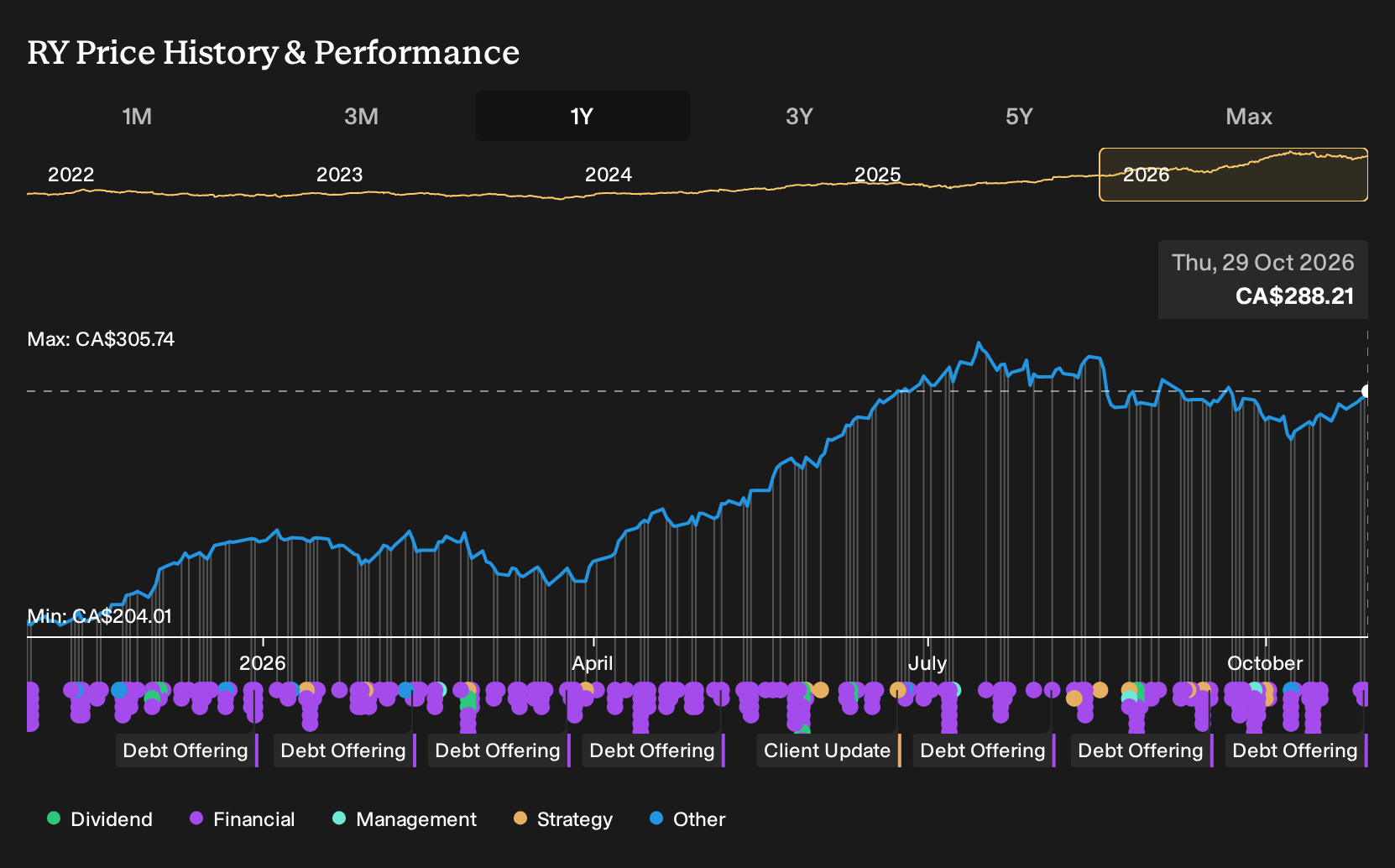
The current analyst price target of CA$302.43, set against a share price of CA$273.78, is 9.5% higher. That gap is not extreme for a large bank, yet it still implies that a fair amount has to go right, from credit trends to AI execution, for the stock to earn that kind of move without stretching the valuation beyond what the sector currently carries.
Uncover how Royal Bank of Canada's fair value indicates a 5% potential upside to its current price before that discount closes.
Exploring Other Perspectives
Three fair value views from the Simply Wall St Community cluster between about CA$302 and CA$355, so some retail investors see Royal Bank of Canada only modestly below their estimates, while others look for far more upside. Set that against credit risk in stressed sectors, along with the AI and wealth growth catalysts, and you can see how opinions can diverge sharply. Use this spread as a prompt to explore several alternative viewpoints before leaning too hard on any single narrative.
Explore 2 other Royal Bank of Canada fair value estimates, including one that suggests up to 23% upside from the current price!
The Verdict Is Yours
Don't just follow the ticker. Dig into the data and build a conviction that's truly your own.
- A great starting point for your Royal Bank of Canada research is our analysis highlighting 4 key rewards and 1 important warning sign that could impact your investment decision.
- See our latest analysis for Royal Bank of Canada. The report includes a comprehensive fundamental analysis summarized in a single visual, the Snowflake, making it easy to evaluate Royal Bank of Canada's overall financial health at a glance.
Looking for more investment ideas beyond Royal Bank of Canada?
Once you have a view on Royal Bank of Canada, it can help to line it up against other opportunities with different risk, income and balance sheet profiles. The Simply Wall St Screener lets you move from a single stock story to a shortlist of candidates that match what you care about most, whether that is stability, value or future potential.
- If capital preservation is near the top of your list, you can start with companies that show more resilient risk profiles through the 8 resilient stocks with low risk scores.
- If value is your focus, compare Royal Bank of Canada with businesses that combine stronger fundamentals and more modest pricing using the 8 high quality undiscovered gems.
- If balance sheet strength matters most, focus on companies that pair solid finances with consistent fundamentals via the list of solid balance sheet and fundamentals (6 results).
Have feedback on this article? Concerned about the content? Get in touch with us directly. Alternatively, email editorial-team@simplywallst.com