
Tosei (TSE:8923) Could Be 35% Overvalued On Shareholder Perk Review
Tosei (TSE:8923) has called a board meeting for October 26, 2026, to review proposed changes to its shareholder benefit program, drawing attention to how the real estate group rewards long term investors.
Recent trading already reflects renewed interest in Tosei, with a 1 month share price return of 6.8% and a year to date gain of 7.8% at a latest share price of ¥1,838. The 1 year total shareholder return of 16.6% and 5 year total shareholder return of 289.2% indicate that long term holders have seen much stronger gains than recent price moves alone suggest, hinting that any shift in the shareholder benefit program could influence how investors balance near term momentum against that longer performance record.
Capitalize on the renewed focus on shareholder rewards by comparing Tosei with other companies that pair investor benefits with solid fundamentals using our curated list of solid balance sheet and fundamentals (23 results).Recent gains now raise a pointed issue for Tosei investors: Is this latest move a catch up to business fundamentals or mostly a burst of enthusiasm around shareholder perks?
Preferred P/E of 11.5x: Is it justified?
Tosei trades on a P/E of 11.5x, which lines up with a share price of ¥1,838 that the market currently prices slightly below the broader JP market valuation but above the real estate peer group.
The P/E ratio compares what investors pay for each unit of earnings. For a real estate focused group like Tosei, this frames how much of those property linked profits the market is willing to capitalise into the share price.
On one hand, Tosei is flagged as good value against its estimated fair P/E of 12.8x and the wider JP market on 13.6x. This points to investors paying less for each unit of earnings than those broader yardsticks. On the other hand, the same 11.5x multiple screens as expensive relative to the JP real estate industry average of 9.7x, which implies the stock is trading at a premium to many sector peers that operate in similar conditions.
That gap to real estate rivals suggests the market is willing to grant Tosei a richer earnings tag than much of the sector. At the same time, the discount to the estimated fair P/E of 12.8x hints at room for that multiple to move closer to the level some models suggest could be justified on fundamentals.
Explore the SWS fair ratio for Tosei.
Result: Price-to-Earnings of 11.5x (ABOUT RIGHT)
Still, the narrative can crack if Tosei mishandles any change to shareholder perks, or if earnings momentum stalls relative to that richer sector multiple.
Find out about the key risks to this Tosei narrative.
Another view on Tosei’s value
The earlier P/E check paints Tosei as roughly in line with what investors are willing to pay for its earnings. A different lens tells a sharper story. Our DCF model estimates future cash flows at about ¥1,188.89 per share, compared with the current ¥1,838 price, which screens as overvalued on this approach. If cash generation does not catch up, it is unclear how patient the market will be.
Look into how the SWS DCF model arrives at its fair value.
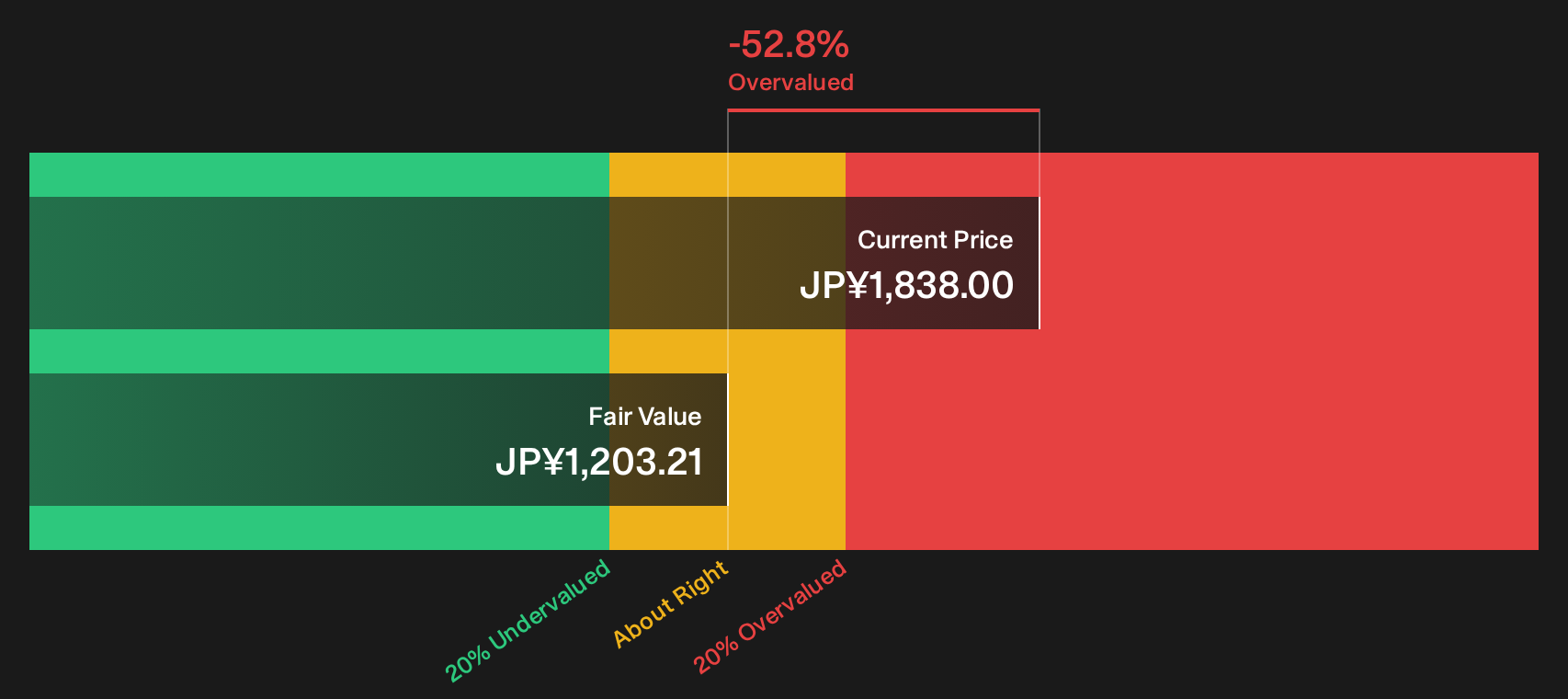
Simply Wall St performs a discounted cash flow (DCF) on every stock in the world every day (check out Tosei for example). We show the entire calculation in full. You can track the result in your watchlist or portfolio and be alerted when this changes, or use our stock screener to discover 15 high quality undervalued stocks. If you save a screener we even alert you when new companies match - so you never miss a potential opportunity.
Next Steps
Mixed signals on Tosei’s valuation and shareholder perks make this a live debate, not a settled verdict. Move quickly, review the full picture, and judge the trade off yourself by weighing the 3 key rewards and 2 important warning signs.
Looking for more Tosei style investment ideas?
If you like the way Tosei blends valuation checks with shareholder rewards, do not stop here. Use the Simply Wall Street screener to widen your opportunity set.
- Target potential mispricing by scanning a curated pool of resilient companies that currently look cheap on both earnings and balance sheet strength through the 15 high quality undervalued stocks.
- Lock in income ideas by filtering for businesses that pair higher yields with balance sheets that can support regular payouts using the 29 dividend fortresses.
- Focus on capital preservation first and hunt for sturdier opportunities with lower risk scores across sectors via the 25 resilient stocks with low risk scores.
Have feedback on this article? Concerned about the content? Get in touch with us directly. Alternatively, email editorial-team@simplywallst.com