
Vistra (VST) Retired $1b Of Preferred Stock, Is The Share Price Already Fully Valued?
Vistra (VST) has retired all one million shares of its 8.0% Series A preferred stock at US$1,000 per share, a US$1.0b redemption that reshapes its capital structure and future financing mix.
Vistra shares trade at US$142.72 after a recent 1-day share price return that declined 2.69% and a 7-day move down 8.59%. The 3-year total shareholder return of about 3.3x and very large 5-year total shareholder return, alongside long-term nuclear contracts and ongoing buybacks, reflect strong historical momentum even as short-term sentiment cools around AI-linked power demand and balance sheet decisions like the preferred redemption reshuffle the risk profile.
Spot opportunities across the wider power and infrastructure theme by scanning our hand-picked 43 power grid technology and infrastructure stocks. These echo the balance sheet reshaping investors just saw at Vistra.Vistra looks like a powerful, contract-heavy utility that recently simplified its capital stack with a US$1.0b preferred redemption. The open question is whether that solid profile is already fully reflected in today’s US$142.72 share price.
Most Popular Narrative: 10% Overvalued
Against Vistra's last close at $142.72, the most followed narrative on the stock now anchors fair value closer to $130. This frames today's pullback less as a collapse and more as a reset after a very strong multi-year run.
My original $291.87 estimate gave too much value to growth without charging enough for the capital required to create it. So I corrected it. Then I discovered that global electricity demand may be entering a regime we have not seen in decades. So I corrected my thinking again.
See why 95 investors see Vistra as 10% overvalued.
Result: Fair Value of $130 (OVERVALUED)
Still, Vistra’s heavy net debt load and recurring hedge related earnings swings could quickly challenge this fair value story if funding costs or sentiment shift.
Find out about the key risks to this Vistra narrative.
Another View: What Vistra’s P/E Ratio Implies
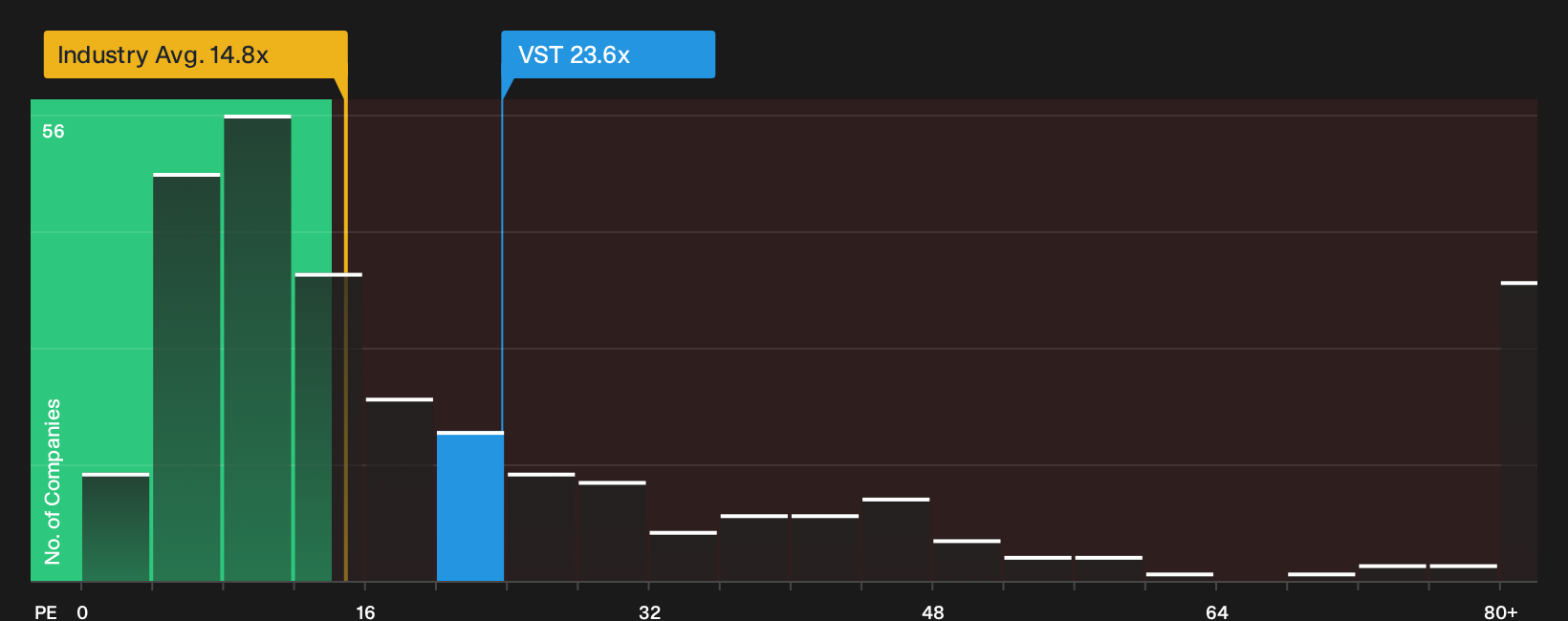
Vistra might look rich on simple comparisons. The stock trades on a P/E of 23.6x, above both the Global Renewable Energy industry around 14.8x and a peer average near 16x. It is still below a fair ratio of 28.2x.
That combination of higher than peers but below the fair ratio leaves investors weighing valuation risk against the possibility that the share price moves toward the implied P/E gap, rather than back toward sector averages.
See what the numbers say about this price — find out in our valuation breakdown.
Next Steps
If this mix of optimism and concern around Vistra feels familiar, treat it as your cue to move quickly and test the numbers yourself. The easiest way to weigh both sides of the debate is to start with the 2 key rewards and 2 important warning signs.
Looking for more investment ideas beyond Vistra?
Do not stop your research with Vistra. The market rarely serves the same setup twice, and fresh opportunities often appear where fewer investors are already looking.
- Target resilient compounding by reviewing companies with a history of payouts and stability through the 6 dividend fortresses.
- Hunt for potential mispricings by scanning our hand picked list of 19 high quality undiscovered gems before they are crowded trades.
- Focus on durability first by filtering for businesses that pair financial strength with calmer risk profiles through the 32 resilient stocks with low risk scores.
Have feedback on this article? Concerned about the content? Get in touch with us directly. Alternatively, email editorial-team@simplywallst.com