
Interest Rates Should Remain Unchanged Today, but at Least 3 Federal Reserve Rate Hikes Are Expected by September 2027
Key Points
Today, Oct. 28, at 2 p.m. ET, the FOMC will announce its decision on interest rates.
Although the odds are strongly against a rate hike today, inflation data points to a ramped-up rate-hiking cycle next year.
If forecasts are correct and the FOMC raises rates several times by September 2027, it could spell disaster for Wall Street and the stock market’s leading catalyst.
Today, Oct. 28, is a huge day for the Dow Jones Industrial Average (DJINDICES:^DJI), S&P 500 (SNPINDEX:^GSPC), and Nasdaq Composite (NASDAQINDEX:^IXIC) -- and it has nothing to do with earnings season. In mere hours, at 2 p.m. ET, Fed Chair Kevin Warsh and the Federal Open Market Committee (FOMC) will announce their decision on interest rates.
Heading into this past weekend, the odds of FOMC policymakers keeping the federal funds target rate unchanged at 3.75%-4.00% surged to almost 91%, up sharply from just 29% one month prior.
Missed AI’s "Act 1"? Act 2 Could Be 15x Bigger. Most investors think they missed the AI boat because they didn't buy Nvidia in 2005. But according to our analysts, we’re only at the end of "Act 1"—the R&D phase. "Act 2" is the global rollout. Continue »
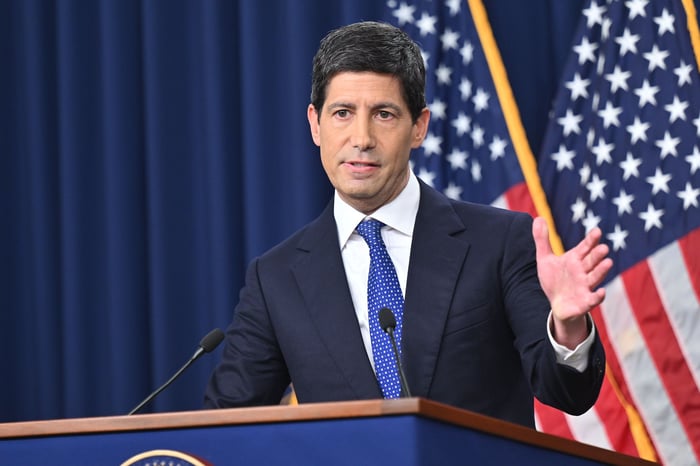
Fed Chair Kevin Warsh and the FOMC are likely to get aggressive with rate hikes at future meetings. Image source: Official Federal Reserve Photo.
But even though interest rates should remain unchanged today, the Fed's fourth rate-hiking cycle of the 21st century looks to be just getting started. That's a potential worst-case scenario for a historically expensive, artificial intelligence (AI)-driven stock market.
Several interest rate hikes are expected by mid-September 2027
Though there's no way to concretely predict what the central bank will do ahead of time, the CME Group's (NASDAQ:CME) FedWatch Tool has an impressive track record of foreshadowing what's to come. The FedWatch Tool uses 30-day Fed Funds futures prices to determine the probabilities of changes to the federal funds target rate.
For the Sept. 15, 2027 meeting, the odds are nearly 56% that policymakers will raise rates by at least 75 basis points (bps):
- Unchanged (3.75%-4.00%): 2.1%
- Raise 25 bps (4.00%-4.25%): 13.1%
- Raise 50 bps (4.25%-4.50%): 29.3%
- Raise 75 bps (4.50%-4.75%): 31.5%
- Raise 100 bps (4.75%-5.00%): 17.8%
- Raise 125 bps (5.00%-5.25%): 5.4%
- Raise 150 bps (5.25%-5.50%): 0.8%
Fed Chair Warsh and the FOMC's meeting minutes have singled out three catalysts driving up consumer prices.
Price changes over last year (September CPI report) Fuel Oil: +74.0% Gasoline: +34.2% Gas Utilities: +5.0% Electricity: +4.4% Overall CPI: +3.7% Food away from home: +3.5% Apparel: +3.4% Shelter: +3.2% Transportation: +2.7% Medical Care: +2.5% Food at home: +1.8% New Cars: +0.6% Used Cars: -1.5%
— Charlie Bilello (@charliebilello) October 14, 2026
President Donald Trump's tariffs have been identified by Warsh and former Fed Chair Jerome Powell as lifting consumer prices. Adding duties to imports risks increasing domestic manufacturing costs, which are then passed on to consumers.
The FOMC also points to the effects of the Iran war on elevated inflation. Iran's closure of the Strait of Hormuz has disrupted the daily flow of around a fifth of the world's crude oil supply, sending fuel prices soaring.
But perhaps the biggest surprise of Warsh's roughly five-month tenure as Fed chair has been the FOMC identifying the AI infrastructure build-out as a meaningful source of inflation.
The AI build-out has been an absolute gift for investors. Several AI hardware stocks have delivered game-changing returns for their shareholders, fueled by otherworldly enterprise demand for their products and persistent supply shortages.
The AI boom is transforming one of the biggest deflationary forces into a key source of US inflation: Import prices for computer and electronic products surged +7.4% in the first 6 months of 2026, to 77.1 points, the highest since January 2016. This also marks a +8.0% YoY jump, the largest annual increase on record. This represents a historic reversal from a downtrend which persisted for over two decades. Between 2006 and 2019, computer and electronic product import prices fell -30%, as improving technology and manufacturing efficiency consistently pushed costs lower. Now, the AI investment boom is straining manufacturing capacity for semiconductors, servers, and electronic components, as companies race to build out AI infrastructure regardless of cost. The AI revolution has flipped technology from a long-term source of deflation into a major driver of inflation.
— The Kobeissi Letter (@KobeissiLetter) July 21, 2026
However, this same dynamic that's powering the Dow Jones Industrial Average, S&P 500, and Nasdaq Composite to new heights is also increasing prices for consumers. Tech hardware supply shortages, coupled with never-before-witnessed pricing power for AI companies, are boosting the prevailing inflation rate with no clear end in sight.
If the CME Group's FedWatch Tool proves accurate and the FOMC gets more aggressive with interest rate hikes at future meetings, it could spell disaster for Wall Street. The AI infrastructure build-out is partially financed with debt. If the cost to borrow rises and the data center build-out slows, even marginally, the second-priciest stock market in history would almost certainly take it on the chin.
Even though interest rates are unlikely to change at today's FOMC meeting, the foundation is being laid for a more aggressive rate-hiking cycle.
Sean Williams has no position in any of the stocks mentioned. The Motley Fool has positions in and recommends CME Group. The Motley Fool has a disclosure policy.