
Q3 Earnings Update Might Change The Case For Investing In Swedbank Stock
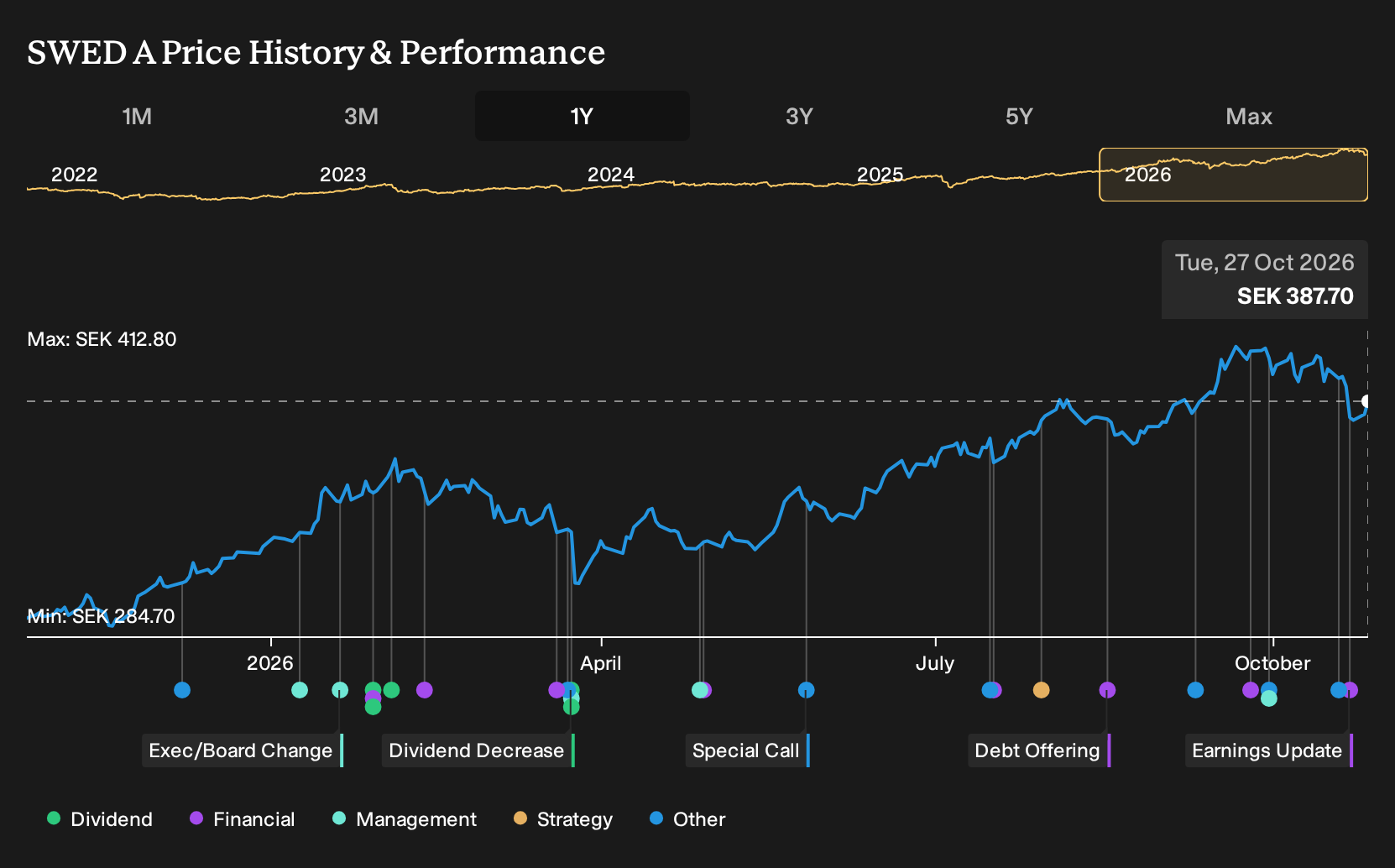
- Swedbank reported third quarter 2026 results with SEK 11,568 million in net interest income and SEK 8,249 million in net income, alongside a completed SEK 642.99 million share buyback of 1,830,000 shares earlier in the year.
- Net interest income for both the quarter and the first nine months of 2026 was higher than a year earlier, while earnings per share were lower, highlighting pressure on profitability even as the balance sheet continues to generate sizeable interest revenue.
- The focus now is how Swedbank's investment narrative absorbs softer earnings per share despite higher net interest income in the latest quarter.
Compare Swedbank's mix of strong interest income, softer earnings per share, and capital returns with other banks by scanning our hand picked list of solid balance sheet and fundamentals (207 results).
Swedbank Investment Narrative Recap
To own Swedbank, you need to be comfortable with a story built on solid net interest income, a large Nordic Baltic footprint, and a long term cost reduction plan. The latest quarter keeps that picture intact. Interest income was SEK 11,568 million, but softer earnings per share underline that profitability is under some pressure while restructuring and divestment plans progress.
Right now, the key short term catalyst is execution on the 2026 to 2028 cost program while handling lower contributions from areas earmarked for sale such as Entercard and PayEx. The biggest risk is that revenue lost from those divestments and any extra Baltic capital requirements erode earnings faster than cost savings arrive. The third quarter figures do not materially change that balance.
The most relevant update for this backdrop is the completed share buyback of 1,830,000 shares for SEK 642.99 million earlier in 2026. That sits alongside the strong CET1 buffer described in the narrative and shows Swedbank using some of its surplus capital for distributions at the same time as it talks about growth and efficiency.
For you as a shareholder or prospective investor, that buyback matters because it interacts directly with the same capital pool that must absorb any extra Baltic risk weights and the income impact from exiting Entercard and PayEx. Future room for similar capital returns will likely depend on how reliably Swedbank delivers its SEK 1b cost run rate reduction target by the end of 2028 while keeping earnings from drifting lower.
What The Swedbank Analyst Consensus Is Building In
Swedbank's narrative projects SEK 79.0b revenue and SEK 35.7b earnings by 2029. This assumes 4.5% yearly revenue growth and an earnings increase of about SEK 4.5b from SEK 31.2b today.
Analysts are essentially sketching a steady grind higher rather than a dramatic reset. Revenue is assumed to rise at 4.5% a year and profit margins are pencilled in to edge from 45.1% to 45.2% by around 2029. In that framework, earnings are expected to move from SEK 31.2b today to SEK 35.7b, with a more optimistic camp modelling as much as SEK 44.0b.
For you, the key link back to Swedbank's recent quarter is how that softer earnings per share profile lines up with this earnings path. Consensus assumes that restructuring, Baltic growth and mortgage share rebuild work well enough for profits to climb a little over SEK 4b over the next few years. Any hit from Entercard, PayEx or extra Baltic capital requirements that displaces that uplift risks leaving the bank tracking under the SEK 35.7b reference point even if net interest income stays healthy.
Uncover why Swedbank's fair value indicates a 5% potential upside to its current price that could narrow quickly.
Exploring Other Perspectives
One alternative view puts Swedbank’s cost work as the real catalyst rather than capital returns. The most upbeat analysts were already pencilling in revenue of about SEK 87.1b and earnings of SEK 44.0b by 2029. Your job now is to judge whether softer earnings per share and the completed buyback shift that story or instead simply require a rewrite of the assumptions behind it.
Explore 3 other Swedbank fair value estimates, including one that suggests as much as 68% upside from the current price.
Reach Your Own Conclusion
Disagree with existing narratives? Extraordinary investment returns rarely come from following the herd, so go with your instincts.
- A great starting point for your Swedbank research is our analysis highlighting 2 key rewards and 3 important warning signs that could impact your investment decision.
- See our latest analysis for Swedbank. The report includes a comprehensive fundamental analysis summarized in a single visual, the Snowflake, making it easy to evaluate Swedbank's overall financial health at a glance.
Looking For More Ideas Beyond Swedbank?
If Swedbank has sharpened your view on what makes a bank investment compelling, use that same checklist across a wider universe of opportunities with the Simply Wall St Screener.
- For investors who care most about quality at a sensible entry point, scan a curated set of 195 high quality undervalued stocks that combine fundamentals with appealing valuations.
- If capital preservation and smoother ride potential matter more to you than chasing every rally, filter for 223 resilient stocks with low risk scores that score well on balance sheet strength and risk metrics.
- When you want sturdier financial footing and cleaner accounts to back up any story, start with a 610 high quality undiscovered gems that already clear tough quality hurdles.
Have feedback on this article? Concerned about the content? Get in touch with us directly. Alternatively, email editorial-team@simplywallst.com