
Meta (META.US) head-on OpenAI and Anthropic: Released Muse Code, the first AI programming agent, focusing on low prices and “crash recovery” capabilities
The Zhitong Finance App learned that at a time when the AI programming tool circuit is becoming increasingly crowded, Meta (META.US) has finally dropped a bombshell. On Wednesday, Meta CEO Mark Zuckerberg officially announced on social media that the company launched its first AI programming agent, Muse Code (beta), directly challenging OpenAI's Codex and Anthropic's Claude Code.
This move means that Meta has taken a critical step in the generative AI application layer. It is also a new monetization path shown to the outside world against the backdrop of pressure on its advertiser industry and the crazy burning of AI infrastructure.
Performance is not the best, but “reliability” and “low price” became breakthroughs
Muse Code is not an isolated product; it is driven by Muse Spark 1.2, the latest basic model launched by Meta Super Smart Labs. According to several benchmark tests published by Meta, Muse Code is not yet as good as top competitors in terms of programming ability, but the differentiating characteristics it shows are very clear.
In the Terminal-Bench 2.1 benchmark, the combined score of Muse Code and Muse Spark 1.2 was 82.9%. Although not as good as Anthropic Claude Code's 86.7% run on Opus 5, it successfully surpassed OpenAI's GPT-5.6 Terra based Codex (81.8%) and Grok Build (81.6%). In terms of DeepSWE 1.1 and Meta's internal coding benchmarks, which measure the coding ability of smart devices, their results are also in the catcher position, falling about 5 to 9 percentage points behind Opus 5 and Codex, respectively.
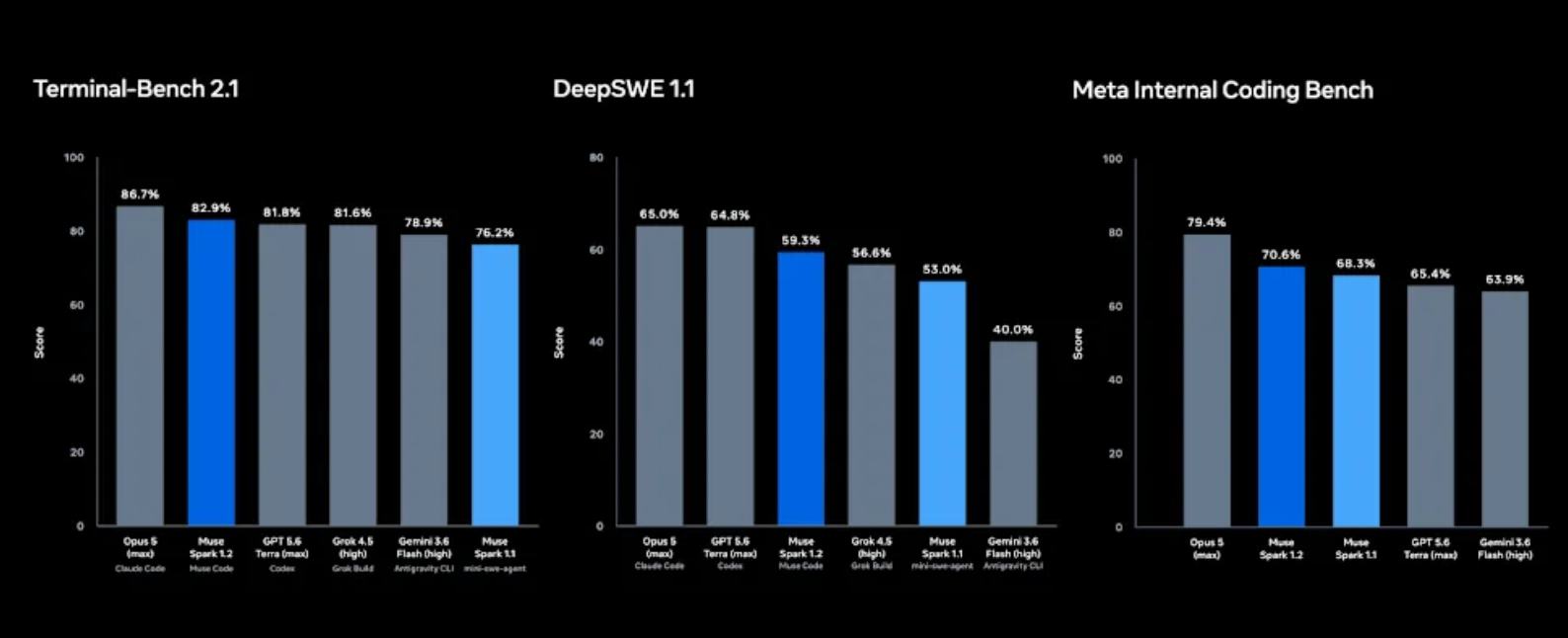
Since pure performance has yet to reach its peak, Meta has locked the selling point on engineering reliability and extreme cost performance. In an interview, Meta's chief AI officer, Alexandr Wang said bluntly that compared to Anthropic and OpenAI products, Meta's style of play is “differentiation in terms of price rather than ability.”
The “contributor tier” pricing introduced by Muse Code is lethal, and its price is less than one-tenth of regular pay-as-you-go, but only if developers who choose the lowest price tier actively agree to help improve the model. This involves Meta's use of third-party data to enhance the underlying technology. For extremely sensitive enterprise users, Meta has also begun accepting “zero data retention” requests, promising not to keep developer data for training.
Designed for long-cycle tasks: crashes can be recovered, and can run continuously for 24 hours
As a programming tool with the ability to make autonomous decisions, Muse Code is designed to handle complex software engineering tasks with large codebases. It can independently complete the entire process of planning revisions, code writing, and verification results, and can also coordinate parallel processing of multiple persistent sub-agents at the same time to improve the speed and accuracy of solving problems.
One of the features that received the most attention from developers is its runtime mechanism. The system will record every model call, tool run, approval, and edit in the local event log, forming a single trusted data source. This means that if an intelligent body crashes or is interrupted during a long period of operation, it can accurately recover from the breakpoint without having to start over again. While competitors have yet to use this as a core selling point, Meta believes this is the most attractive feature for programmers developing long-cycle, high-complexity tasks.
In a stress test, Muse Code iteratively optimized the kernel for over 1,000 tool calls on the Nvidia (NVDA.US) Hopper GPU, and the entire task lasted up to 24 hours. In addition, Muse Code also demonstrated powerful multi-modal capabilities: in one demonstration, the user only dropped an aerial video file of the house into the terminal, and Muse Code was able to interpret the video content and directly generate a visually rich website with a reservation function.
AI strategy reorganization: Alexandr Wang leads a team, eager to prove monetization
The introduction of Muse Code is a core result of Zuckerberg's reorganization of AI strategy. Alexandr Wang, who joined Meta's Super Smart Lab in June last year, is a central figure in this transformation. Previously, Meta's self-developed model clearly lagged behind ChatGPT and Claude in key capabilities such as programming. Zuckerberg also publicly acknowledged this last month, and revealed that the company was already using the previous version of Muse Spark to build application functions.
Bringing the programming agent to market comes at a time when Meta is financially sensitive. Last week, Meta shares fell in response to the company's weak revenue expectations and disclosure of a sharp contraction in free cash flow in the second quarter. The market is generally concerned about whether the huge amount of money it invests in data centers and related computing power facilities every year will bring corresponding returns. The paid API interface provided by Muse Code is an important attempt by Zuckerberg to directly generate revenue using AI in addition to the advertising business, which accounts for 98% of the company's revenue.
Wang revealed that currently developers can use Muse Code on Meta's developer page for pay-as-you-go through the API, and the model will later be launched on the OpenRouter platform that hosts popular open source models such as DeepSeek.