'%3e %3cpath d='M41.7832962%2c0 C41.9459106%2c0 42.0882746%2c0.0866854658 42.1666825%2c0.216359069 C43.8289923%2c2.66540836 44.7676281%2c5.46271319 44.7676281%2c8.43208061 C44.7676281%2c18.1345746 34.7460532%2c26 22.383814%2c26 C10.0215749%2c26 0%2c18.1345746 0%2c8.43208061 C0%2c5.46716016 0.935826425%2c2.67378733 2.58829888%2c0.223985685 C2.67109477%2c0.0916264068 2.81687473%2c0 2.9840593%2c0 C3.23130408%2c0 3.43173558%2c0.200393004 3.43173558%2c0.447590303 C3.43173558%2c0.475056669 3.42926112%2c0.501945205 3.42452292%2c0.528045226 L3.41810883%2c0.550292077 C3.37800671%2c0.861741908 3.3575721%2c1.17661276 3.3575721%2c1.49443092 C3.3575721%2c7.98336 11.2132389%2c12.5742305 22.383814%2c12.5742305 C33.5543891%2c12.5742305 41.410056%2c7.98336 41.410056%2c1.49443092 C41.410056%2c1.17865223 41.3898828%2c0.865783153 41.3502888%2c0.556288325 C41.3402868%2c0.521941442 41.3356199%2c0.48531078 41.3356199%2c0.447590303 C41.3356199%2c0.200393004 41.5360514%2c0 41.7832962%2c0 Z' id='logo%e5%a4%87%e4%bb%bd-6' fill='white'%3e%3c/path%3e %3cpath d='M74.6899231%2c3.74404927 C75.2411227%2c3.74404927 75.7734299%2c3.66184338 76.2756219%2c3.50883715 L73.8159676%2c20.8666902 C73.5770593%2c22.5662954 72.8072434%2c23.0518969 71.4268838%2c23.0518969 L69.9934336%2c23.0518969 C68.7988917%2c23.0518969 68.1618027%2c22.458384 67.7901674%2c20.893668 L65.6930827%2c11.9909739 C65.639992%2c11.7481731 65.639992%2c11.6942174 65.5338105%2c11.6942174 C65.427629%2c11.6942174 65.4010836%2c11.7481731 65.3479929%2c11.9909739 L63.2509082%2c20.893668 C62.8792729%2c22.458384 62.2421839%2c23.0518969 61.047642%2c23.0518969 L59.6141918%2c23.0518969 C58.2338322%2c23.0518969 57.4640163%2c22.5662954 57.225108%2c20.8666902 L54.7463723%2c3.37406084 C55.3593498%2c3.61307396 56.0249975%2c3.74404927 56.7207458%2c3.74404927 C57.3314263%2c3.74404927 57.918917%2c3.64314414 58.4679557%2c3.4568446 L60.3574623%2c19.3829078 C60.3840076%2c19.6257086 60.3840076%2c19.7875757 60.4901891%2c19.7875757 C60.5963706%2c19.7875757 60.5963706%2c19.6257086 60.6494614%2c19.3829078 L62.9323637%2c9.91367858 C63.0916359%2c9.26620991 63.4632712%2c8.69967483 64.6047223%2c8.69967483 L66.4363532%2c8.69967483 C67.5778044%2c8.69967483 67.9494397%2c9.26620991 68.1087119%2c9.91367858 L70.3916142%2c19.3829078 C70.4447049%2c19.6257086 70.4447049%2c19.7875757 70.5508864%2c19.7875757 C70.6570679%2c19.7875757 70.6570679%2c19.6257086 70.6836133%2c19.3829078 L72.5891207%2c3.32292288 C73.2365902%2c3.59432921 73.9460524%2c3.74404927 74.6899231%2c3.74404927 Z' id='Combined-Shape' fill='white'%3e%3c/path%3e %3cpath d='M84.5933901%2c7.43171536 C88.6813779%2c7.43171536 90.9111894%2c10.2643908 90.9111894%2c14.2840921 L90.9111894%2c15.7948523 C90.9111894%2c16.2264981 90.7519172%2c16.4692988 90.3802819%2c16.4692988 L81.7264895%2c16.4692988 L81.7264895%2c16.5502324 C81.7264895%2c18.1149484 82.3635785%2c19.9764208 84.9119346%2c19.9764208 C86.849747%2c19.9764208 88.6813779%2c19.8145536 89.7962837%2c19.7066422 L89.8759198%2c19.7066422 C90.1413735%2c19.7066422 90.3537366%2c19.8415315 90.3537366%2c20.1113101 L90.3537366%2c21.8918489 C90.3537366%2c22.3234947 90.2741004%2c22.5123397 89.7962837%2c22.5932733 C88.0708343%2c22.9170076 87.0355646%2c23.0518969 84.6464808%2c23.0518969 C81.9919433%2c23.0518969 78.2225%2c21.5950924 78.2225%2c16.2804538 L78.2225%2c14.2840921 C78.2225%2c10.0755457 80.5319476%2c7.43171536 84.5933901%2c7.43171536 Z M84.5933901%2c10.5071915 C82.9475768%2c10.5071915 81.7530349%2c11.6942174 81.7530349%2c13.8254684 L81.7530349%2c13.9333799 L87.3806545%2c13.9333799 L87.3806545%2c13.8254684 C87.3806545%2c11.7211953 86.2392034%2c10.5071915 84.5933901%2c10.5071915 Z' id='Combined-Shape' fill='white'%3e%3c/path%3e %3cpath d='M97.4154906%2c2.98826245 L97.4148064%2c7.62056039 C98.3969853%2c7.48567108 99.3260735%2c7.43171536 99.9631625%2c7.43171536 C104.236968%2c7.43171536 106.307507%2c9.99461216 106.307507%2c14.2031585 L106.307507%2c16.2804538 C106.307507%2c20.4890001 104.236968%2c23.0518969 99.9631625%2c23.0518969 C98.2642584%2c23.0518969 96.2733553%2c22.7821183 94.627542%2c22.3504725 C94.0169984%2c22.1886054 93.9108169%2c22.0267382 93.9108169%2c21.6220703 L93.9098179%2c3.08694115 C94.4185466%2c3.24434375 94.9584615%2c3.32900525 95.5178331%2c3.32900525 C96.184659%2c3.32900525 96.8238351%2c3.20869291 97.4154906%2c2.98826245 Z M99.9631625%2c10.3453244 C99.3260735%2c10.3453244 98.1580769%2c10.4262579 97.4148064%2c10.5341694 L97.4148064%2c19.9494429 C97.9191686%2c20.0573544 99.007529%2c20.1382879 99.9631625%2c20.1382879 C102.246065%2c20.1382879 102.803518%2c18.4926384 102.803518%2c16.2804538 L102.803518%2c14.2031585 C102.803518%2c11.9909739 102.246065%2c10.3453244 99.9631625%2c10.3453244 Z' id='Combined-Shape' fill='white'%3e%3c/path%3e %3cpath d='M111.036668%2c8.72457747 C111.579488%2c8.72457747 112.103987%2c8.64485191 112.599444%2c8.49629404 L112.598761%2c16.5232546 C112.598761%2c19.3289521 113.607485%2c19.9764208 115.147117%2c19.9764208 L115.306389%2c19.9764208 C116.846021%2c19.9764208 117.854746%2c19.3289521 117.854746%2c16.5232546 L117.854207%2c8.4334735 C118.406525%2c8.62226395 118.997939%2c8.72457747 119.612866%2c8.72457747 C120.223332%2c8.72457747 120.810625%2c8.62374317 121.359498%2c8.43756894 L121.358735%2c16.5232546 C121.358735%2c22.4044283 116.872567%2c23.0518969 115.306389%2c23.0518969 L115.060464%2c23.0512514 C113.42215%2c23.0271041 109.094772%2c22.2994073 109.094772%2c16.5232546 L109.094446%2c8.36700801 C109.698522%2c8.59813531 110.353066%2c8.72457747 111.036668%2c8.72457747 Z' id='Combined-Shape' fill='white'%3e%3c/path%3e %3cpath d='M128.314162%2c3.03790128 L128.313623%2c22.269539 C128.313623%2c22.5662954 128.10126%2c22.836074 127.809261%2c22.836074 L125.340541%2c22.836074 C125.048542%2c22.836074 124.809634%2c22.5662954 124.809634%2c22.269539 L124.809455%2c3.04219481 C125.358161%2c3.22824247 125.945253%2c3.32900525 126.555503%2c3.32900525 C127.17043%2c3.32900525 127.761844%2c3.22669173 128.314162%2c3.03790128 Z' id='Combined-Shape' fill='white'%3e%3c/path%3e %3cpath d='M133.90653%2c3.32900525 C134.473329%2c3.32900525 135.02015%2c3.24208064 135.534793%2c3.08063296 L135.533966%2c22.269539 C135.533966%2c22.5662954 135.321603%2c22.836074 135.029603%2c22.836074 L132.560884%2c22.836074 C132.268884%2c22.836074 132.029976%2c22.5662954 132.029976%2c22.269539 L132.029909%2c2.99605058 C132.615669%2c3.21152525 133.2476%2c3.32900525 133.90653%2c3.32900525 Z' id='Combined-Shape' fill='white'%3e%3c/path%3e %3c/g%3e %3c/g%3e %3c/g%3e%3c/svg%3e)



Manus AI is a general-purpose autonomous agent designed to plan, research, and execute complex multi-step tasks, including financial analysis workflows. For US investors exploring AI-powered research tools, understanding how Manus AI for trading and investing fits alongside a regulated brokerage platform is increasingly relevant. This article covers how Manus works, its documented finance use cases, how it compares to competing AI agents, and how Webull supports investors who want to act on their research.
Key Takeaways
Manus AI is an autonomous agent that can analyze stock data, generate financial reports, and monitor market trends without step-by-step user prompting.
It is a research and analysis tool, not a trade execution platform, and does not provide personalized investment advice.
Manus 2.0 introduced Cascade, Automations, and Cloud Computer for more efficient and persistent workflows.
For actual trade execution in US markets, a FINRA-registered broker-dealer such as Webull is required.
All investing involves risk, including the potential loss of principal. Past performance does not guarantee future results.
Part 1. What Is Manus AI and How Does It Work for Finance
1.1 Architecture: The Three-Agent System
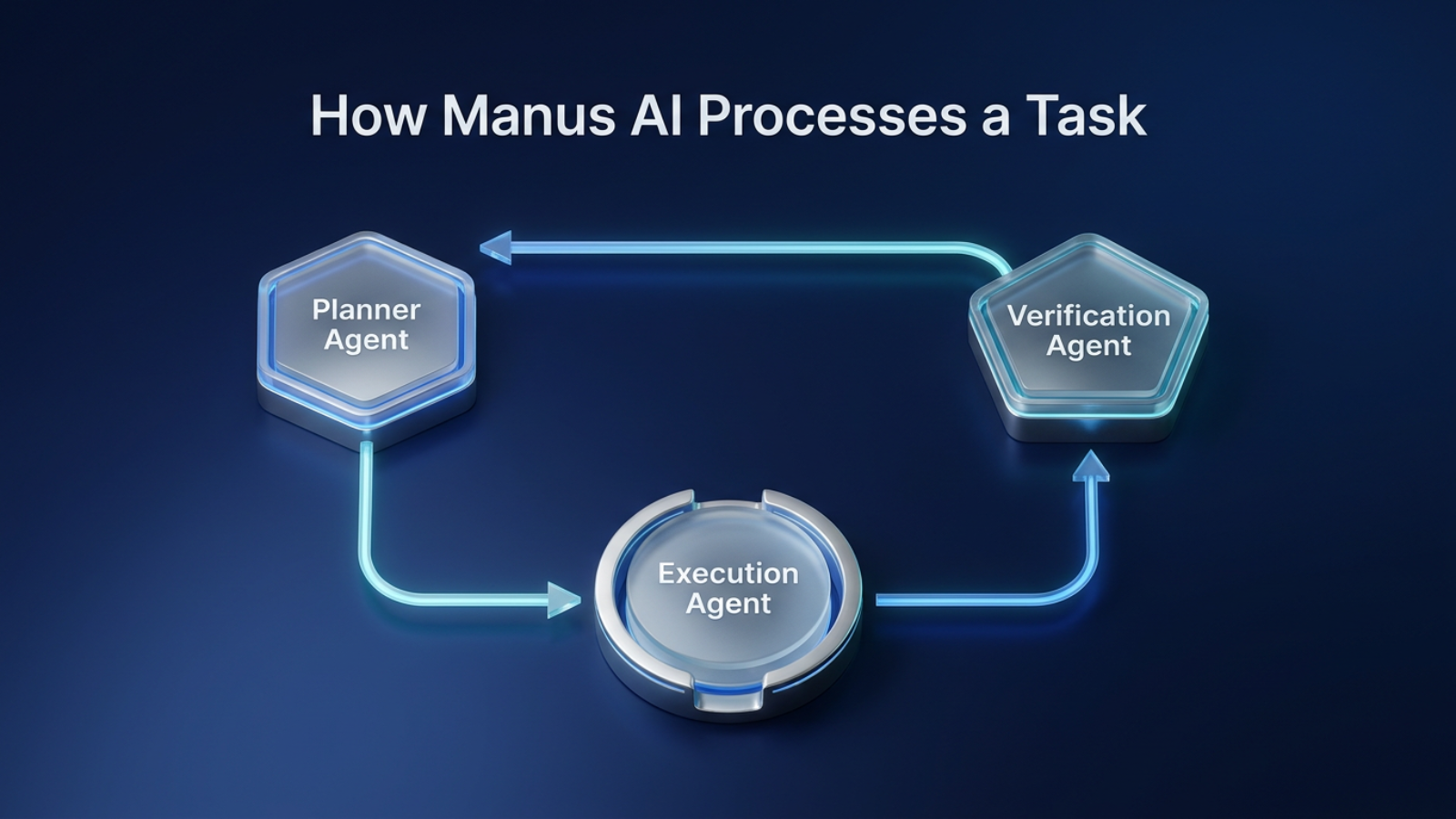
Manus AI was developed by the Chinese startup Butterfly Effect and introduced in early 2025 as a general-purpose autonomous AI agent. Its core design relies on three coordinated sub-agents working together: a Planner Agent that breaks a high-level goal into manageable sub-tasks, an Execution Agent that carries out each step by invoking external tools and data sources, and a Verification Agent that reviews outputs for accuracy before finalizing results.
This architecture runs inside a cloud-based sandbox environment. Dividing responsibilities across specialized sub-agents enables parallel processing of complex tasks, which can reduce completion time compared to single-model systems.
1.2 How Manus AI Handles Financial Queries
Rather than responding to a single prompt with a text answer, Manus executes end-to-end workflows from one instruction. When asked to analyze a company, Manus can independently retrieve publicly available data, generate charts of key indicators, and produce a structured analyst-style report, all without further user guidance.
Manus AI's underlying models combine large language model (LLM) capabilities with reinforcement learning, enabling real-time adaptation to new information. On the GAIA benchmark, a comprehensive test measuring an AI's ability to reason, use tools, and complete real-world tasks, Manus reportedly outperformed several leading models at the time of its evaluation.
Virginia Tech — https://arxiv.org/html/2505.02024v1
1.3 Manus 2.0: Key Architecture Updates
Manus 2.0 introduced Cascade, an updated agent harness that, in one tested configuration, used 23.2% fewer tokens, completed tasks 28.2% faster, and ran at 32% lower cost than the previous system. These efficiency improvements are relevant for users running recurring or large-scale financial research workflows.
Manus 2.0 also added Automations, which allow tasks to be triggered by events in connected services such as new emails, Slack messages, or Notion updates, rather than only at scheduled times. Cloud Computer provides a persistent hosted environment for projects that need to run continuously.
Manus — https://manus.im/blog/introducing-manus-2-0
Investing.com — https://www.investing.com/news/stock-market-news/manus-launches-ai-agent-platform-as-startup-expands-tools-93CH-4921041
Part 2. Manus AI Finance Use Cases: Research, Analysis, and Automation
2.1 Autonomous Stock and Market Research
Documented use cases show Manus AI gathering historical stock data, producing performance graphs, identifying key market indicators, and delivering analytical summaries from a single prompt. In one noted example, Manus analyzed an individual equity, creating correlation studies and visual dashboards without requiring human intervention beyond the initial request.
For broader market analysis, Manus has been used to examine S&P 500 data under various scenarios, including Monte Carlo simulations with 10,000 iterations to generate confidence intervals and project potential recovery timelines.
Important note: These are research outputs, not personalized investment advice. All AI-generated analysis should be reviewed critically. Investors should make decisions based on their own circumstances and, where appropriate, consult a qualified financial professional.
2.2 Automated Financial Reporting Workflows
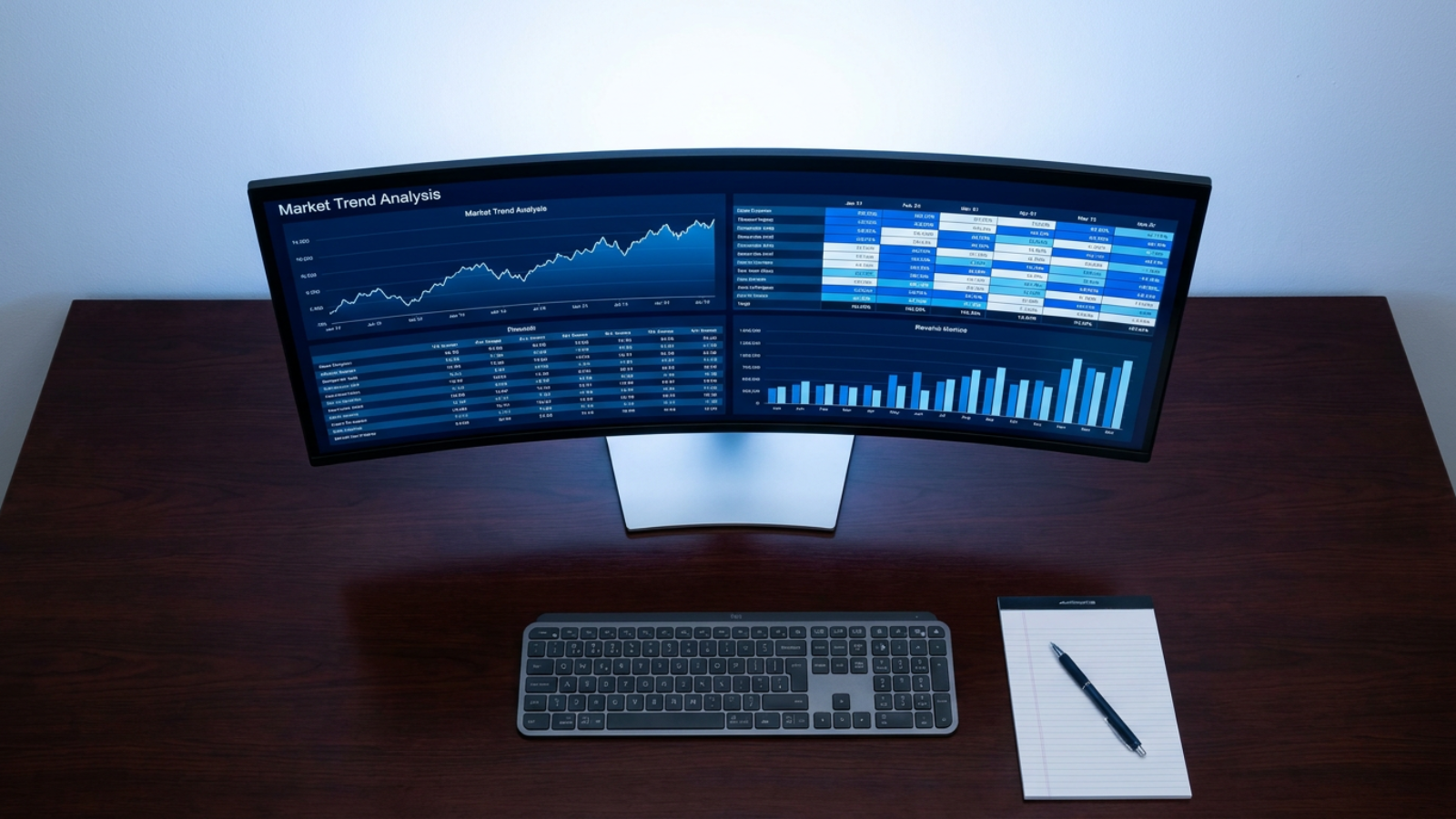
Manus AI can generate comprehensive analyst-style reports autonomously, covering data collection, visualization, and written summaries in one workflow. Financial professionals have used the platform to produce investor reports with supporting charts, perform correlation studies across financial instruments, and compile structured market overviews.
With Manus 2.0's Automations, these reporting workflows can be triggered by external events, such as an earnings release arriving via email, enabling analysts to receive updated reports without manually initiating each run.
Single Grain — https://www.singlegrain.com/marketing/manus-ai-use-cases-real-world-applications/
2.3 Portfolio Monitoring and Risk Research
Manus AI can be configured to monitor a set of securities by tracking publicly available price data and news, flagging anomalous patterns, and cross-referencing macroeconomic indicators with company-level information. SentiSight documents examples where investors used Manus to generate in-depth stock evaluations covering financial health, market trends, and relevant indicators, with visual dashboards consolidating the data.
SentiSight — https://www.sentisight.ai/20-most-interesting-applications-of-manus-ai/
Risk disclosure: AI-generated portfolio analysis is not a substitute for professional financial advice. Investment values may fluctuate, and investors may receive less than they originally invest. Past performance does not guarantee future results.
2.4 AI Agent Impact on Capital Markets Research
Start Fast Ventures notes that autonomous AI agents are emerging as a significant force in finance, capable of digesting news and earnings data continuously, adapting analytical frameworks as new information arrives, and surfacing insights faster than manual processes. Within days of Manus's initial launch, more than 1 million requests were submitted for its private beta waitlist.
The broader implication for investors is that AI-assisted research tools may support more thorough pre-trade analysis, though they do not replace the judgment, oversight, and execution capabilities of a regulated brokerage platform.
Start Fast Ventures — https://startfastventures.com/the-rise-of-ai-agents-impacts-on-markets-productivity-and-investment-strategy/
Part 3. Manus AI vs. Other AI Agents: A Factual Comparison for Investors
3.1 Feature Comparison Table
The table below provides a neutral, factual comparison of Manus AI and three other documented AI agent systems, based on publicly available information.
Feature | Manus AI | OpenAI Operator | Anthropic Computer Use | Google Mariner |
|---|---|---|---|---|
Agent type | Browser-based (Linux sandbox) | Browser-based | API-based | Browser-based (Chrome) |
Autonomous web browsing | Yes | Yes | Yes (via API) | Yes |
Multi-step task execution | Yes | Limited | Limited (via API) | Yes |
Multi-modal input/output | Yes | Limited | Limited | Yes |
Finance-specific demos documented | Yes | Limited | Limited | Not documented |
Event-triggered automations | Yes (Manus 2.0) | No | No | No |
Availability | Web, desktop, mobile | Subscribers | API/beta | Research phase |
Virginia Tech — https://arxiv.org/html/2505.02024v1
3.2 Manus AI vs. GPT-4 for Financial Research Tasks
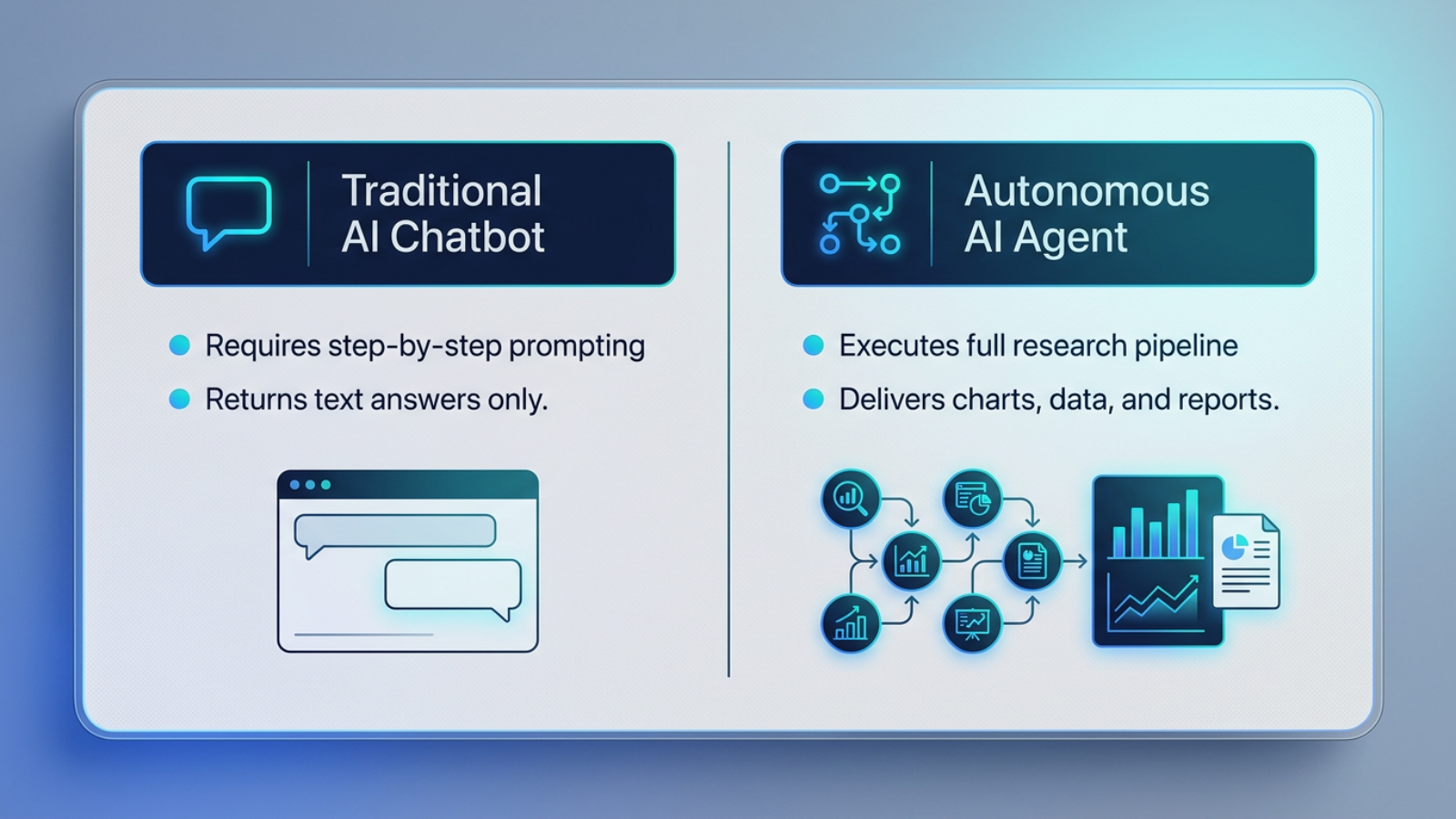
GPT-4 is a capable conversational AI that can explain financial concepts, summarize documents, and respond to analytical queries. However, it does not natively execute multi-step workflows autonomously. Users must guide GPT-4 through each stage of a research process manually.
Manus AI is designed to complete end-to-end tasks from a single high-level prompt, handling data retrieval, analysis, visualization, and report generation without ongoing guidance. On the GAIA benchmark, Manus demonstrated stronger performance on practical task completion than GPT-4, including versions augmented with plug-in tools, at the time of the evaluation.
3.3 Manus AI vs. Anthropic Claude for Investor Use Cases
Claude is recognized for its large context window and Constitutional AI training methodology, making it well-suited for reading and summarizing lengthy financial documents. Like GPT-4, Claude does not natively operate as an autonomous agent without external orchestration frameworks.
Research commentary has described Manus as combining strong language reasoning with integrated tool-use capabilities, including the ability to write and execute code, extending its utility for quantitative research beyond what conversational models offer on their own.
Virginia Tech — https://arxiv.org/html/2505.02024v1
Part 4. Pros and Cons of Manus AI for Investment Research
4.1 Strengths
End-to-end autonomous execution: Manus handles complete research workflows, from data collection through final report delivery, without requiring step-by-step user prompting. This can reduce the time spent on routine analytical tasks.
Multi-modal outputs: Manus processes text, images, and code simultaneously, enabling reports that combine written analysis with charts and data visualizations in a single automated workflow.
Documented GAIA benchmark performance: On the GAIA benchmark, Manus demonstrated strong performance on practical multi-step real-world tasks, reportedly outperforming several contemporary AI models at the time of evaluation. This indicates capable reasoning and tool-use integration.
Event-triggered automations: With Manus 2.0, research workflows can be triggered by external events, enabling continuous monitoring pipelines without manual initiation each time.
Versatility across finance research tasks: Documented applications include individual stock analysis, S&P 500 scenario modeling, comparative financial instrument studies, and business intelligence dashboards.
Single Grain — https://www.singlegrain.com/marketing/manus-ai-use-cases-real-world-applications/
4.2 Limitations and Risks
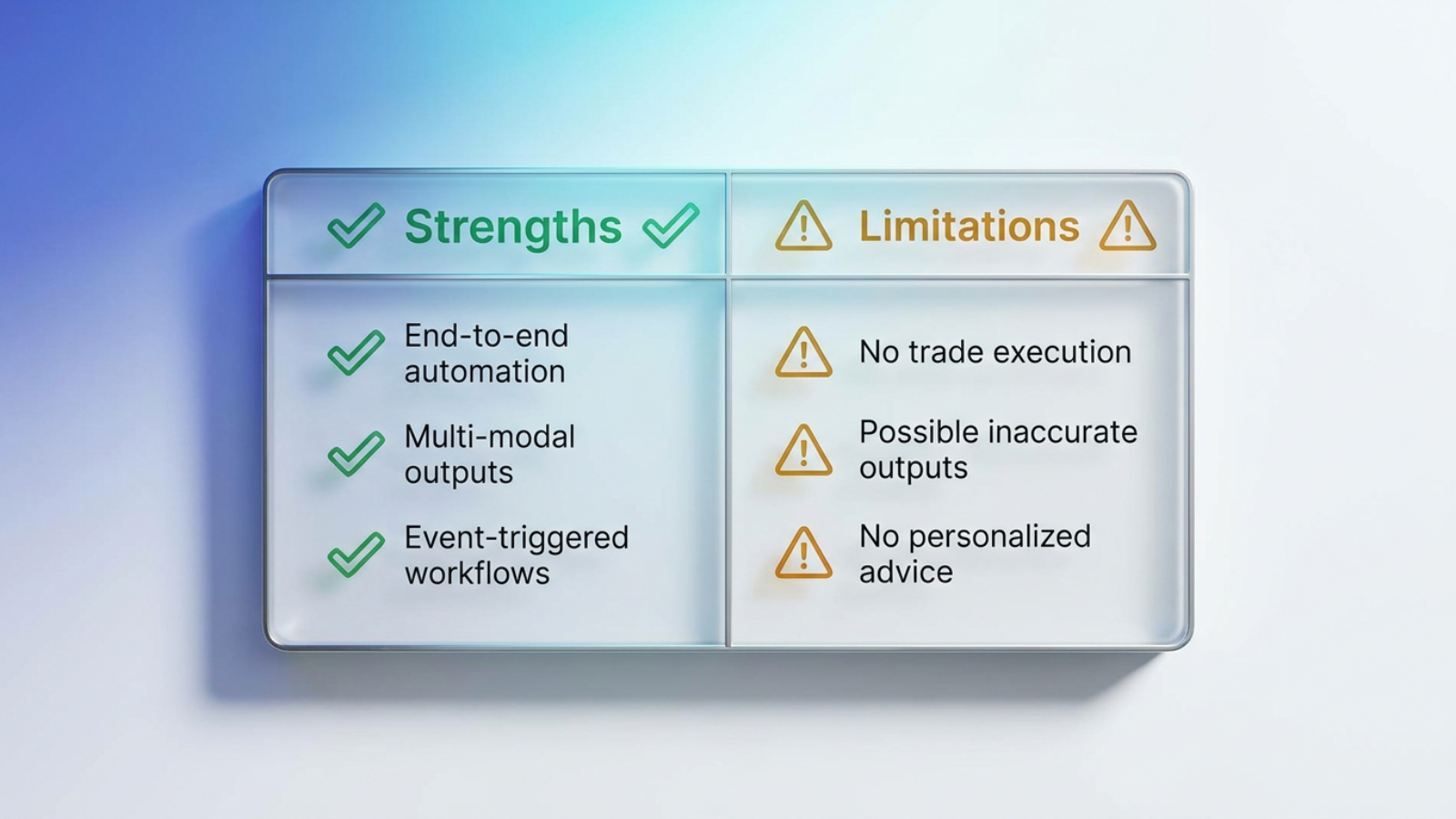
No trade execution capability: Manus AI is an analysis and automation platform. It does not connect to brokerage accounts, place orders, or manage positions. A separate, regulated broker-dealer is required for any actual trading activity.
Risk of inaccurate outputs: Like all AI systems, Manus may generate incorrect or outdated information, particularly when sourcing data from external web sources. The internal Verification Agent reduces but does not eliminate this risk. Human review of outputs is strongly recommended before using them in financial decisions.
No personalized investment advice: Manus AI generates general research and analysis outputs. These do not constitute personalized investment advice and should not be treated as such.
Data privacy considerations: Effective financial analysis with Manus may require uploading or describing sensitive financial data. Users should review Manus's data handling and privacy policies before sharing confidential information.
Usage costs: Manus offers a freemium model with daily credits for basic tasks. Teams requiring daily or weekly analytical workflows may need a paid subscription plan. Rates vary by service provider; please refer to the latest pricing.
Manus — https://manus.im/playbook/stock-level-checker
Part 5. Trading and Investing on Webull: Executing Research-Driven Decisions
5.1 Why a Regulated US Broker-Dealer Is Essential
AI tools like Manus can support research workflows, but they do not replace a regulated brokerage platform for executing trades, holding securities, or accessing US financial markets. Under US securities law, purchasing and selling stocks, ETFs, options, and other securities requires a FINRA-registered broker-dealer.
Webull is a FINRA-registered broker-dealer and a member of SIPC (Securities Investor Protection Corporation). SIPC protection covers eligible customer accounts up to $500,000, including up to $250,000 for cash claims, in the event of broker-dealer failure. SIPC coverage does not protect against investment losses.
SIPC — https://www.sipc.org/
FINRA — https://www.finra.org/
5.2 Webull's Research and Trading Platform
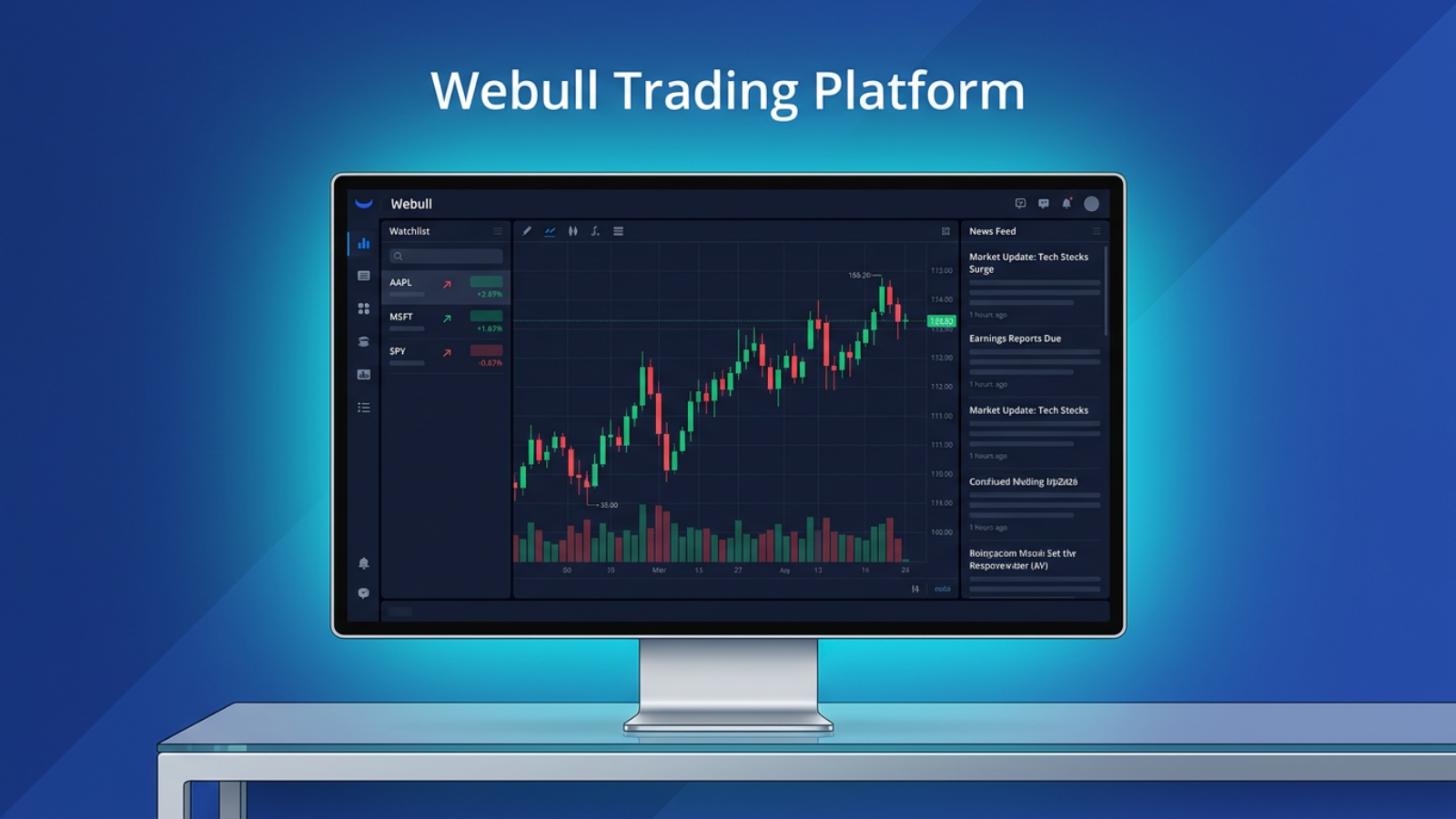
Webull offers a range of built-in research tools designed to support informed trading decisions. The platform provides real-time quotes, advanced charting with technical indicators, and market screeners across stocks, ETFs, options, and futures. These tools can complement AI-generated research from platforms like Manus.
Webull is accessible across three platforms: the Webull mobile app (iOS and Android), the desktop application for Mac, Windows, and Linux, and a browser-based WebTrade platform that requires no download. Platform-specific tutorials are available through the Webull Learn Center, accessible from the mobile app, desktop sidebar, or website.
5.3 Step-by-Step: From AI Research to Trade Execution
The following outlines a general workflow for combining AI-assisted research with a regulated brokerage platform. These steps are informational; they do not constitute investment advice.
Step 1: Conduct preliminary research using Manus AI. Use Manus to generate a market overview, sector analysis, or summary of publicly available financial data on a security of interest. Critically review all AI outputs and independently verify key data points.
Step 2: Open or log in to your Webull account. Download the Webull mobile app or access WebTrade via a browser. Complete the account opening process, which includes identity verification and regulatory disclosures.
Step 3: Cross-reference findings with Webull's built-in tools. Use Webull's real-time market data, advanced charting, and charts and tools features to validate or further explore the AI-generated analysis. Consider using paper trading to practice strategies without risking real capital.
Step 4: Review fees and account details before trading. Webull offers commission-free trading for US-listed stocks and ETFs. Other costs may apply, including regulatory fees, options contract fees, and margin interest. Visit the Webull pricing page for current fee information. Rates vary by service provider; please refer to the latest pricing.
Step 5: Make decisions based on your own research and risk tolerance. All investment decisions involve risk. Ensure any trading activity aligns with your individual financial situation and risk tolerance. No AI tool, including Manus, should substitute for your own judgment or professional financial guidance where appropriate.
5.4 Additional Webull Features for Research-Driven Investors
Webull offers a broad range of account types and investment products suited to different investor profiles:
Cash management for uninvested funds
Webull Advisors for managed account services
Recurring investment for systematic, scheduled investing
Fixed income products for portfolio diversification

All investing involves risk. The value of investments may decline and investors may receive less than they originally invest.
The Bottom Line
Manus AI offers investors a capable autonomous research tool for financial analysis, market data aggregation, and automated reporting workflows. It is not a trade execution platform and does not provide personalized investment advice. For US investors, a FINRA-registered broker-dealer like Webull provides the regulated infrastructure needed to act on research. Combining AI-assisted analysis with a trusted brokerage platform may support more thorough, informed decision-making.
All investing involves risk, including the potential loss of principal. Past performance does not guarantee future results.
Disclosure
Webull Financial LLC (member SIPC, FINRA) offers self-directed securities trading. All investments involve risk. More info: https://www.webull.com/policy
The information provided does not constitute investment advice and it should not be relied on as such. It should not be considered a solicitation to buy or an offer to sell a security. It does not take into account any investor's particular investment objectives, strategies, tax status or investment horizon. Investing involves risk, including the risk of loss of principal.
