'%3e %3cpath d='M41.7832962%2c0 C41.9459106%2c0 42.0882746%2c0.0866854658 42.1666825%2c0.216359069 C43.8289923%2c2.66540836 44.7676281%2c5.46271319 44.7676281%2c8.43208061 C44.7676281%2c18.1345746 34.7460532%2c26 22.383814%2c26 C10.0215749%2c26 0%2c18.1345746 0%2c8.43208061 C0%2c5.46716016 0.935826425%2c2.67378733 2.58829888%2c0.223985685 C2.67109477%2c0.0916264068 2.81687473%2c0 2.9840593%2c0 C3.23130408%2c0 3.43173558%2c0.200393004 3.43173558%2c0.447590303 C3.43173558%2c0.475056669 3.42926112%2c0.501945205 3.42452292%2c0.528045226 L3.41810883%2c0.550292077 C3.37800671%2c0.861741908 3.3575721%2c1.17661276 3.3575721%2c1.49443092 C3.3575721%2c7.98336 11.2132389%2c12.5742305 22.383814%2c12.5742305 C33.5543891%2c12.5742305 41.410056%2c7.98336 41.410056%2c1.49443092 C41.410056%2c1.17865223 41.3898828%2c0.865783153 41.3502888%2c0.556288325 C41.3402868%2c0.521941442 41.3356199%2c0.48531078 41.3356199%2c0.447590303 C41.3356199%2c0.200393004 41.5360514%2c0 41.7832962%2c0 Z' id='logo%e5%a4%87%e4%bb%bd-6' fill='white'%3e%3c/path%3e %3cpath d='M74.6899231%2c3.74404927 C75.2411227%2c3.74404927 75.7734299%2c3.66184338 76.2756219%2c3.50883715 L73.8159676%2c20.8666902 C73.5770593%2c22.5662954 72.8072434%2c23.0518969 71.4268838%2c23.0518969 L69.9934336%2c23.0518969 C68.7988917%2c23.0518969 68.1618027%2c22.458384 67.7901674%2c20.893668 L65.6930827%2c11.9909739 C65.639992%2c11.7481731 65.639992%2c11.6942174 65.5338105%2c11.6942174 C65.427629%2c11.6942174 65.4010836%2c11.7481731 65.3479929%2c11.9909739 L63.2509082%2c20.893668 C62.8792729%2c22.458384 62.2421839%2c23.0518969 61.047642%2c23.0518969 L59.6141918%2c23.0518969 C58.2338322%2c23.0518969 57.4640163%2c22.5662954 57.225108%2c20.8666902 L54.7463723%2c3.37406084 C55.3593498%2c3.61307396 56.0249975%2c3.74404927 56.7207458%2c3.74404927 C57.3314263%2c3.74404927 57.918917%2c3.64314414 58.4679557%2c3.4568446 L60.3574623%2c19.3829078 C60.3840076%2c19.6257086 60.3840076%2c19.7875757 60.4901891%2c19.7875757 C60.5963706%2c19.7875757 60.5963706%2c19.6257086 60.6494614%2c19.3829078 L62.9323637%2c9.91367858 C63.0916359%2c9.26620991 63.4632712%2c8.69967483 64.6047223%2c8.69967483 L66.4363532%2c8.69967483 C67.5778044%2c8.69967483 67.9494397%2c9.26620991 68.1087119%2c9.91367858 L70.3916142%2c19.3829078 C70.4447049%2c19.6257086 70.4447049%2c19.7875757 70.5508864%2c19.7875757 C70.6570679%2c19.7875757 70.6570679%2c19.6257086 70.6836133%2c19.3829078 L72.5891207%2c3.32292288 C73.2365902%2c3.59432921 73.9460524%2c3.74404927 74.6899231%2c3.74404927 Z' id='Combined-Shape' fill='white'%3e%3c/path%3e %3cpath d='M84.5933901%2c7.43171536 C88.6813779%2c7.43171536 90.9111894%2c10.2643908 90.9111894%2c14.2840921 L90.9111894%2c15.7948523 C90.9111894%2c16.2264981 90.7519172%2c16.4692988 90.3802819%2c16.4692988 L81.7264895%2c16.4692988 L81.7264895%2c16.5502324 C81.7264895%2c18.1149484 82.3635785%2c19.9764208 84.9119346%2c19.9764208 C86.849747%2c19.9764208 88.6813779%2c19.8145536 89.7962837%2c19.7066422 L89.8759198%2c19.7066422 C90.1413735%2c19.7066422 90.3537366%2c19.8415315 90.3537366%2c20.1113101 L90.3537366%2c21.8918489 C90.3537366%2c22.3234947 90.2741004%2c22.5123397 89.7962837%2c22.5932733 C88.0708343%2c22.9170076 87.0355646%2c23.0518969 84.6464808%2c23.0518969 C81.9919433%2c23.0518969 78.2225%2c21.5950924 78.2225%2c16.2804538 L78.2225%2c14.2840921 C78.2225%2c10.0755457 80.5319476%2c7.43171536 84.5933901%2c7.43171536 Z M84.5933901%2c10.5071915 C82.9475768%2c10.5071915 81.7530349%2c11.6942174 81.7530349%2c13.8254684 L81.7530349%2c13.9333799 L87.3806545%2c13.9333799 L87.3806545%2c13.8254684 C87.3806545%2c11.7211953 86.2392034%2c10.5071915 84.5933901%2c10.5071915 Z' id='Combined-Shape' fill='white'%3e%3c/path%3e %3cpath d='M97.4154906%2c2.98826245 L97.4148064%2c7.62056039 C98.3969853%2c7.48567108 99.3260735%2c7.43171536 99.9631625%2c7.43171536 C104.236968%2c7.43171536 106.307507%2c9.99461216 106.307507%2c14.2031585 L106.307507%2c16.2804538 C106.307507%2c20.4890001 104.236968%2c23.0518969 99.9631625%2c23.0518969 C98.2642584%2c23.0518969 96.2733553%2c22.7821183 94.627542%2c22.3504725 C94.0169984%2c22.1886054 93.9108169%2c22.0267382 93.9108169%2c21.6220703 L93.9098179%2c3.08694115 C94.4185466%2c3.24434375 94.9584615%2c3.32900525 95.5178331%2c3.32900525 C96.184659%2c3.32900525 96.8238351%2c3.20869291 97.4154906%2c2.98826245 Z M99.9631625%2c10.3453244 C99.3260735%2c10.3453244 98.1580769%2c10.4262579 97.4148064%2c10.5341694 L97.4148064%2c19.9494429 C97.9191686%2c20.0573544 99.007529%2c20.1382879 99.9631625%2c20.1382879 C102.246065%2c20.1382879 102.803518%2c18.4926384 102.803518%2c16.2804538 L102.803518%2c14.2031585 C102.803518%2c11.9909739 102.246065%2c10.3453244 99.9631625%2c10.3453244 Z' id='Combined-Shape' fill='white'%3e%3c/path%3e %3cpath d='M111.036668%2c8.72457747 C111.579488%2c8.72457747 112.103987%2c8.64485191 112.599444%2c8.49629404 L112.598761%2c16.5232546 C112.598761%2c19.3289521 113.607485%2c19.9764208 115.147117%2c19.9764208 L115.306389%2c19.9764208 C116.846021%2c19.9764208 117.854746%2c19.3289521 117.854746%2c16.5232546 L117.854207%2c8.4334735 C118.406525%2c8.62226395 118.997939%2c8.72457747 119.612866%2c8.72457747 C120.223332%2c8.72457747 120.810625%2c8.62374317 121.359498%2c8.43756894 L121.358735%2c16.5232546 C121.358735%2c22.4044283 116.872567%2c23.0518969 115.306389%2c23.0518969 L115.060464%2c23.0512514 C113.42215%2c23.0271041 109.094772%2c22.2994073 109.094772%2c16.5232546 L109.094446%2c8.36700801 C109.698522%2c8.59813531 110.353066%2c8.72457747 111.036668%2c8.72457747 Z' id='Combined-Shape' fill='white'%3e%3c/path%3e %3cpath d='M128.314162%2c3.03790128 L128.313623%2c22.269539 C128.313623%2c22.5662954 128.10126%2c22.836074 127.809261%2c22.836074 L125.340541%2c22.836074 C125.048542%2c22.836074 124.809634%2c22.5662954 124.809634%2c22.269539 L124.809455%2c3.04219481 C125.358161%2c3.22824247 125.945253%2c3.32900525 126.555503%2c3.32900525 C127.17043%2c3.32900525 127.761844%2c3.22669173 128.314162%2c3.03790128 Z' id='Combined-Shape' fill='white'%3e%3c/path%3e %3cpath d='M133.90653%2c3.32900525 C134.473329%2c3.32900525 135.02015%2c3.24208064 135.534793%2c3.08063296 L135.533966%2c22.269539 C135.533966%2c22.5662954 135.321603%2c22.836074 135.029603%2c22.836074 L132.560884%2c22.836074 C132.268884%2c22.836074 132.029976%2c22.5662954 132.029976%2c22.269539 L132.029909%2c2.99605058 C132.615669%2c3.21152525 133.2476%2c3.32900525 133.90653%2c3.32900525 Z' id='Combined-Shape' fill='white'%3e%3c/path%3e %3c/g%3e %3c/g%3e %3c/g%3e%3c/svg%3e)



If you're searching for AI trading software to sharpen your investment edge, you're not alone. Millions of US retail investors are turning to AI-powered platforms to cut through market noise, manage risk, and make faster, data-informed decisions. This guide breaks down how the best AI trading software for US investors works, spotlights Webull's built-in AI tools, and compares the leading platforms available in 2026 — so you can evaluate your options with confidence.
Key Takeaways
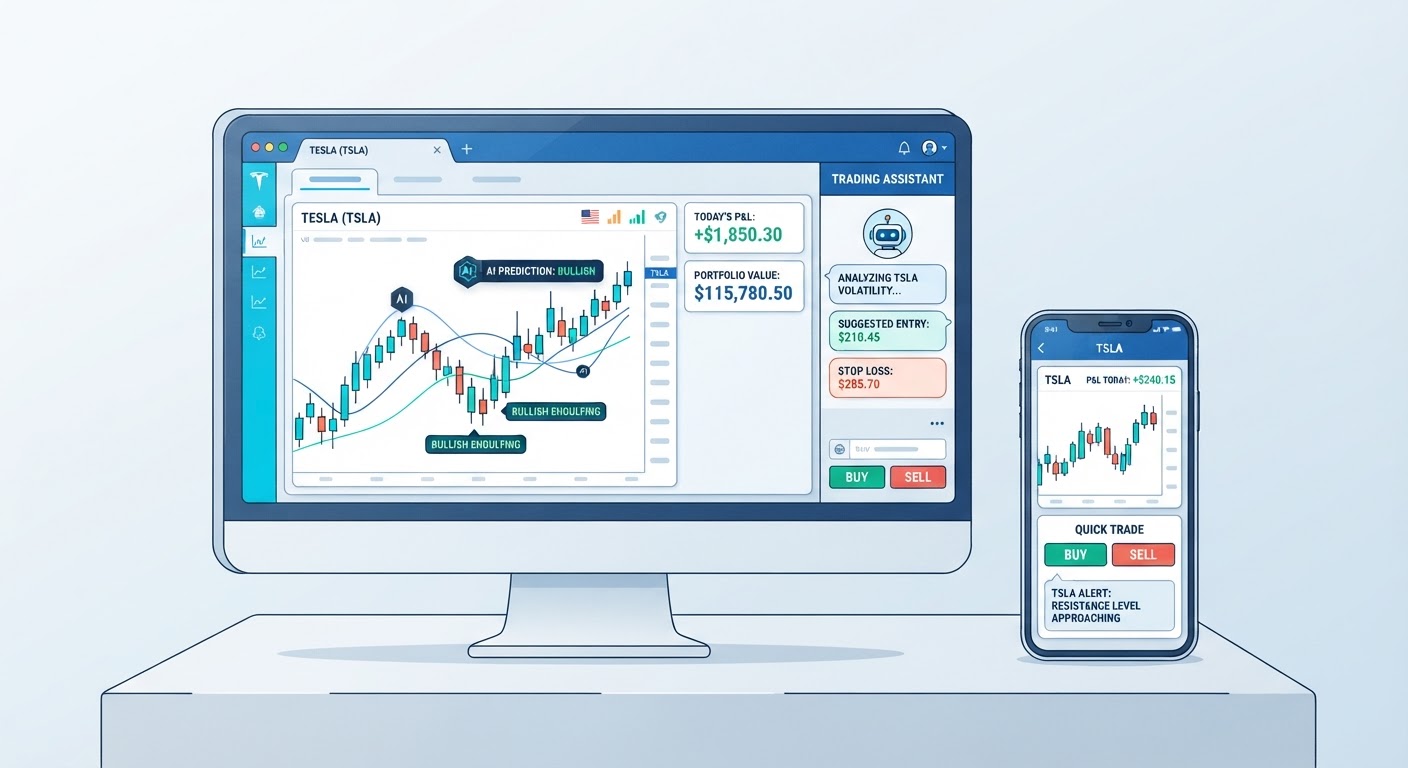
AI trading software uses machine learning and data analysis to help investors screen stocks, manage orders, and monitor portfolio performance in real time.
Webull offers a built-in Trading Assistant that tracks real-time P&L, win rates, and order alerts directly within the app.
Third-party AI tools such as TrendSpider, AInvest, Danelfin, Tickeron, and Trade Ideas each offer distinct approaches to AI-driven stock analysis.
When evaluating any AI trading platform, US investors should consider regulatory standing, fee transparency, data methodology, and risk disclosure practices.
No AI tool guarantees investment success; all tools carry limitations and should be used as part of a broader, disciplined investment strategy.
Part 1. What Is AI Trading Software? A Guide for US Investors
Artificial intelligence has moved from science fiction into the everyday toolkit of American retail traders. But the term "AI trading software" covers a wide range of tools — from simple screeners that filter stocks by preset criteria to sophisticated machine learning engines that analyze thousands of data points in seconds. Understanding the landscape is the first step toward using these tools wisely.
1.1 How AI Trading Software Works
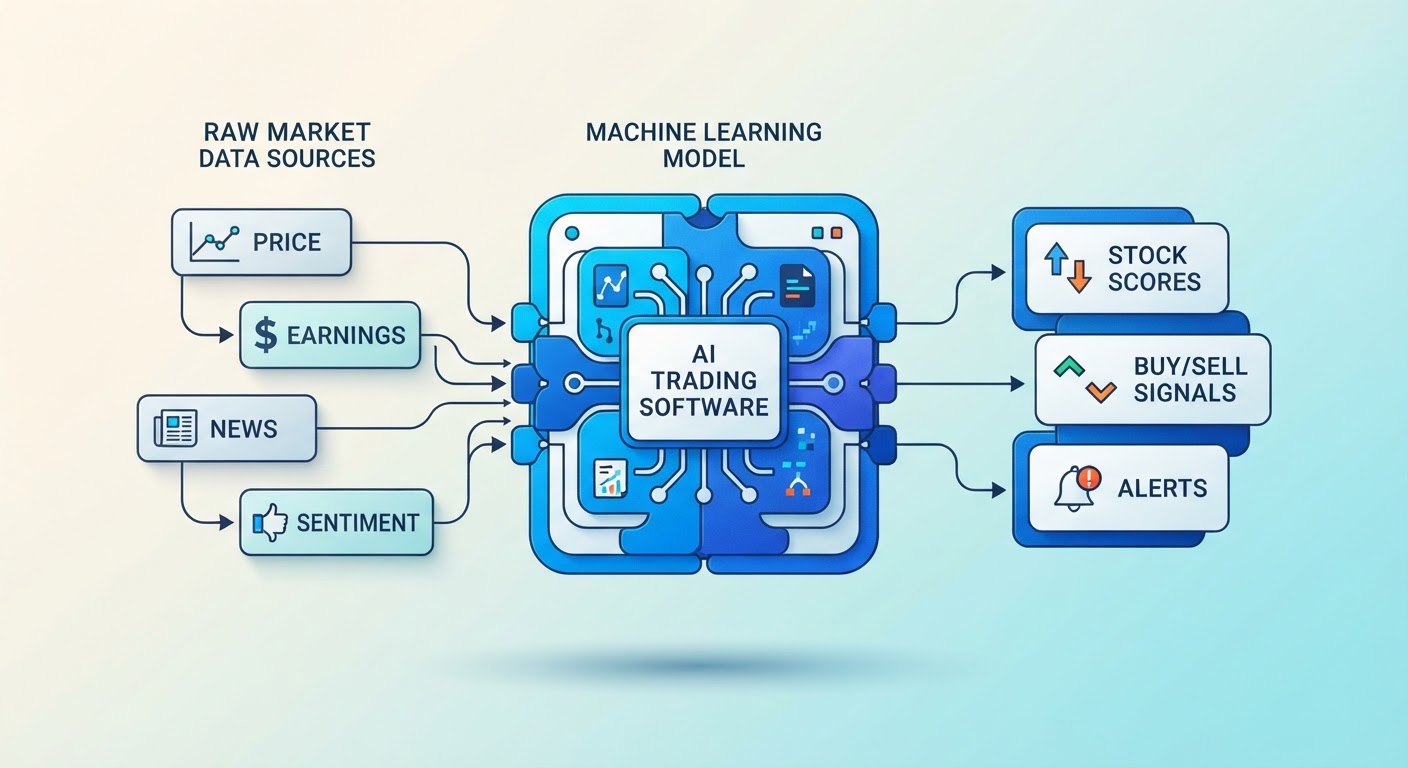
At its core, AI trading software applies machine learning algorithms to financial data — price history, earnings reports, trading volume, options flow, analyst ratings, macroeconomic indicators, and even social sentiment — to identify patterns and generate actionable insights.
As Jack Fu, co-founder of Draco Evolution, explained to U.S. News: "When properly built and monitored, AI can add real value to stock selection. It processes torrents of information faster than any research team, reading macro indicators such as weekly jobless claims, changes in the yield curve, new orders indices, consumer sentiment and real-time money supply, then cross-checking them with price action and market tone." (U.S. News, 2026)
In practical terms, AI trading software may do any or all of the following:
Scan thousands of stocks simultaneously using technical and fundamental criteria
Assign predictive scores that estimate the probability a stock outperforms a benchmark over a given period
Generate buy/sell signals based on identified patterns or indicator alignment
Execute trades automatically via pre-programmed bots or strategy algorithms
Monitor open positions and alert traders when P&L thresholds or order conditions are met
Analyze news and filings to surface material events in real time
According to a study cited in the Journal of Financial Economics (October 2024), an AI model outperformed human analysts in 54.5% of stock return predictions studied from 2001 to 2018. Combining AI analysis with human expertise was found to reduce extreme forecasting errors by up to 90%. These findings suggest AI tools can add value as a complement to — not a replacement for — informed human judgment.
Important: AI-generated signals are analytical outputs, not guarantees. All investing involves risk, and no software can predict market movements with certainty.
1.2 AI Stock Picker vs. AI Stock Screener: Key Differences
Two terms that frequently appear together are worth distinguishing clearly:
Term | Definition | How It Works |
|---|---|---|
AI Stock Screener | Filters stocks based on criteria you set | You define parameters (e.g., P/E under 20, positive cash flow); the tool returns matching stocks |
AI Stock Picker | Actively recommends specific stocks predicted to outperform | The AI evaluates hundreds of factors and surfaces its top candidates without manual filter input |
A screener puts the decision-making criteria in your hands; a stock picker delegates more of the selection logic to the algorithm. Many modern platforms combine both functions. For example, AInvest's AI advisor "Aime" supports conversational queries like "Find me tech stocks with a P/E ratio under 20 and positive cash flow" while also generating its own trade ideas (WEB-2).
Understanding this distinction matters for US investors because it shapes how much you rely on the tool's underlying methodology — which should always be reviewed before acting on any output.
Part 2. Webull's AI Trading Tools: Features Built for Active US Traders
Webull has developed a suite of AI-assisted features designed to help US-based active traders monitor their performance and manage their orders more effectively. Central to this offering is the Trading Assistant, a built-in tool available directly within the Webull mobile app.
2.1 Trading Assistant: Real-Time P&L and Order Management
The Webull Trading Assistant gives traders real-time visibility into their trading activity and financial performance. Here is a breakdown of what it offers:
What the Trading Assistant does:
Real-time P&L monitoring: View your profit and loss data as it updates throughout the trading session.
Win rate tracking: The total win rate is calculated by determining the number of times you successfully closed a profitable position compared to the total number of stock and options trades made in a day.
P&L alerts: Set custom alerts that trigger a push notification when your open P&L reaches a specified threshold. Note that you will receive only one P&L alert per day per alert you set; all P&L alert notifications can be viewed in the Messages section of the app.
Order alerts: Set order-specific alerts that generate a popup notification when the alert condition is triggered.
Order management: Track and manage your open orders directly within the Trading Assistant interface.
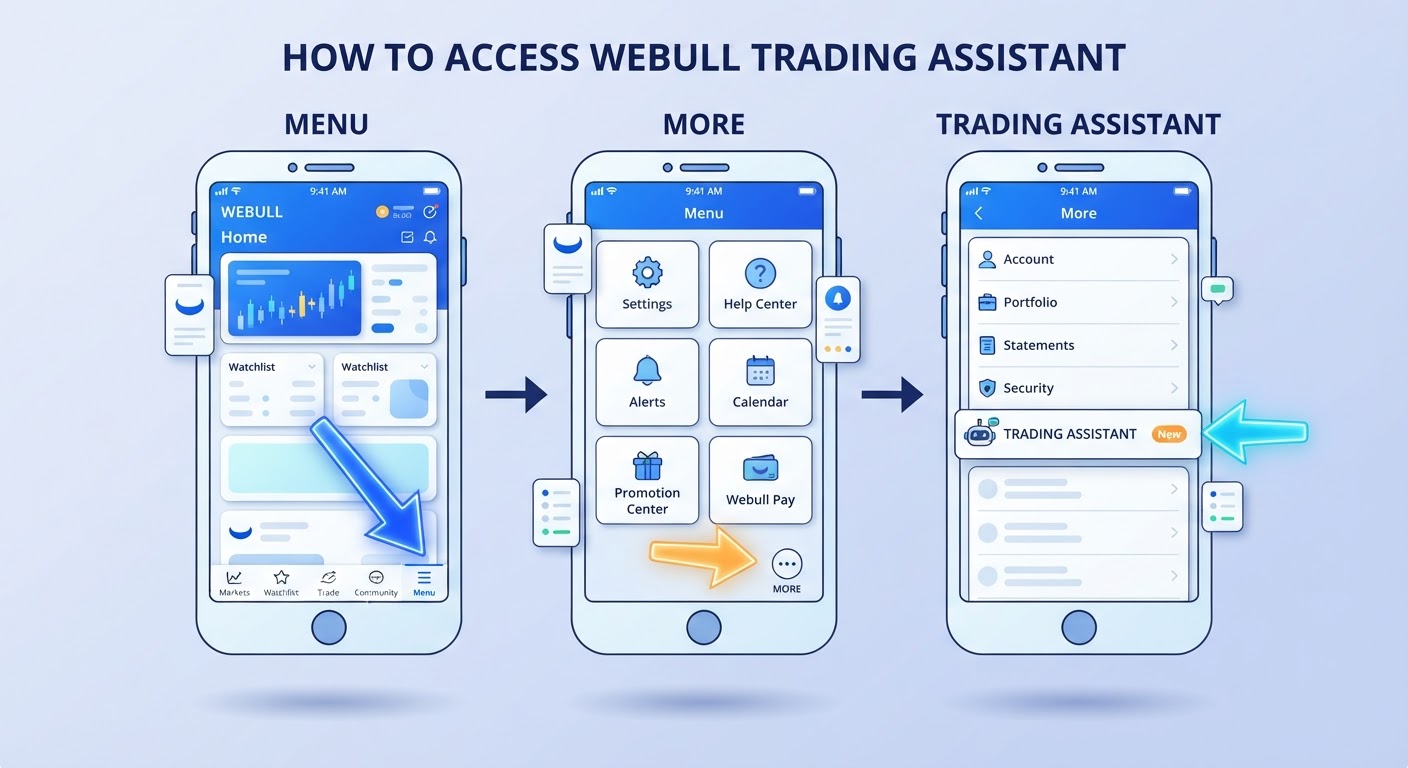
How to find the Trading Assistant on the Webull app:
Open the Webull mobile app
Tap Menu
Below Shortcuts, select More
Tap Trading Assistant
This straightforward navigation ensures the feature is accessible without requiring multiple steps, making it useful for traders who need quick access to performance data during active market hours.
For more details on Webull's platform features and how to get started, visit www.webull.com.
2.2 Brokerage Integration and Platform Safety
Webull operates as a registered US broker-dealer, subject to oversight by the Securities and Exchange Commission (SEC) and FINRA (Financial Industry Regulatory Authority). Customer accounts are protected by SIPC (Securities Investor Protection Corporation) up to applicable limits.
SIPC Coverage Note: SIPC protects customers of SIPC-member broker-dealers if the firm fails financially. It covers securities and cash up to $500,000, including a $250,000 limit for cash claims. SIPC protection does not protect against investment losses from market fluctuations.
Third-party AI tools, such as AInvest, support brokerage integration with Webull, allowing traders to sync their Webull account to access AI-driven analysis of their holdings (WEB-2). This integration expands the analytical capabilities available to Webull users who choose to connect third-party tools.
2.3 Pros and Cons of Webull's AI Features
Pros:
Real-time P&L data available during live market sessions
Daily win rate calculation for stock and options trades
Customizable alerts (P&L thresholds and order conditions)
Built directly into the Webull app — no third-party subscription required for core features
Operated by a FINRA-registered, SEC-regulated broker-dealer
SIPC member for account protection
Cons:
P&L alerts are limited to one notification per alert per day
Trading Assistant is mobile-app based (per available documentation)
AI features are performance monitoring tools, not predictive stock-picking engines — investors seeking advanced AI stock scoring should evaluate supplemental third-party tools
This content is for educational purposes only and is not a solicitation to buy or sell any security. Please review all platform features and fees at www.webull.com before opening an account.
Part 3. Top AI Trading Software Platforms Compared (2026)
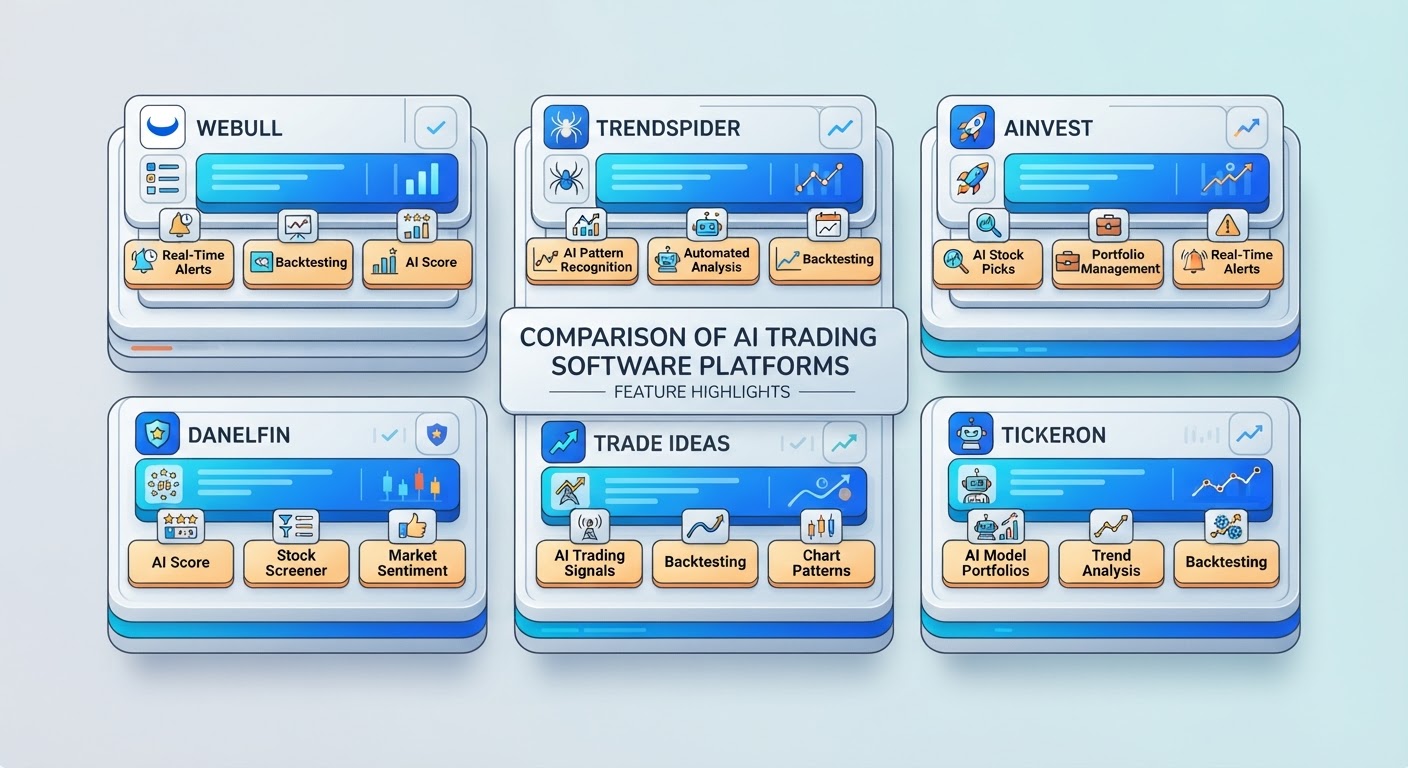
Beyond Webull's built-in tools, a range of standalone AI trading software platforms are available to US investors. The following overview is based on publicly available information and is intended to help you understand the landscape — not to recommend any specific product.
3.1 Platform Comparison Table
Platform | Primary AI Function | Key Differentiator |
|---|---|---|
Webull Vega | Real-time P&L tracking, order alerts, win rate | Integrated into a regulated US broker-dealer platform |
TrendSpider | Automated charting, backtesting, trading bots | Multi-timeframe AI analysis; automated strategy execution |
AInvest (Aime) | Conversational AI screener, trade ideas, news analysis | Brokerage integration (including Webull); conversational interface |
Danelfin | AI stock scoring (1–10), probability of beating market | Clear AI score methodology; US and European equities |
Trade Ideas (Holly AI) | Real-time AI scanning, nightly backtests, trade alerts | Holly AI runs thousands of backtests nightly; SmartStop risk management |
Tickeron | AI trading bots, pattern recognition, buy/sell signals | Customizable bots; reported 86.6% win rate over a three-month backtested period |
Kavout | Kai Score (1–9) stock rating, daily screening | Analyzes 9,000+ US stocks daily across 200+ factors |
3.2 Notable Platforms Overview
TrendSpider is a technical analysis-focused AI tool that offers automated chart pattern recognition, real-time scanning, multi-timeframe analysis, backtesting, and an AI "Sidekick" assistant that can build custom technical indicators. It also supports an automated strategy bot for trade execution based on predetermined algorithms.
AInvest (powered by the Aime AI advisor) functions as a conversational stock screener and AI advisor. Users can ask questions in plain language to screen stocks by fundamental and technical criteria, and the platform supports brokerage account integration — including Webull — for portfolio analysis. User feedback has noted the platform's subscription structure, where individual premium features require separate paid plans, with total costs reported to potentially exceed $2,000 per year for full access.
Danelfin assigns each US-listed stock an AI Score from 1 to 10, reflecting the estimated probability of beating the market over the next three months. The score integrates fundamental, technical, and sentiment factors. Neal Shah, CEO of CareYaya Health Technologies, described Danelfin's approach to U.S. News as offering "a clear, straightforward approach". A free plan includes a daily list of top-ranked stocks.
Trade Ideas uses an AI system called "Holly" that runs thousands of nightly backtests to generate real-time trade alerts. The platform includes a proprietary risk management tool (SmartStop) with stop-loss and take-profit suggestions. Pricing starts at approximately $89/month.
Tickeron offers AI-powered trading bots, real-time pattern recognition, predictive analytics, and daily buy/sell signals. The platform reported an 86.6% win rate over a three-month backtested period; investors should note that backtested results may not reflect live trading performance.
Risk Disclosure: All platforms listed involve risk. Backtested or historical performance data do not guarantee future results. Subscription costs vary and should be evaluated against your trading frequency and strategy. This is not a recommendation to use any specific platform.
Part 4. How to Evaluate AI Trading Software: A Framework for US Investors
With dozens of AI trading software options on the market, knowing what to look for can save you from costly mistakes — both financially and in terms of wasted time. Here is a practical framework designed for US investors.
4.1 Key Features to Look For
According to publicly available analysis from U.S. News and leading financial technology sources, the most relevant evaluation criteria for AI trading tools include:
1. Versatility and query capability
Can the tool answer nuanced questions? Some AI platforms support detailed, conversational queries that allow you to specify precise criteria — sector, valuation metrics, momentum signals — and receive tailored results.
2. Trading signals and execution
Does the platform generate buy/sell signals? Can it execute trades automatically? Tools like TrendSpider and Trade Ideas offer automated execution via pre-programmed bots, while others such as Danelfin provide signals only (no direct execution).
3. Data quality and breadth
What data feeds the AI model? Look for platforms that incorporate a broad range of inputs: price and volume history, earnings data, analyst consensus, options flow, SEC filings, and macroeconomic indicators. Check whether data is updated in real time or on a delayed basis.
4. Scoring methodology transparency
A platform that publishes how its AI score is calculated is more trustworthy than one that treats its model as a complete black box. For example, Pineify's scoring system processes fundamental metrics, technical indicators, analyst consensus, and real-time sentiment into a daily 1–10 score. Understanding the methodology helps you assess when to trust — and when to question — the output.
5. Risk management tools
Does the platform include stop-loss suggestions, portfolio risk analysis, or volatility assessments? Trade Ideas' SmartStop feature and Incite AI's risk management module are examples of tools designed to help manage downside exposure.
6. Pricing structure and total cost
Some platforms appear affordable at first glance but charge separately for individual features, which can significantly increase the total cost. AInvest users have reported total subscription costs potentially exceeding $2,000 per year when all premium features are included (WEB-2). Always assess the full cost of access before committing.
7. Integration with your existing brokerage
Can the AI tool connect directly to your brokerage account? AInvest, for instance, supports integration with Webull, Robinhood, Schwab, Fidelity, and E*TRADE. Seamless integration can reduce friction and improve the relevance of AI-generated insights to your actual holdings.
4.2 Regulation, Security, and FINRA/SEC Considerations
This is a critical area that many retail investors overlook when evaluating AI trading tools.
Understanding the regulatory distinction:
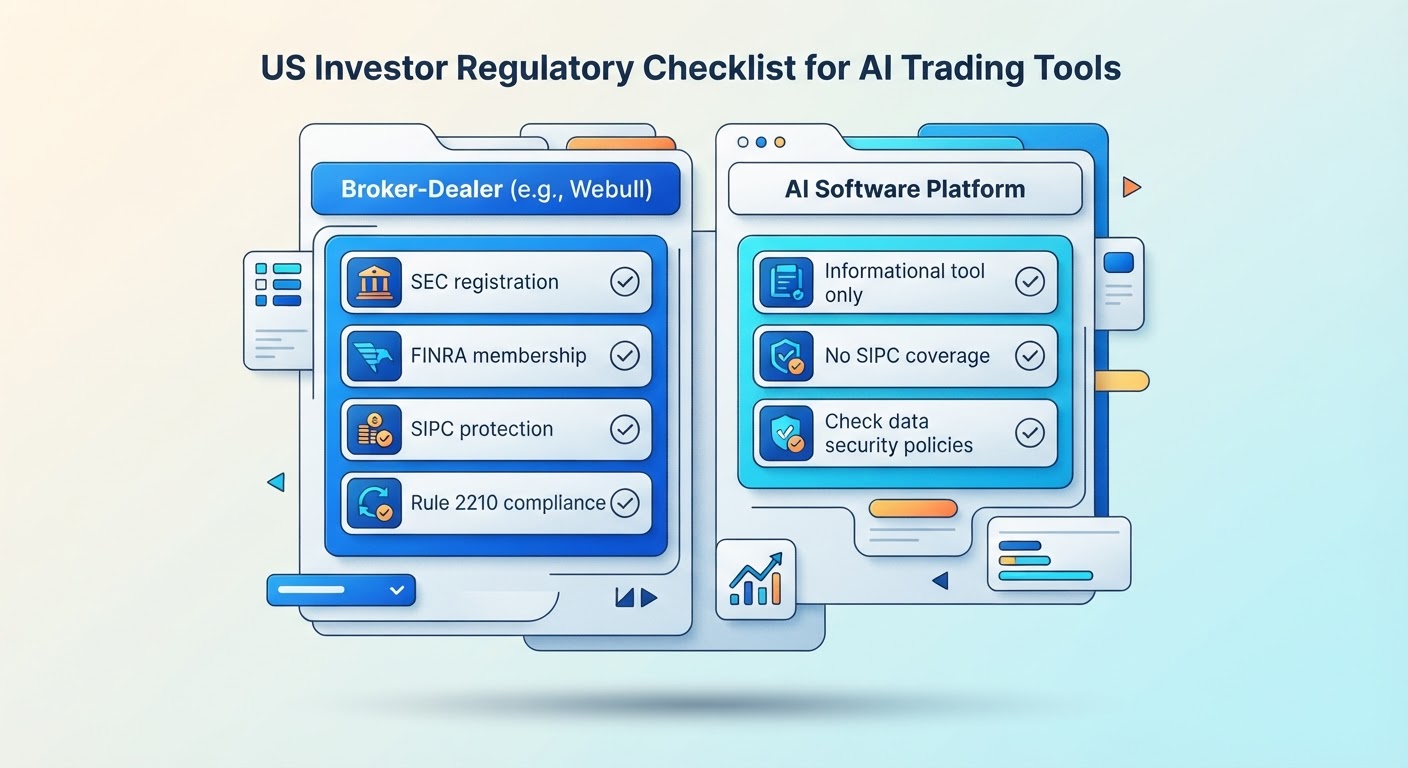
Broker-dealers (such as Webull) are registered with the SEC and are FINRA members. They are subject to comprehensive regulatory oversight, capital requirements, customer protection rules, and conduct standards under FINRA Rule 2210 and related regulations.
Standalone AI software platforms (such as TrendSpider, Danelfin, or Tickeron) are typically technology companies — not registered broker-dealers or investment advisers. They provide analytical tools, not brokerage services. Most explicitly disclose that their output is for informational and educational purposes only, not personalized investment advice (WEB-3).
What this means for you as a US investor:
An AI tool's buy/sell signal is not the same as advice from a registered investment adviser.
Funds held in a brokerage account (such as Webull) are protected under SIPC up to applicable limits. Funds paid to a software subscription service are not similarly protected.
Always verify whether a platform is registered with the SEC or FINRA before linking brokerage credentials or sharing financial account data.
Review each platform's privacy policy and data security practices before integration.
FINRA and SEC resources for investors:
FINRA BrokerCheck: brokercheck.finra.org — verify broker-dealer registration
SEC EDGAR: sec.gov/edgar — review SEC filings
SEC Investor Education: investor.gov — unbiased information for US investors
For a deeper look at Webull's regulatory standing and platform security features, visit www.webull.com.
Frequently Asked Questions About AI Trading Software
1. What is AI trading software and how does it work?
AI trading software uses machine learning algorithms to analyze financial data — including price history, fundamentals, news, and sentiment — and generate insights such as stock scores, buy/sell signals, alerts, or automated trade execution. It processes large datasets faster than a human analyst can, helping investors identify patterns and opportunities. Results are analytical outputs, not guarantees of performance.
2. Is AI trading software legal in the US?
Yes. AI trading software is legal in the United States. Platforms that operate as broker-dealers must be registered with the SEC and are FINRA members. Standalone AI analysis tools are typically technology companies offering educational and informational services; they are not required to be registered as broker-dealers but may be subject to other regulations depending on their services. Always verify a platform's registration status via FINRA BrokerCheck before use.
3. Can AI trading software guarantee profits?
No. No AI trading software can guarantee profits or the preservation of principal. All investing involves risk, including the possible loss of the amount invested. Statements suggesting guaranteed returns would violate US securities regulations. AI tools are designed to assist analysis and decision-making, not to eliminate market risk.
4. What does Webull's Trading Assistant do?
Webull's Trading Assistant allows you to view real-time trading and profit and loss (P&L) data, track your daily win rate across stock and options trades, and set alerts for open P&L levels and order conditions. P&L alerts trigger push notifications; order alerts trigger popup notifications within the app. It is accessible via Menu → More → Trading Assistant in the Webull mobile app.
5. What is the difference between an AI stock picker and an AI stock screener?
An AI stock screener filters stocks based on criteria you define (such as P/E ratio or revenue growth). An AI stock picker uses the AI's own model to actively recommend specific stocks it predicts will outperform a benchmark. Many modern platforms combine both capabilities. Understanding how each tool's model works is important before relying on its output.
6. Are AI trading tools safe to connect to my brokerage account?
Security practices vary by platform. Before linking any third-party AI tool to your brokerage account, review the provider's data privacy policy, encryption standards, and whether the connection uses read-only API access. For platforms like AInvest that support Webull integration, confirm the scope of data access granted. Your brokerage account itself — if held at a SIPC-member firm like Webull — carries SIPC protection; however, this does not extend to third-party software providers.
7. What should US investors consider before using AI trading software?
Key considerations include: (1) the platform's regulatory status and data security practices; (2) the transparency of its AI methodology; (3) total cost of access; (4) whether the tool integrates with your existing brokerage; (5) how the platform handles risk disclosure and limitations; and (6) your own investment goals and risk tolerance. AI tools should complement — not replace — sound investment principles and, where appropriate, advice from a qualified financial professional.
The Bottom Line
AI trading software gives US investors powerful tools to monitor performance, screen opportunities, and manage risk — but no platform eliminates investment risk. Webull's built-in Trading Assistant offers real-time P&L tracking and alerts within a regulated brokerage environment. Whether you explore Webull's native tools or evaluate third-party platforms, focus on transparency, regulatory standing, and realistic expectations. Learn more at www.webull.com.
Disclamer
The Webull OpenAPI and MCP Server are provided "as is" without warranty of any kind and do not constitute investment advice. All trading involves a substantial risk of loss. By utilizing these tools, you acknowledge that Al-driven agents may misinterpret instructions, act on delayed data, or perform poorly under certain market conditions. Webull assumes no liability for losses resulting from automated or Al-directed decisions. You are solely responsible for verifying all order details prior to execution, actively monitoring your positions, and ensuring that any connected agents, algorithms, or tools operate exactly as intended. Vega AI is an artificial intelligence tool provided for informational and educational purposes only, it does not provide investment advice, recommendations, or endorsements, and outputs may contain errors for which we make no guarantees of accuracy, completeness, or reliability. Vega Analyst requires subscription, fees may apply. Credit usage varies per report and cannot be guaranteed.
Disclosure
Webull Financial LLC, Member SIPC, FINRA. Investing involves risk. More info at webull.com/policy
