
- PREMIUM
- LIVE QUOTES
- INSTITUTION
 Index Options


 State Street
 CME Group
 Nasdaq
 Cboe
Cboe TradingView
 Wall Street Journal
Does Apple’s Soaring 2025 Valuation Still Make Sense After Its Strong Multi Year Rally?
- If you are wondering whether Apple is still a buy at current levels, you are not alone. This article is going to focus squarely on what the numbers say about its underlying value.
- Over the last year the stock is up 16.1%, with gains of 3.9% over the past month and 15.1% year to date. This continues a longer run that has seen Apple climb 100.4% in three years and 135.6% over five years.
- Recently, investors have been focused on Apple expanding its services ecosystem and deepening its push into areas like financial services and on device AI. Both of these are seen as key long term growth drivers. At the same time, ongoing regulatory scrutiny and shifts in global demand for consumer hardware are shaping how the market prices in future risks and rewards.
- Right now Apple scores just 1 out of 6 on our valuation checks. This suggests that, by most traditional measures, it does not screen as obviously undervalued. Next, we will unpack the different valuation approaches behind that score and then finish with a more holistic way to think about what Apple is really worth.
Apple scores just 1/6 on our valuation checks. See what other red flags we found in the full valuation breakdown.
Approach 1: Apple Discounted Cash Flow (DCF) Analysis
A Discounted Cash Flow model estimates what a business is worth today by projecting the cash it can generate in the future and then discounting those cash flows back to the present. For Apple, this approach focuses on the cash shareholders can ultimately receive from the company.
Apple generated trailing twelve month Free Cash Flow of about $100 billion, a very high level of cash generation in absolute terms. Analysts provide explicit forecasts for several years, and Simply Wall St then extrapolates those estimates further out, assuming moderating growth as the company matures. Under this two stage Free Cash Flow to Equity model, Apple’s Free Cash Flow is projected to approach roughly $186.8 billion in 2030, still in dollar terms, before being discounted back each year to reflect risk and the time value of money.
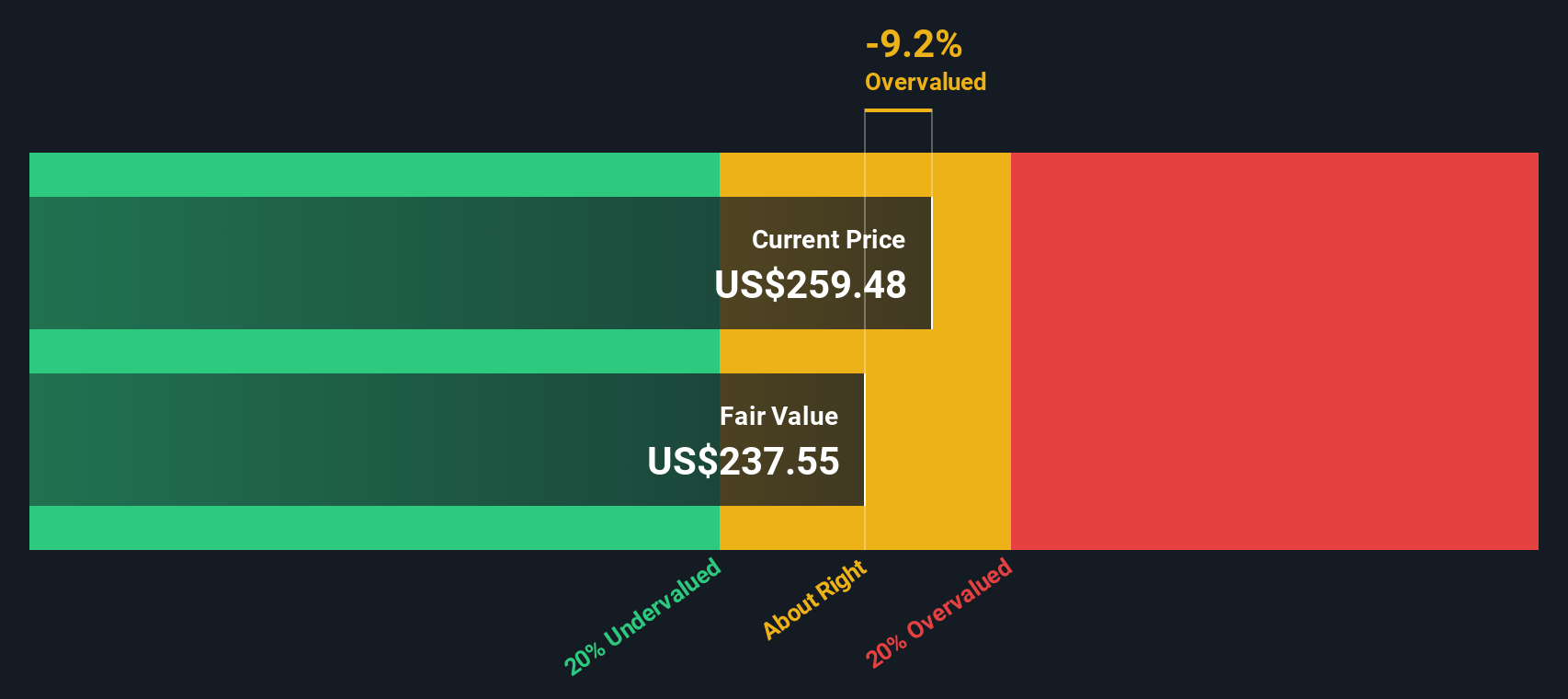
When all projected cash flows are discounted and summed, the model arrives at an intrinsic value of about $224.31 per share. Compared with the current share price, this implies the stock is roughly 25.1% overvalued on a DCF basis.
Result: OVERVALUED
Our Discounted Cash Flow (DCF) analysis suggests Apple may be overvalued by 25.1%. Discover 913 undervalued stocks or create your own screener to find better value opportunities.
Approach 2: Apple Price vs Earnings
For a mature, highly profitable business like Apple, the Price to Earnings (PE) ratio is a useful way to gauge valuation because it directly links what investors are paying to the company’s current earnings power. In general, stronger growth and lower perceived risk justify a higher PE multiple, while slower growth or greater uncertainty usually call for a lower, more conservative ratio.
Apple currently trades on a PE of about 37.0x. That is well above the broader Tech industry average of roughly 22.7x and also ahead of its peer group average of around 33.8x, suggesting investors are already paying a premium for Apple’s scale, brand and cash generation. Simply Wall St’s proprietary Fair Ratio, which estimates what a reasonable PE should be after factoring in Apple’s earnings growth outlook, profit margins, size, industry and risk profile, comes out at about 38.4x.
Because the Fair Ratio of 38.4x is only slightly higher than the current 37.0x, the model implies Apple’s valuation is broadly in line with what you might expect given its fundamentals, rather than significantly stretched or cheap.
Result: ABOUT RIGHT

PE ratios tell one story, but what if the real opportunity lies elsewhere? Discover 1442 companies where insiders are betting big on explosive growth.
Upgrade Your Decision Making: Choose your Apple Narrative
Earlier we mentioned that there is an even better way to understand valuation, so let us introduce you to Narratives, a simple way to connect your view of a company’s story to the numbers behind its future. A Narrative on Simply Wall St is your personal storyline for a stock, where you describe what you think will happen to its business and pair that with concrete forecasts for revenue, earnings and margins, which then flow through to an estimated fair value. In practice, a Narrative links three things together: the business story you believe in, the financial forecast that follows from that story, and the fair value that drops out at the end. Narratives are easy to create and explore on Simply Wall St’s Community page, where millions of investors share their views, update them as news or earnings come in, and compare their Fair Value to the current share price to decide whether a stock looks buyable, holdable or sellable. For Apple, for example, one Narrative currently sees fair value near $177 while another sees closer to $281, reflecting very different expectations for tariffs, AI and long term growth.
For Apple however we'll make it really easy for you with previews of two leading Apple Narratives:
Fair value: $281.75 per share
Implied undervaluation vs last close: -0.4%
Forecast revenue growth: 7.02%
- Sees Apple’s expanding services ecosystem, AI integration and wearables as reinforcing its ecosystem and supporting higher, more stable margins over time.
- Assumes steady mid single digit revenue growth and rising profit margins, with ongoing buybacks helping earnings per share and supporting a premium PE multiple.
- Accepts tariff, regulatory and supply chain risks, but concludes that product pipeline momentum and services growth more than offset these headwinds at today’s price.
Fair value: $177.34 per share
Implied overvaluation vs last close: 58.3%
Forecast revenue growth: 14.68%
- Argues that Apple’s valuation multiple is too high relative to its maturing growth profile, with the market overpaying for a slowing hardware franchise.
- Highlights pressure on margins from rising costs, supply chain issues and tougher competition, particularly in China and other price sensitive markets.
- Questions Apple’s capital allocation and innovation pace, suggesting large cash reserves and buybacks are not translating into new growth engines, which could increase the risk of a correction if expectations reset.
Do you think there's more to the story for Apple? Head over to our Community to see what others are saying!

This article by Simply Wall St is general in nature. We provide commentary based on historical data and analyst forecasts only using an unbiased methodology and our articles are not intended to be financial advice. It does not constitute a recommendation to buy or sell any stock, and does not take account of your objectives, or your financial situation. We aim to bring you long-term focused analysis driven by fundamental data. Note that our analysis may not factor in the latest price-sensitive company announcements or qualitative material. Simply Wall St has no position in any stocks mentioned.
Have feedback on this article? Concerned about the content? Get in touch with us directly. Alternatively, email editorial-team@simplywallst.com