
- PREMIUM
- LIVE QUOTES
- INSTITUTION
 Index Options


 State Street
 CME Group
 Nasdaq
 Cboe
Cboe TradingView
 Wall Street Journal
Does GEN Restaurant Group (NASDAQ:GENK) Have A Healthy Balance Sheet?
David Iben put it well when he said, 'Volatility is not a risk we care about. What we care about is avoiding the permanent loss of capital.' When we think about how risky a company is, we always like to look at its use of debt, since debt overload can lead to ruin. Importantly, GEN Restaurant Group, Inc. (NASDAQ:GENK) does carry debt. But should shareholders be worried about its use of debt?
Why Does Debt Bring Risk?
Debt and other liabilities become risky for a business when it cannot easily fulfill those obligations, either with free cash flow or by raising capital at an attractive price. Part and parcel of capitalism is the process of 'creative destruction' where failed businesses are mercilessly liquidated by their bankers. However, a more common (but still painful) scenario is that it has to raise new equity capital at a low price, thus permanently diluting shareholders. Of course, the upside of debt is that it often represents cheap capital, especially when it replaces dilution in a company with the ability to reinvest at high rates of return. The first step when considering a company's debt levels is to consider its cash and debt together.
What Is GEN Restaurant Group's Debt?
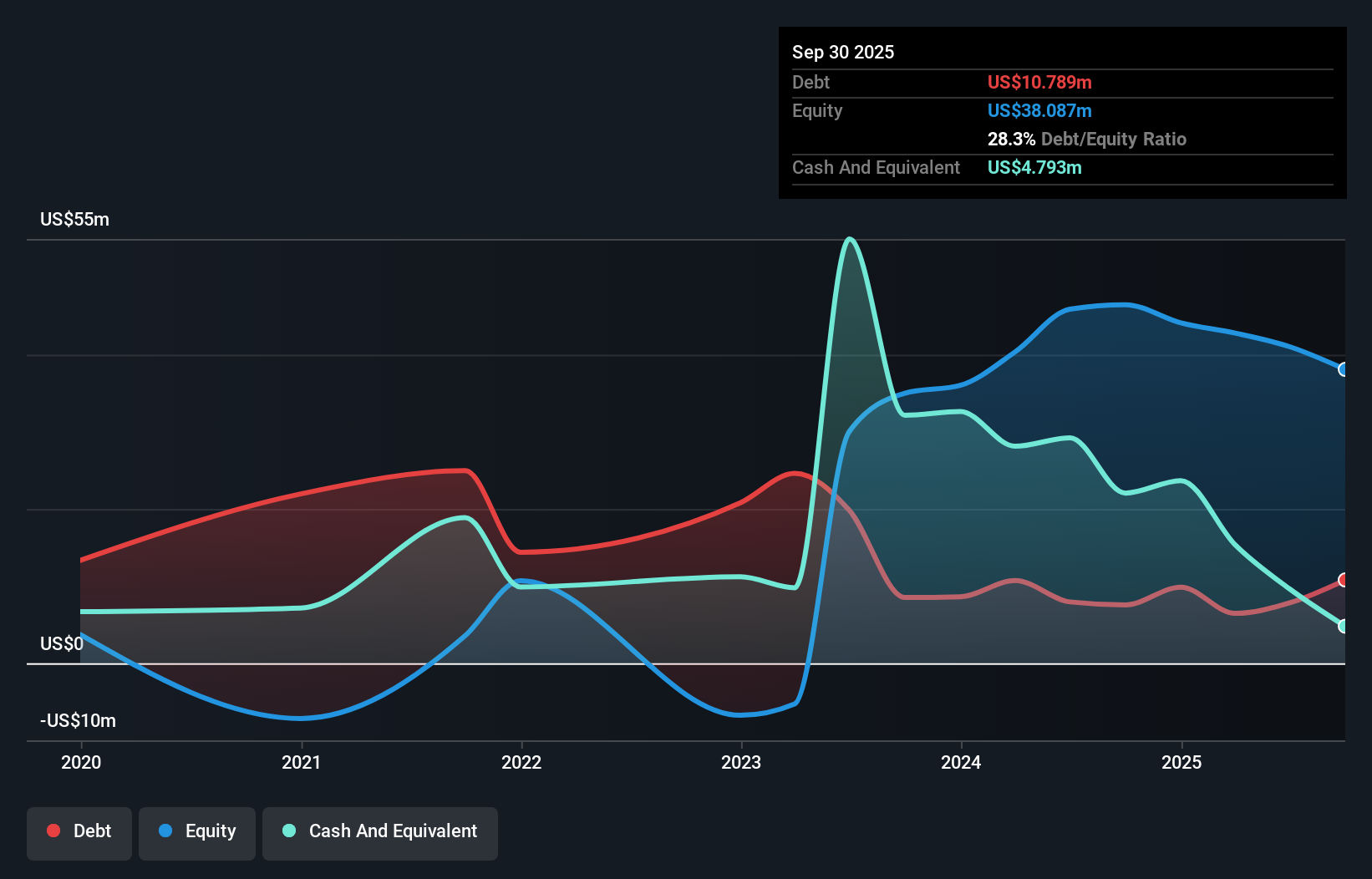
The image below, which you can click on for greater detail, shows that at September 2025 GEN Restaurant Group had debt of US$10.8m, up from US$7.55m in one year. However, it also had US$4.79m in cash, and so its net debt is US$6.00m.
How Healthy Is GEN Restaurant Group's Balance Sheet?
We can see from the most recent balance sheet that GEN Restaurant Group had liabilities of US$40.5m falling due within a year, and liabilities of US$167.0m due beyond that. Offsetting this, it had US$4.79m in cash and US$1.77m in receivables that were due within 12 months. So it has liabilities totalling US$200.9m more than its cash and near-term receivables, combined.
This deficit casts a shadow over the US$74.1m company, like a colossus towering over mere mortals. So we definitely think shareholders need to watch this one closely. After all, GEN Restaurant Group would likely require a major re-capitalisation if it had to pay its creditors today. The balance sheet is clearly the area to focus on when you are analysing debt. But ultimately the future profitability of the business will decide if GEN Restaurant Group can strengthen its balance sheet over time. So if you want to see what the professionals think, you might find this free report on analyst profit forecasts to be interesting.
See our latest analysis for GEN Restaurant Group
In the last year GEN Restaurant Group wasn't profitable at an EBIT level, but managed to grow its revenue by 9.4%, to US$217m. That rate of growth is a bit slow for our taste, but it takes all types to make a world.
Caveat Emptor
Over the last twelve months GEN Restaurant Group produced an earnings before interest and tax (EBIT) loss. Its EBIT loss was a whopping US$9.6m. Combining this information with the significant liabilities we already touched on makes us very hesitant about this stock, to say the least. Of course, it may be able to improve its situation with a bit of luck and good execution. But we think that is unlikely, given it is low on liquid assets, and burned through US$19m in the last year. So we consider this a high risk stock and we wouldn't be at all surprised if the company asks shareholders for money before long. When analysing debt levels, the balance sheet is the obvious place to start. But ultimately, every company can contain risks that exist outside of the balance sheet. For example - GEN Restaurant Group has 1 warning sign we think you should be aware of.
At the end of the day, it's often better to focus on companies that are free from net debt. You can access our special list of such companies (all with a track record of profit growth). It's free.
Have feedback on this article? Concerned about the content? Get in touch with us directly. Alternatively, email editorial-team (at) simplywallst.com.
This article by Simply Wall St is general in nature. We provide commentary based on historical data and analyst forecasts only using an unbiased methodology and our articles are not intended to be financial advice. It does not constitute a recommendation to buy or sell any stock, and does not take account of your objectives, or your financial situation. We aim to bring you long-term focused analysis driven by fundamental data. Note that our analysis may not factor in the latest price-sensitive company announcements or qualitative material. Simply Wall St has no position in any stocks mentioned.