
- PREMIUM
- LIVE QUOTES
- INSTITUTION
 Index Options


 State Street
 CME Group
 Nasdaq
 Cboe
Cboe TradingView
 Wall Street Journal
Black Friday Shopping Shows Success, Despite Ongoing Inflation

U.S. consumers continue to face ongoing inflation and higher prices.
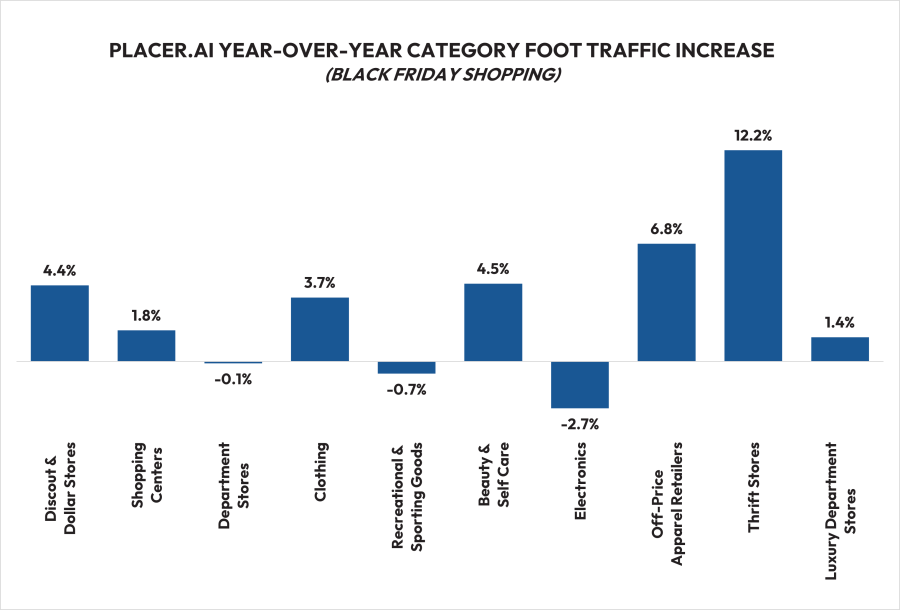
However, when it came to Black Friday shopping, statistics from Placer.ai showed a year-over-year increase in foot traffic across many retail stores and sectors. The Placer.ai analysts listed the following foot traffic “winners:”
- Sam’s Club 9.7%
- Nordstrom: 2.4%
- The Gap: 12.5%
- Lowe’s: 9.7%
- Barnes & Noble: 5.8%
- Bath & Body Works: 23.7%
Elizabeth Lafontaine, Placer.ai’s Director of Research, noted that the numbers weren’t too surprising, despite otherwise gloomy news. “The stronger performance of traffic to retailers in October signaled that consumers were more resilient than anticipated, and the trend continued with visits on Black Friday across many retailers,” Lafontaine told Connect CRE.
Additionally, consumers tended to be more promotionally driven in 2025, meaning Black Friday represented a “return to form in many ways,” she added.
Understanding the Standouts
While increased traffic at Sam’s Club and other discount retailers probably wouldn’t raise an eyebrow, other brands making it onto the winner’s list might be considered unusual.
Or maybe not.
Lafontaine explained that Nordstrom. The Gap and others have worked hard to build loyalty and demonstrate authenticity over the past year. Additionally, each retailer is focused on its core competencies. Nordstrom is known for customer service and category expertise, while The Gap provides the latest trends at an affordable price.
Meanwhile, bookseller Barnes & Noble is experiencing a resurgence due to its experiential offerings. As a result, “these retailers stand out to shoppers among the countless choices, keeping them top-of-mind during major shopping seasons,” Lafontaine said.
Malls Away
While many of the larger malls have struggled in recent years, there are signals of a rebound in the space. Placer.ai’s Mall Black Friday Mall Index demonstrated a year-over-year increase in foot traffic, especially among indoor malls.
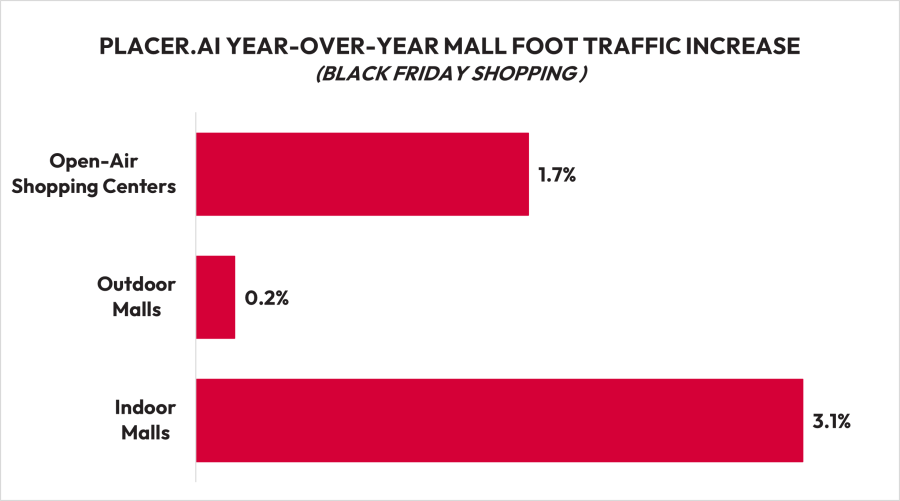
Malls, especially indoor malls, are moving away from their previous death knell. Lafontaine explained that these centers are becoming a “third space” for consumer shopping in recent years. “Operators have added dining and entertainment offerings, and malls have become more relevant, especially among younger shoppers.”
Additionally, malls have become a Black Friday tradition. “For shoppers looking to browse specialty retailers, malls still offer a good cross-section of stores and categories,” Lafontaine noted.
Then, There’s Consumer Behavior
Lafontaine acknowledged that consumer sentiment has been a challenge this year. At the same time, consumers consider the holiday season as a time for spending on others. While shoppers are more price-sensitive this year, “it has shifted their behavior toward spending during larger events,” Lafontaine commented. Also, while they might be buying less, their retail outings haven’t declined.
There’s a caveat here, however. According to Lafontaine, “higher income households haven’t altered their retail habits, but as lower and middle income shoppers have become more constrained, they may look for more deals or pull back on shopping to conserve income.”
She went on to say that this economic bifurcation will mark the remainder of the holiday shopping season, while retailers may benefit as consumers do their buying closer to Christmas.
The post Black Friday Shopping Shows Success, Despite Ongoing Inflation appeared first on Connect CRE.