
US tech giants frantically issue bonds to “add fuel” to AI dreams as concerns about the bubble heat up
The Zhitong Finance App learned that as concerns about the artificial intelligence (AI) bubble heat up, Wall Street is increasingly worried that tech giants will incur high debts to build AI infrastructure. While huge AI spending by big tech companies is nothing new, raising record debt for it is a new situation. What worries investors even more is that this trend breaks the practice of recent years — in the past, technology companies used huge cash reserves on hand to pay for capital expenses. Today, the use of leverage and the cyclical nature of many financing transactions have introduced risks that have never been seen before.
Tech giant debt frenzy intensifies market concerns, Oracle “bears the brunt”
According to the data, the top five AI spending companies — Amazon (AMZN.US), Alphabet (GOOGL.US), Microsoft (MSFT.US), Meta Platforms (META.US), and ORCL.US (ORCL.US) — collectively raised a record $108 billion in debt in 2025, more than three times the average of the past nine years.
Investors said that so far, they are not too concerned about the impact of recent bond issuance by tech giants on stock valuations because the leverage ratio of these companies is still low. However, the sudden increase in the amount of debt issued by tech giants raised questions about whether the bond market could absorb this surge in supply and heightened concerns about growing AI spending — concerns that dragged down a sharp correction in US stocks this month after six months of continuous gains.
Although investor demand for technology company bonds has always been strong, investors are demanding significant new issuance premiums to absorb some of the new bonds. Janley Henderson said in a report that the bonds recently issued by Alphabet and Meta have a premium of about 10-15 basis points over existing bonds.
US investment-grade credit spreads (the premium paid by high-rated companies above treasury yields to attract investor demand) are still historically low, but they have risen slightly in recent weeks, partly reflecting concerns about a new wave of bond supply impacting the market.
Brij Khurana, portfolio manager at Wellington Management, said: “All of these hyperscale companies are issuing bonds. I think the market realizes that it will not be the private equity credit market or free cash flow that will fund AI. It will have to come from the public bond market.” “You need capital from somewhere to finance all of this. What is happening now is that people realise that capital almost needs to flow from stocks to bonds.”
It is worth mentioning that Oracle's debt issuance behavior has received special attention. The company issued $18 billion in US investment-grade bonds in September to increase AI spending, and related banks also initiated $38 billion in debt offerings to fund Oracle-related data centers. Since then, Oracle's stock price soared in September, but since hitting a record high on September 10, the stock has plummeted 33% as investors reassessed the impact of the company's aggressive capital expenditure on its balance sheet and how it is financing huge capital expenses.
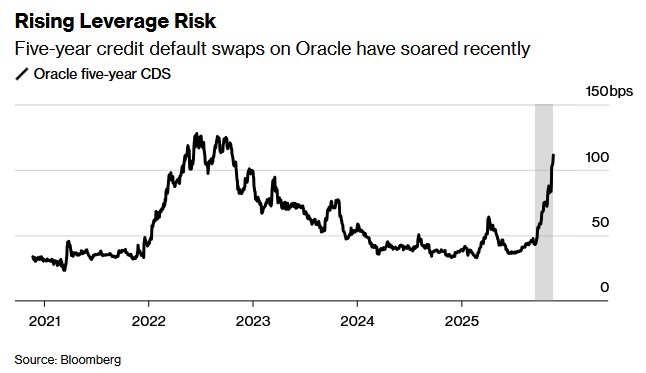
Investors' concerns are evident in related financial derivatives — Oracle's 5-year credit default swap (CDS), which reflects leveraged risk, has soared to its highest level in three years. In response, Arnim Holzer, a global macro strategist at Easterly EAB, said, “It shouldn't be surprising to see Oracle's CDS rise. These companies are investing huge sums of money and promising huge capital expenses, some of which will be funded through debt. That doesn't mean Oracle's stock is trash, but it should be more volatile.”
Oracle predicts that its capital expenditure for the current fiscal year will be $35 billion, most of which will be spent on its cloud business. At the same time, this huge expense is hurting the company's balance sheet. Free cash flow is expected to be negative $9.7 billion this year, and last year the company had negative free cash flow for the first time since 1990. More importantly, Oracle's free cash flow will be further reduced over the next two fiscal years, and may reach negative $24.3 billion by fiscal year 2028.
S&P Global Ratings has recently revised Oracle's outlook to “negative,” “due to its anticipated capital expenditure and debt issuance to fund the accelerated growth of AI infrastructure, which has strained its credit situation.”
This credit frenzy isn't limited to Oracle. According to industry data, Meta has issued bonds worth $30 billion, Alphabet has issued $38 billion, and Amazon has issued $15 billion in bonds. In response, senior credit analyst Robert Schiffman said, “We may be in the early stages of AI capital expenditure construction, but to some extent this also means we may be in the early stages of re-leveraging our balance sheet. I'm worried that this wave of issuance may just be the beginning of things in the next few years.”
Risk secretly accumulates
Just a few months ago, AI spending was mainly from a few companies with strong balance sheets and steady growth in free cash flow. But now, the situation has changed, and so has the risk profile of the tech industry. This new dynamic came to light on Thursday. US technology stocks first rose sharply due to the strong performance of Nvidia (NVDA.US), then fell sharply as investors assessed the capital needed to build AI infrastructure and the profit schedule for these investments.
Lisa Shalett, chief investment officer at Morgan Stanley Wealth Management said, “I see this as a sign that the AI story has matured and entered a new phase, which is likely to be characterized by more volatility and additional risk.” She added, “We've seen the ecosystem expand to include companies with weaker balance sheets and more debt like Oracle and CoreWeave, and we're also seeing more intertwined and cyclical revenue relationships. This interconnectedness among participants poses systemic risks.”
Until recently, capital expenditure was seen as a necessary condition for companies to participate in AI. Some investors even saw it as a positive reflection of the company's confidence. But as Wall Street professionals look to see stronger returns on investment, capital spending is under increasing scrutiny, and adding debt to the equation will only exacerbate the problem.
Larry Hatheway, a global investment strategist at the Franklin Templeton Institute, said: “Over the past few weeks, there have been some concerns surrounding the AI spending story. These concerns relate to the company's need to be able to finance this, including through debt.”
Brian Levitt, chief global market strategist at Invesco, warned: “Some companies promise large-scale investments, but their own cash flow is insufficient to support them, and they may need to take on huge debts to finance future investments.” “This model may work until credit markets are in turmoil. But I think the market is paying more and more attention to this risk.”
The increase in the debt of tech giants has also brought a new layer of concern to the market. Although the market is fueled by AI's promise of high returns, investors are wary that the technology has yet to generate the profits needed to justify such large-scale capital expenditure. Investment management company Sage Advisory said in a recent report that AI capital expenditure is expected to rise to 600 billion US dollars by 2027, up from over 200 billion US dollars in 2024 and nearly 400 billion US dollars in 2025, while net debt issuance is expected to reach 100 billion US dollars in 2026.
Bob Savage, Head of Market Macro Strategy at BNY, said, “When companies that don't need to borrow borrow money to invest, this sets a threshold for the return on those investments. We're in a 'give me your money' phase.”
Despite increased leverage, investors are generally positive about tech giants due to their long-lasting profit growth and strong competitive position. Furthermore, according to UBS estimates, about 80% to 90% of the planned capital expenditure of the tech giant comes from its own cash flow. According to Sage Advisory's research report, top hyperscale companies are expected to shift from more cash than debt to only a modest level of borrowing, and the leverage ratio will remain below 1 times, which means their total debt will be less than their earnings. Goldman Sachs analysts said that with the exception of Oracle, hyperscale companies can absorb up to 700 billion US dollars in additional debt, and are still considered safe, and the leverage ratio will be lower than typical A+ rated companies.
Bob Savage added, “To say that these bond issuance is a major turning point and that the AI bubble will burst seems a bit exaggerated. Debt may complicate the situation, but I don't think it changes the basic argument.”